Even 10 years back, the Tax Office can audit cases of forged and fictitious invoices for which newer evidence emerges from the investigation of the Tax Administration after the lapse of the five-year period, when tax cases become time-barred according to the basic rule of the Tax Procedure Code (TPC).
The ability of auditors to “search” tax evasion cases and uncover supplementary evidence beyond the five-year period now also has the “green light” of the Council of State, which by its decision held that it is lawful to extend the audit to ten years if the fraud involving fictitious invoices is uncovered by the auditing authorities (in this case the matter concerns SDOE) after the first five-year period.
The case examined by the Second Chamber of the Council of State concerned an application for cassation (which was rejected) by a general partnership of plumbing installations, to which income tax had been assessed for fiscal year 2005 due to the receipt and recording of fictitious and forged invoices.
The company argued that the State’s right had become time-barred, because the “unified tax administration” knew the critical facts within the five-year period, so these were not “new supplementary evidence” extending the limitation period to ten years.
However, the Supreme Court held that the application of the ten-year limitation period is lawful when the receipt and recording of fictitious invoices is revealed for the first time by a subsequent audit report of SDOE, which constitutes genuinely new “supplementary evidence”.
The background
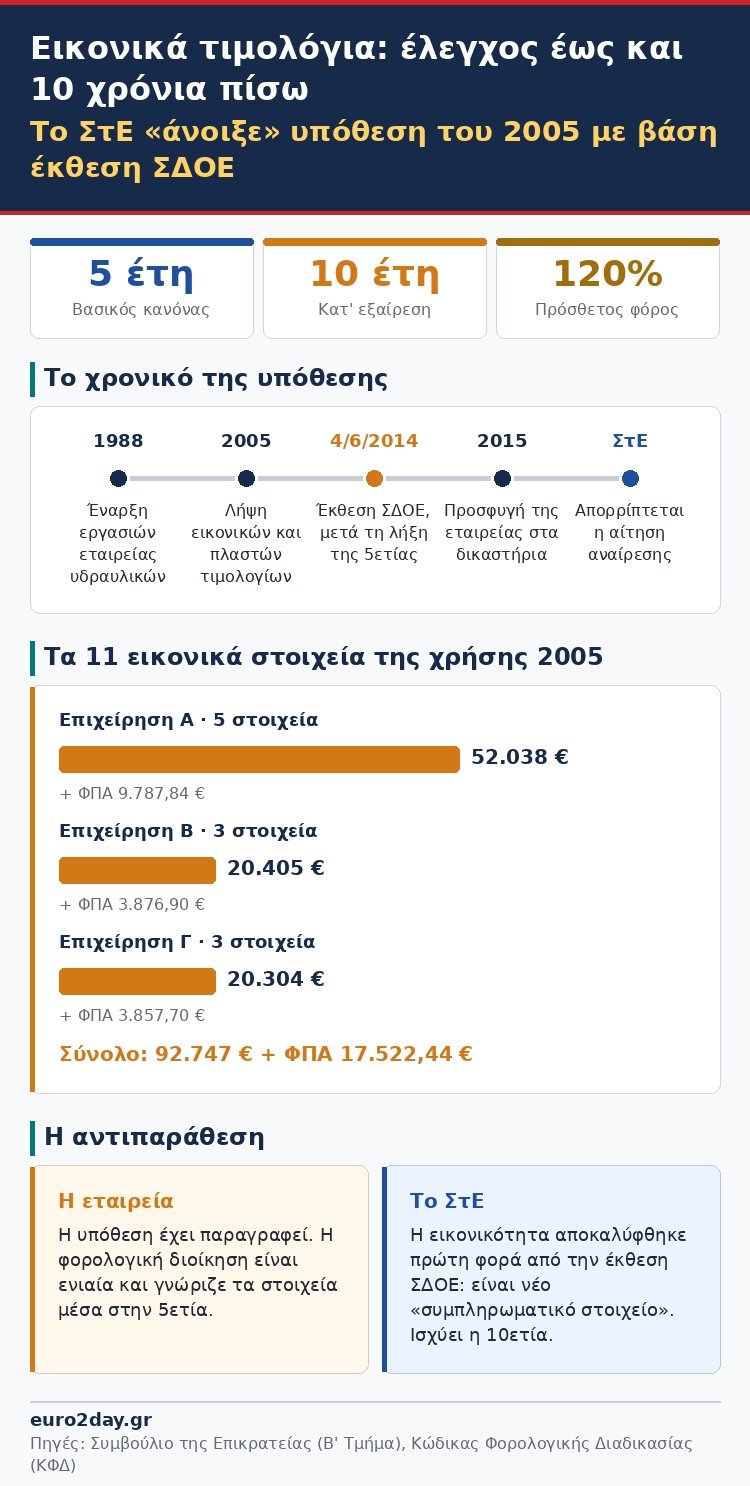
The company had commenced operations in early 1988. After audits carried out by various tax services on third-party businesses, it was found that in 2005 they had transacted with the company using fictitious and forged invoices.
More specifically, it was found that the plumbing company had received and recorded in its books:
- 5 tax documents of a total value of 52,038 euros plus VAT of 9,787.84 euros from one business,
- 3 tax documents, of a total value of 20,405 euros plus VAT of 3,876.90 euros from another business and:
- 3 tax documents, of a total value of 20,304 euros plus VAT of 3,857.70 euros from a third business.
After this, the company’s books were deemed inaccurate and objectively impossible to audit on an accounting basis, and thus its gross and net income were determined extrajudicially and the corresponding principal tax was imposed on it, as well as additional tax due to inaccuracy at a rate of 120%.
The company appealed to the tax courts in 2015, but did not dispute the substance of the case. In its arguments it claimed, among other things, that the violations attributed to it had become time-barred, given that by the issuance of the relevant assessment acts the prescribed five-year period had elapsed.
It argued that the newer information from the various tax and other authorities (SDOE, YPEE, GGPS, VIES of the 14th Directorate of the Ministry of Finance, Athens 19th Tax Office, Haidari Tax Office, Aigaleo Tax Office, Thebes Tax Office, Palaio Faliro Tax Office, Piraeus 3rd Tax Office, Piraeus 5th Tax Office, Larissa Regional Audit Center and Piraeus Regional Audit Center) that came to the competent Tax Office could not be considered supplementary evidence, and therefore could not extend the limitation period to ten years, given that the various services of the tax administration constitute over time a single whole, subject to a single body (Ministry of Finance).
The reasoning
The decision of the Supreme Court was based on the finding that the company had received and recorded in its books forged and fictitious tax documents.
The fictitious nature of the disputed invoices was established by an SDOE audit report, which was drawn up on 4 June 2014, that is, after the completion of the normal five-year limitation period.
The Council of State examined the time period in which the specific evidence arose that identified the fictitious nature of the transactions. Given that the fictitious nature was established for the first time by the subsequent SDOE audit, the findings of the report could be characterized as supplementary evidence and justify the application of the ten-year limitation period.
The decision does not mean, however, that every subsequent audit report by AADE auditors, since SDOE has now been abolished, automatically extends the limitation period.
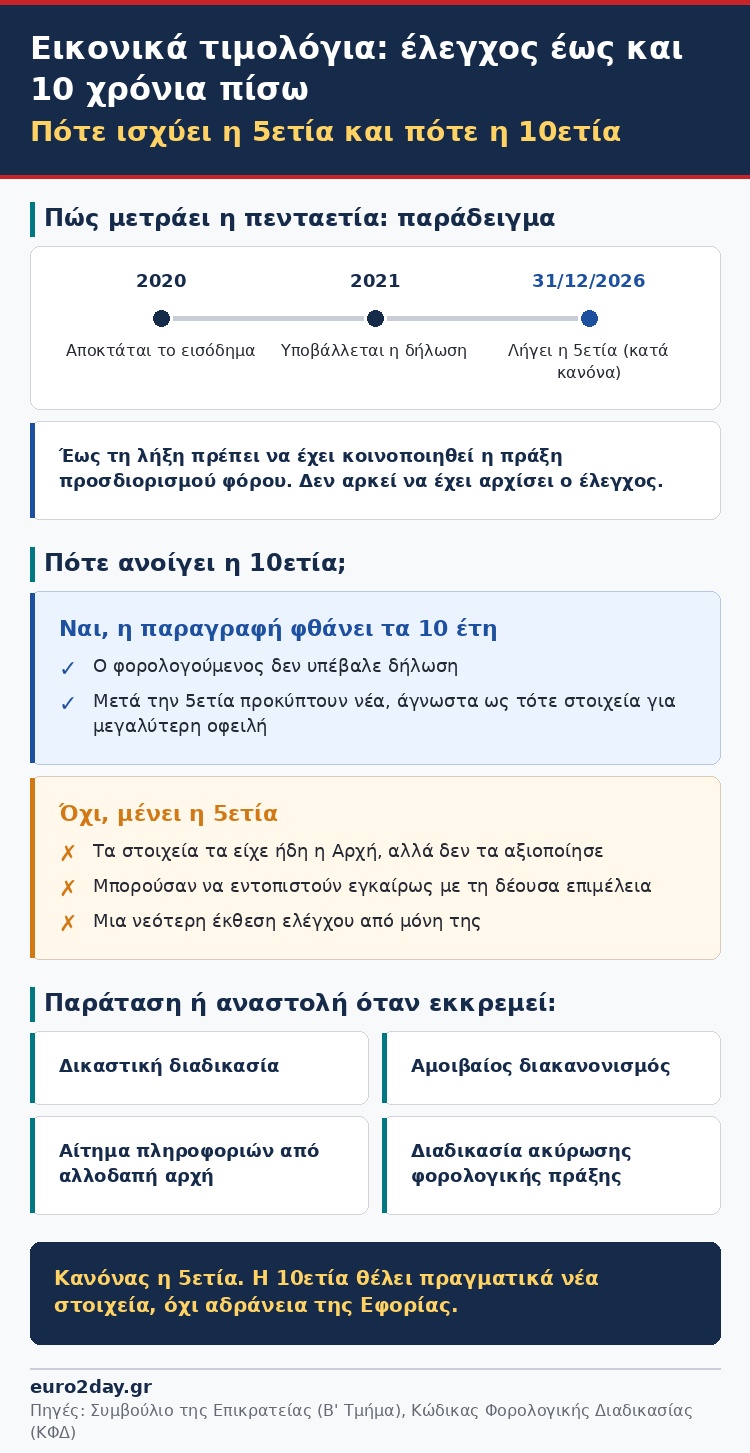
The five-year period continues to be the basic rule. For the ten-year period to apply, the evidence must consist of new elements that were not known, nor could they have been identified by the competent authority within the initial five-year period. On the contrary, elements that were already at the disposal of the Tax Authority but were not used in time cannot be characterized as supplementary.
When the five-year period does not apply
The TPC is clear as to when a tax evasion case becomes time-barred within five years and when the limitation period can reach 10 years. The rule is the five-year period, while the ten-year period is a specifically justified exception.
More specifically, the Code provides that:
The five-year period is calculated from the end of the year within which the deadline for filing the tax return expires. For example, for income of 2020, the return for which was filed in 2021, the limitation period is completed, as a rule, on 31 December 2026. By then the tax assessment act must have been lawfully notified. In other words, it is not enough for the audit merely to have begun.
By way of exception, the limitation period may reach ten years when: the taxpayer has not filed a return or when, after the five-year period, new evidence or information comes to the Tax Administration that it objectively could not have known earlier and from which a greater tax liability arises.
Any document that appears later does not constitute new evidence.
For example, if the Authority already had the data at its disposal or could have identified them in time with due diligence, its own inaction does not justify extension of the limitation period.
The ten-year period applies only when genuinely new evidence emerges.
The limitation period may also be extended or suspended in special cases, such as when judicial proceedings are pending, a mutual settlement, a request for the provision of information from a foreign authority, or proceedings for the annulment of a tax act.