With borrowing costs returning to the forefront internationally as the debts of many countries relative to GDP are near or at historical record levels, state deficits are once again coming under the scrutiny of the markets, along with state spending and revenues.Under different circumstances, Greece would be in the international spotlight but this is not happening. Moreover, the converging estimates of analysts for the course of Greek public finances in the coming years are positive.
However, nothing is written in stone and Greek history teaches that unpleasant surprises are more numerous than pleasant ones.
It is therefore worth taking a look at the side of the fiscal equation that is state spending. And this is because politicians, regardless of political party, have a tendency to increase it, citing real needs.
For those who may have forgotten. In 2007, when Greece's Gross Domestic Product (GDP) reached the highest point in modern history, general government expenditure amounted to 47.5% of GDP.
Public spending swelled even more over the next two years and, combined with the decline in GDP, rose to 50.7% of GDP in 2008, to 54.1% in 2009 before falling to 52.5% of GDP in 2010 when the country entered the 1st memorandum. The deep recession pushed spending to 54.1% of GDP in 2011 according to Eurostat.
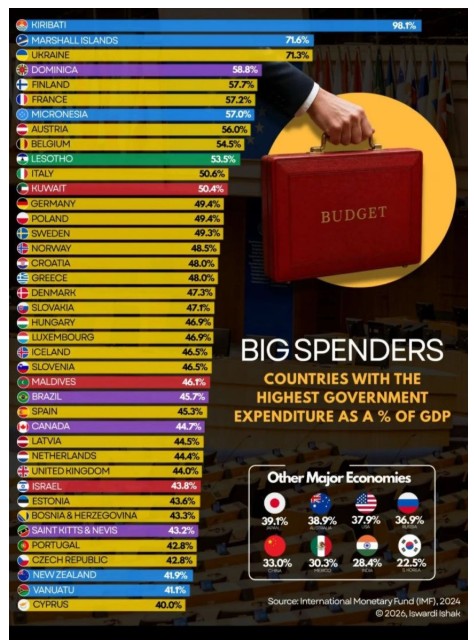
Since then, a lot of water has flowed under the bridge. General government expenditure (central administration and the broader public sector) has fallen to 48% of GDP, helped by the increase in economic output according to IMF data for 2024. The figure did not change dramatically in 2025 as it went to 48.3% while it is estimated to rise to 49% of GDP in 2026.
In other words, the government continues to spend about half of Gross Domestic Product. As a result, Greece remains in the top 10 of European Union (EU) countries with the highest public spending proportionally, as you can see in the table below by Ishwardi Ishak based on IMF data.
Finland, France, Austria, Belgium and Italy with state spending above 50% of GDP make up the most generous countries in the EU. On the opposite side, Cyprus, the Czech Republic and Portugal record the lowest state spending relative to GDP in 2024.
However, it would be an omission to look at Greece's total state spending relative to GDP without comparing it by sector with the corresponding EU averages, as this is more difficult to do on a country-by-country basis.
What do we find?
As one would expect, Greece spends more on its national defense compared to the European average. Based on NATO methodology, defense spending is estimated to reach 3.65% in 2026, although Eurostat's methodology places it above 2% and it is almost double the average in the EU.
Also, Greece spends more money on pensions and benefits than the European average, while the same applies to general public services and public debt servicing according to the Commission.
On the other hand, the country spends less on education and health compared to the European average.
It therefore matters how much money a country spends, but it is also important where it spends it.