J.P. Morgan significantly raises target prices for the four systemic banks. At the same time, it maintains an overweight recommendation for all and sees upside potential of 18% to 30% from current levels. The American house shifts the valuation horizon to the end of 2028, from the end of 2027 previously.
In detail, the new target price for Eurobank is set at 6.10 euros from 4.40 euros. This corresponds to potential upside of 30%, the highest in the sector.
For Piraeus Bank the target rises to 13.70 euros from 10.20 euros, with upside potential of 28%.
For Alpha Bank the target price increases to 5.80 euros from 4.40 euros (+21%).
For the National Bank the target rises to 20.70 euros from 16 euros, with upside potential of 18%. The calculations are based on the closing prices of September 16.
In the report titled “Greek Banks: A guide for new investors”, analysts Mehmet Sevim and Anna Zaslavskaya rank Eurobank and Piraeus first in their preferences. Alpha Bank and National follow.
Lower cost of capital and higher profits
Behind the upgrades is also the change in methodology. J.P. Morgan now values the banks with a cost of capital of 10%, fully aligned with European banks. For Alpha Bank, for example, the cost of capital is reduced from 11.5%. In addition, the house separately recognizes distributable capital above the 13% CET1 target, adjusted for deferred tax credits (DTC). In National’s case, this adjustment adds 1.10 euros per share to the valuation.
At the same time, the house revises upward its estimates for adjusted net profits for the 2026-2028 period:
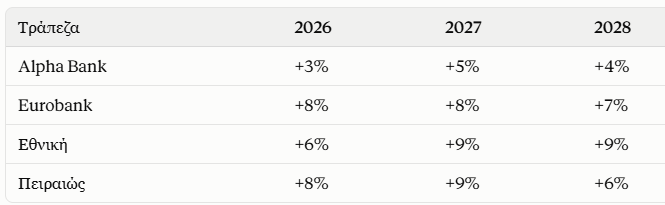
The revisions are mainly due to higher net interest income. The new models incorporate an average 3-month Euribor of 2.75% in 2027 and 2.50% in 2028. Stronger fee income also contributes. J.P. Morgan’s estimates are on average 6%, 4% and 1% above market consensus for the three years.
For the sector overall, the house forecasts average annual earnings per share growth of 12% in the 2025-2028 period. The increase is supported by credit expansion of 8-10%, higher net interest margins and double-digit growth in fees. Return on tangible equity (ROTE) is expected to move at levels above 15%.
The picture by bank
Eurobank combines, according to J.P. Morgan, the highest returns, diversification and attractive valuation. Its 2028 ROTE is estimated at 17.3%, the highest in the sector. About half of the group’s profits come from Bulgaria and Cyprus. Some investors consider this a source of complexity, but the house sees it as an advantage. The stock trades at 8.6 times 2028 earnings and 1.4 times tangible book value, a valuation that analysts consider unjustifiably low.
Piraeus has been transformed, according to the report, from the most characteristic turnaround story into a domestic growth story with high returns. It has the greatest leverage to the rise in loans and fees. The stock has gained 57% since the beginning of the year, but remains cheap at 8.6 times 2028 earnings. Ethniki Insurance is expected to contribute to a 27% rise in fees this year. In 2027 fees are estimated to decline marginally due to a high comparison base. The bank shows the highest internal capital generation, about 340 basis points on risk-weighted assets annually.
For Alpha Bank, a critical event is the investor day on November 5. Details are expected there on the cooperation with UniCredit and the recent acquisitions. The house forecasts average annual earnings per share growth of 14% and ROTE of 13.5% in 2028. It notes, however, that first-half fee income of 287 million euros requires significant acceleration in the second half in order to achieve the target of 600 million euros.
National has the strongest funding and capital position in Greece. Its CET1 ratio rose to 17.3% in the second quarter, versus 14.1% for competitors. Its 2028 ROTE, at 15.4%, appears restrained relative to the quality of the bank. According to J.P. Morgan, this mainly reflects lower leverage and excess capital. The partnerships with Allianz and Dromeus add a second pillar of income, while capital adequacy leaves room for share buybacks. Total shareholder return is estimated at 6.5% in the base scenario.
Entry into the European indices
The report is written on the occasion of the inclusion of Greek stocks in the Euro STOXX and STOXX Europe 600 indices as part of the September rebalancing. Passive inflows are estimated at about 1 billion dollars. Inclusion in the SX7E banking index is expected to bring Greek banks into the spotlight of a broader circle of European investors. Greece will remain in MSCI Emerging Markets until May 2027, creating an unusual period of simultaneous presence in developed and emerging market indices.
Since the beginning of the year Greek banks have risen by 41%, versus 21% for the SX7E. During this period, the valuation discount versus central European banks has essentially closed. The sector trades at 9 times 2028 earnings and 1.4 times tangible book value, versus 9 and 1.6 times respectively for central European banks. Compared with banks in Southern Europe and Central and Eastern Europe, however, the discount remains about 10%. These banks are valued at 10.2 times earnings, even though their expected earnings growth is only 8%. According to J.P. Morgan, the next rise will come less from a new general rerating and more from the delivery of profitability targets.
The risks
The house reminds how much the landscape has changed since the crisis era. The four systemic banks control almost 93% of the sector’s assets. The non-performing exposures ratio has fallen to 2-3% and the loan-to-deposit ratio is around 60%. Distributions to shareholders returned with 2023 profits, after 15 years.
Among the main risks for the sector, J.P. Morgan includes:
- faster slowdown in credit expansion,
- margin compression as support from the Recovery Fund weakens,
- delays in fee growth,
- risks from the integration of acquisitions.
In the house’s base scenario, growth in performing loans remains in the high single digits through 2028 and then declines to 4-6%.