International organizations and rating agencies, such as Moody’s recently, recognize Greece’s significant progress in public finances and the reduction of public debt relative to GDP in recent years. However, the growth rate is not equally satisfactory, although it is almost double the eurozone average in the post-pandemic period, compared with what it should be.
Especially if one compares the cumulative increase in Greece’s real per capita GDP in purchasing power parity dollars (PPP dollars) with 175 other countries from 1990 to 2025. Purchasing power parity dollars are used to compare the value of goods and products in different countries. In other words, what someone can buy locally with the same amount of money.
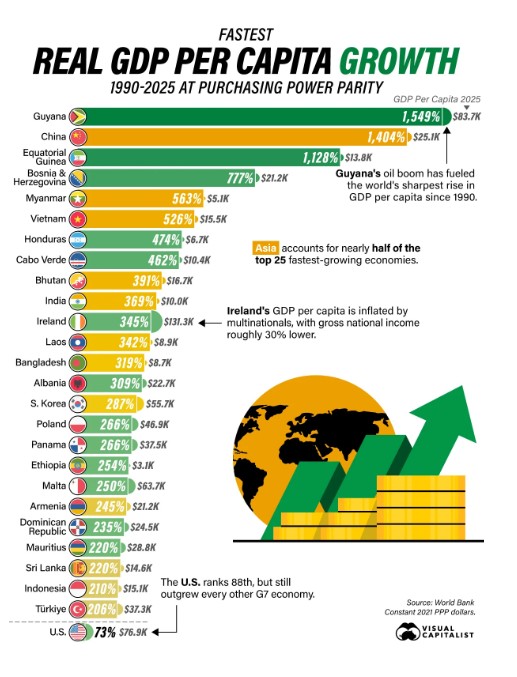
In the Visual Capitalist table, which is based on World Bank data below, the reader can identify the best performances of 25 countries. In first place is small Guyanaof fewer than 1 million inhabitants in Latin America with a cumulative increase in real growth of 1,549% since 1990. However, this is due to the oil it began producing in 2019 and therefore is not representative of the whole period.
They are followed by China with cumulative growth of 1,549% at 25.100 thousand international dollars, Equatorial Guinea with 1,128% and 13,800 international dollars in 2025, Bosnia with 777% and 21,100 international dollars, Myanmar with 563% at 5,100 dollars, Vietnam with 526% and 15,500 dollars, and India with 369% at 10,000 dollars.
Among the other countries of Greek interest, we single out Ireland in 11th place with 345%, which is in 11th place, and neighboring Albania in 14th place with 309% at 22,700 international dollars. As is well known, Ireland’s GDP is inflated due to multinationals and therefore should be reduced by about 30% to be more accurate. Even so, Ireland’s performance is impressive.
Equally impressive is Poland’s 16th place with 266% and real per capita income of about 47 thousand international dollars and of course Turkey in 25th place with 206% at 37.3 thousand international dollars. Also performing very well were Romania in 43rd place with 150% at 40.8 thousand international dollars and Bulgaria in 49th place with 136% at 35.3 thousand international dollars. Even Cyprus, which went through a short-lived crisis in the previous decade, is in 69th place with a cumulative increase of 96% at 54.1 thousand dollars.
It is noted that the average global increase in per capita GDP in international dollars was 94% cumulatively from 1990 until last year.
By contrast, Greece is in 130th place in the overall ranking among 176 countries with a cumulative increase of 42% at 38.2 thousand dollars in 2025 with France in 129th place with 43% and 55.1 thousand international dollars.
Of course, the comparison using international dollars has its problems as it does not take into account differences in the consumption habits of each people, which may be due to different reasons, e.g. culture. In other words, it assumes that the household shopping basket is the same for all countries.
What is certain is that Greece’s growth in real terms lagged far behind its neighbors and the global average in the 1990-2025 period. The roughly 25% plunge in GDP during the crisis years explains this lag to a significant extent.
However, behind all this something else is “hidden” that has not changed dramatically because neither the political system nor a large part of society wants to change despite declarations to the contrary. The country’s production model, which is based on consumption.