Within the next twelve months, citizens in Latvia, Estonia, Finland, France, Greece, Spain and, by the end of 2027, Italy will go to the polls.
The recent electoral experience in developed countries showed that almost all governments that faced the popular verdict suffered significant losses in percentages. The decisive common denominator was none other than the collapse in living standards and the continuous shrinking of purchasing power.
With international crude oil prices testing levels above 100 dollars per barrel and natural gas moving close to 80 euros per megawatt-hour, government staffs recognize the difficulty of the situation. However, the European Union still does not provide a collective umbrella of substantial protection.
Strict rules, but without common insurance
The official European response is limited to recommendations and fiscal flexibility: relaxation of limits on state aid and a limited national spending margin of around 0.3% of GDP annually, strictly for structural energy security measures and not for tax relief or offsetting increased prices (about 750 million euros for Greece).
The President of the European Commission highlighted the problem in her State of the Union speech, noting that European fossil fuel imports were burdened with 90 billion euros in additional cost, “without a single extra molecule of energy.” Even so, no common financing instrument was provided for European households.
At the same time, a European insurance plan for natural disasters was announced, with the argument that only 25% of damages are covered by the insurance market and “national budgets end up becoming the insurer of last resort.”
The exact same finding applies equally to energy, where ex ante risk insurance remains nonexistent. This is the major institutional gap: no one is insured before the shock, and everyone pays afterward from the national budget.
A common European insurance mechanism could, at an annual cost of 3 to 4 billion euros, buy hedging rights that would be activated automatically when oil and gas exceed predefined safety thresholds. Such a fund would provide liquidity of 20 to 25 billion euros in times of crisis, channeling aid to those disproportionately affected.
These amounts are indicative parameters of a mechanism under consideration, not calculated costing results.
For our country, such a model would return 5% to 6% of total resources, an amount more than triple compared with the size of the Greek economy in the EU (1.5% of European GDP), due to the high dependence on fuel imports. This is a proposed allocation: the final percentage will depend on the eligibility rule and the energy exposure of each member state.
Recently at the Eurogroup, six member states requested the establishment of a pan-European tax on energy windfall profits, so that relief can be felt immediately at the pumps. The revenues of such a tax constitute the natural premium for financing the common mechanism, and Greece has every interest in taking the lead in claiming it. Until then, however, each national government is acting entirely on its own.
What the data show in Greece
In Greek society, high prices are assessed by eight out of ten citizens (80%) as the primary problem of everyday life. To assess the real scale of the pressure, the analytical model examines the effects on an “indicative middle-income household.”
What does “indicative middle-income household” mean? It is not a certified statistical measure, but a simple working assumption of the analytical model, in order to assess the order of magnitude of the pressure on an average-income household.
It is assumed to have a net monthly income of about 1,700 euros and monthly consumer spending of 1,430 euros, assumptions of the analytical model pending verification by ELSTAT, not certified statistical data.
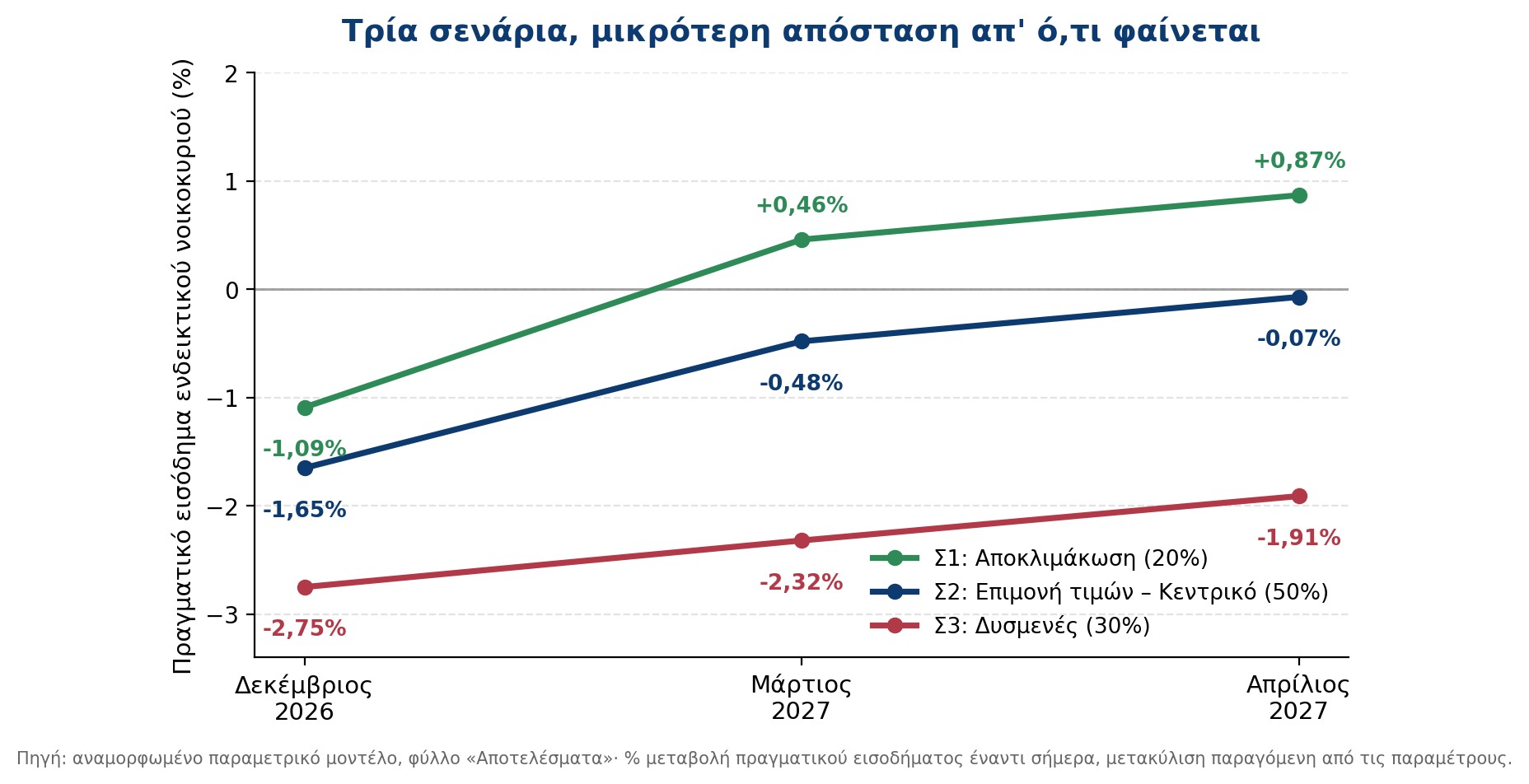
Based on the assumptions of the analytical model, three scenarios are examined for the evolution of international prices and real purchasing power. The probabilities 20%, 50% and 30% are subjective weightings of the exercise, not empirically estimated probabilities:
Scenario 1: Price de-escalation (probability 20%): International prices decline (oil at 79 dollars, gas at 52 euros). The loss of real income is -1.1% (-18.5 euros per month) in December, but turns into a surplus as early as March: +0.5% (+7.8 euros per month), strengthening to +0.9% (+14.8 euros per month) in April.
Scenario 2: Persistence of current prices (central scenario - probability 50%): Prices remain at current levels (oil at 95 dollars, gas at 75 euros). In the 3-month period (December), the household records a net loss of purchasing power of -1.6% (about 28 euros less per month).
In the 6-month period (March), thanks to the planned nominal increases in pensions and wages, the loss is limited to -0.5% (-8.1 euros per month) and is almost fully eliminated in April (-0.07%, about -1 euro per month).
Scenario 3: Adverse scenario of further escalation (probability 30%): In the event of escalation (oil above 128 dollars, gas above 120 euros), the blow remains the heaviest of all three scenarios across the entire horizon, though it is not static: real disposable income shrinks by -2.75% (-46.8 euros per month) in December, improves to -2.3% (-39.4 euros per month) in March and to -1.9% (-32.5 euros per month) in April.
There is fiscal space in state coffers, as international agencies also point out. However, the size of the net accounting figures alone is not enough to explain why citizens feel such intense insecurity and anger. The explanation is provided by four fundamental behavioral and practical mechanisms.
Why social discontent is much greater than the numbers
First, in human psychology losses hurt twice as much (loss aversion). According to the fundamental theory of Daniel Kahneman and Amos Tversky, the psychological pain from a financial loss is experienced about 2.25 times more intensely compared with the satisfaction of an exactly equal gain. A monthly loss of 28 euros is not registered in the mind as 28 euros, but is subjectively experienced like a burden of 63 euros.
Moreover, because of the way we separate money in our thinking (“mental accounting”), an extraordinary government benefit (e.g. the 400 euros for pensioners) is recorded as temporary aid that disappears immediately, while persistent high prices on the shelf and at the gas station are inscribed as a permanent injury to the budget.
Even with state support, a fill of 600 liters of heating oil costs 930 euros versus 660 euros last year: a one-off burden of 270 euros in a single transaction is equivalent to eleven whole months of the annual increase of an average 900-euro pension.
Second, the inflation measured by statistics is not the one the citizen lives. Citizens’ perception is shaped not by the general average, but by essential goods they pay for regularly and cannot avoid.
In the summer, while overall official inflation was moving at 3.4%, gasoline recorded an increase of +13%, diesel +22%, heating oil +53% and beef +14%. The statistical reduction in electricity by -2% is never recorded as meaningful relief.
Most importantly: citizens do not compare prices with the previous year, but with the psychological benchmark of normality of 2019, against which today’s price level remains 25% more expensive.
Third, at the ballot box what counts is the picture at the end and not the historical past. The vote is decisively influenced by how the citizen feels in the last two to three months before the elections (“peak-end rule”). In 2023, the rapid retreat of inflation from 12% to 2.8% in the spring contributed decisively to the electoral result.
For 2027, the statistical curve creates two completely different political realities:
- In the central scenario, annual inflation remains sky-high (5.1% to 5.2%) from December to February, as it is compared with the low prices of the pre-shock period. Then, however, it de-escalates sharply to 4.1% in March and 2.6% in April, because the comparison base now includes last year’s price increases.
- In income, the distance between the central scenario (almost complete normalization in spring) and the adverse scenario (remaining in negative territory) creates a difference of about 1.1 to 1.8 percentage points. In the international electoral literature, such a difference in purchasing power translates into a measurable, but restrained, shift at the ballot box.
Fourth, extraordinary checks versus steady monthly bleeding. The announcements at the TIF correspond to an indicative assumption of about 420 euros of benefit, for the household that is eligible for the full set of measures; this does not automatically apply to every household. In the central scenario, this amount covers the monthly losses in accounting terms until May.
In the adverse scenario, the cumulative real income loss from October to April amounts to about 252 euros, an amount that the extraordinary benefit of 420 euros more than covers in accounting terms, leaving a net surplus of about 168 euros.
However, because the psychological pain of a loss weighs more heavily than the equal satisfaction of a gain, the subjective picture changes depending on the loss aversion coefficient: with the moderate coefficient of a 2024 meta-analysis (1.31) the household continues to feel marginally better off, while with the stricter, historical coefficient of Kahneman and Tversky (2.25) the equation turns psychologically negative.
The conclusion is not a specific amount in euros, but the reminder that the perception of aid depends critically on how heavily the loss weighs, not only on whether it is covered in accounting terms. This is a hypothetical behavioral assessment, not a measurement of how Greek households actually feel.
In addition, there is a large social category that remains completely uncovered: the working couple in the private sector that has no pensioner in the family, is not employed in the public sector and is not entitled to rent allowance.
Based on different assumptions of income and consumption than the basic indicative household (hence the deviation from the cumulative amount of 252 euros) and without any extraordinary support, this household suffers a net loss of about 105 euros in the central scenario and -493 euros in the adverse one: an estimate of the initial exercise that has not yet been reproduced in the revised parametric model.
What this means for the timing of the elections
Winter shapes the negative psychology: peak inflation and burdened heating bills. The parametric model calculates economic magnitudes, not electoral shifts; the connection with the vote needs independent empirical documentation. Spring, by contrast, tends to erase impressions in two of the three scenarios:
- A ballot in May finds inflation at 2.7% and real income losses having essentially been eliminated.
- A ballot in March takes place under the weight of 4.1% inflation and the fresh burdens of winter.
- In the adverse scenario, however, the relief is only partial: the loss is reduced from -2.75% in December to -1.9% in April, but it remains the most negative income experience at all three points in time.
From slogans to the substance of the numbers
The discussion on support measures requires specific and realistic costing:
The horizontal reduction of the Excise Duty (EFD)
A reduction of 20 cents on fuels costs 140 million euros per month, that is about 980 million euros over a period of 7 months: a hypothetical comparison size, not the costing of a specific, legally vetted intervention. In diesel, the Greek EFD (41 cents/liter) exceeds the European minimum threshold (33 cents/liter) by only 8 cents; without a special legal exemption, the actual margin for reduction is smaller than the assumed one.
Despite the enormous cost, the reduction indiscriminately subsidizes all consumption, granting resources even to those who have no real need. Nor is the basic assumption of 140 million euros per month independently verified; it requires calculation with the actual taxable quantities per fuel, taking into account the European minimum thresholds.
The alternative solution of Targeted Energy Credit
Instead of horizontal tax exemptions, targeted credit directly on bills is proposed (through the digital platform of the tax authority) for 1,000,000 eligible middle-income households that do not receive any of the extraordinary TIF support measures. Assuming 80% participation (about 800,000 active beneficiaries), the average support amounts to 139.50 euros in the central scenario and 279 euros in the adverse one, per active beneficiary:
- In the central scenario: Subsidy of 20 cents per liter of heating oil, 4 cents per kilowatt-hour of electricity and 2 cents per kilowatt-hour of natural gas, with a cap of 150 euros per family. Total fiscal cost: just 111.6 million euros.
- In the adverse scenario: The subsidy rates and the upper limit are automatically doubled (40 cents on oil, 8 cents on electricity, 4 cents per kilowatt-hour on gas, with a cap of 300 euros). Total cost: 223.2 million euros.
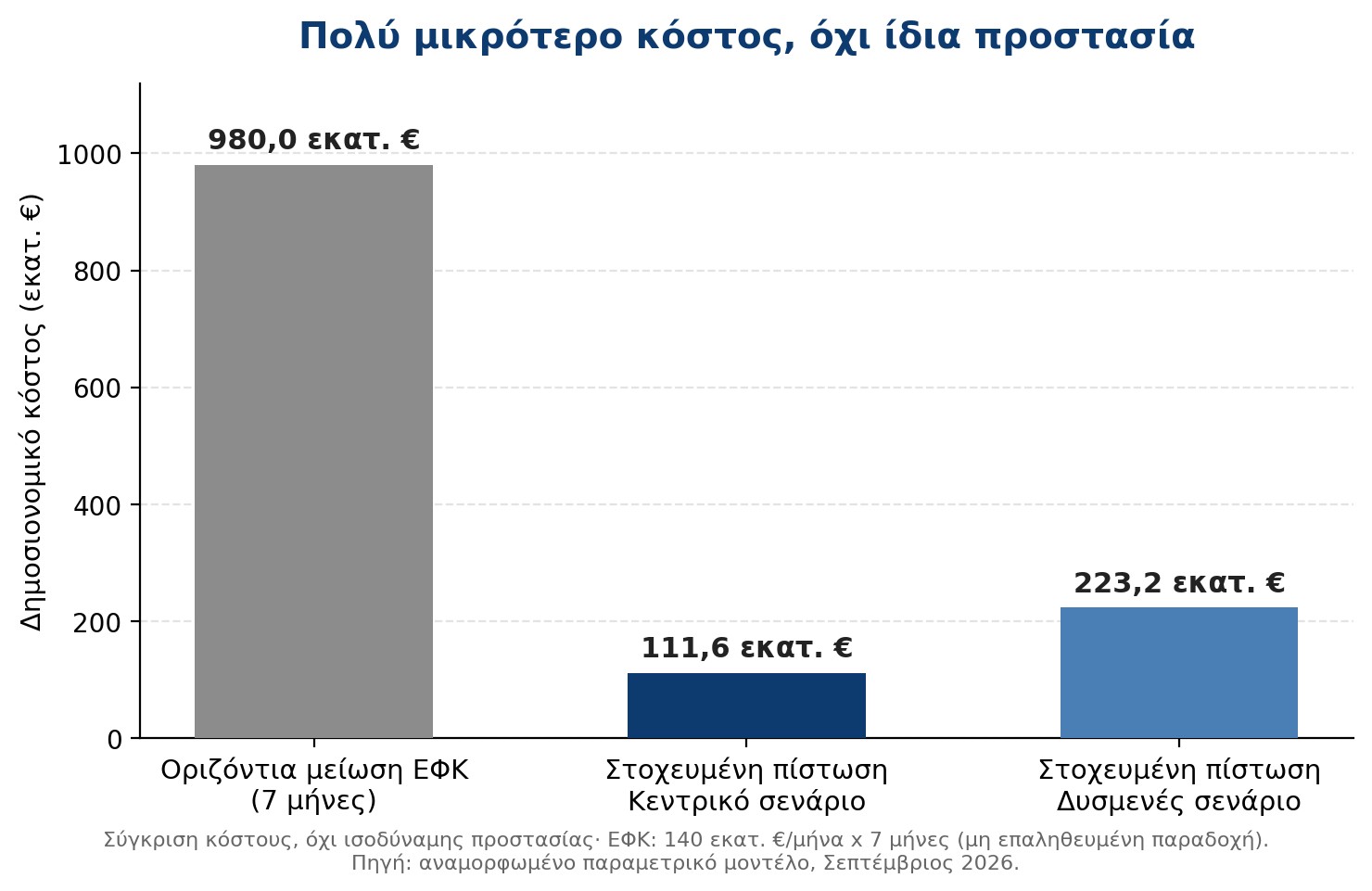
This intervention costs only 11% to 23% of the resources of a horizontal tax reduction for a corresponding period, without this meaning equivalent protection; it is directed immediately to those most affected, and preserves the incentive for saving beyond each household’s cap.
High prices do not vote based on abstract statistical price indices. They vote with the gas station receipt, the heating cost and the constant comparison with pre-crisis reality. As long as Europe insures only the climate but leaves energy unprotected, the final risk is assumed by the popular vote, while the political cost is paid in full by whoever governs.
* Vangelis Pilalis is an Economist, Banking Executive and former member of the Board of Directors of the Hellenic Development Bank (HDB).
* Read the assumptions and the results of the parametric model in the “Accompanying Material” column.