In 2007, when Gross Domestic Product (GDP) reached its highest level of all time, aided by the unchecked borrowing of the Greek state, the economy was characterized by the high share of consumption (private and public) which amounted to 88% of GDP, the high share of investments (private and public) at 24% - a significant part of which was in real estate - of GDP and the low share of exports at 22% of GDP.The main characteristic of the Greek economy was low openness, which is defined by the sum of imports and exports in GDP and high energy dependence on abroad.
Where are we today? The Greek economy continues to be characterized by the high share of consumption relative to GDP, close to 88% as in 2007. Total investments have fallen to 17% of GDP versus 24% then and exports have almost doubled to 40% of GDP from 22%.
The sum of exports (goods and services) and imports, i.e. openness, ranges between 83% and 90% of GDP in the two-year period 2024-2025, approaching the global average which stands at 90%. In other words, the openness of the Greek economy has strengthened significantly compared to the past.
What is happening on the front of energy dependence? In 2007, Greece's energy dependence stood close to 70% while it has risen to approximately 78% in recent years based on Eurostat data. And all this despite the great penetration of RES in electricity generation as the sharp reduction in lignite production was replaced by natural gas.
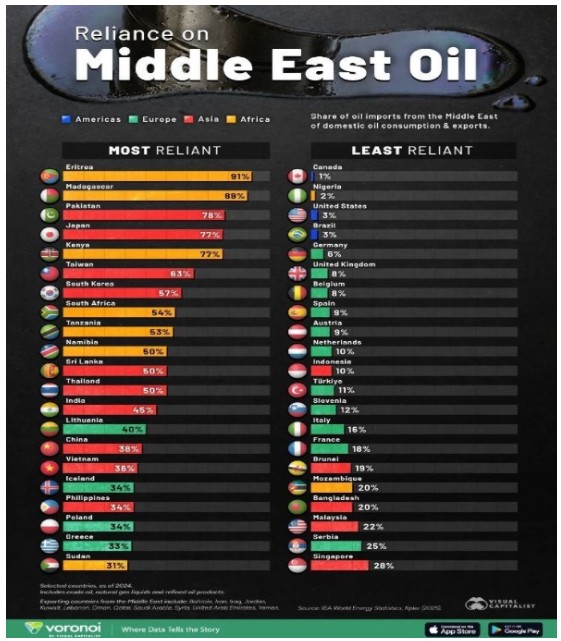
In other words, Greece is more vulnerable to fossil fuel imports today compared to 2007. According to the Virtual Capitalist website, Greece appears to be the third most dependent country in the European Union after Lithuania and Poland on Middle Eastern oil which is at the center of global interest. Lithuania's dependence amounts to 40% versus 34% for Poland and 33% for Greece. (see chart)
It is therefore not surprising that the current account deficit widens every time international oil and natural gas prices start climbing in earnest. And this despite the fact that the country simultaneously exports refined products.
We witnessed this fact once again yesterday as the Bank of Greece (BoG) released the current account balance data for the period January-July 2026. The deficit increased by 1.5 billion euros and reached 9.3 billion despite the increase in revenues from tourism and goods exports.
It is obvious that the improvement of the external balance is linked to the reduction of Greece's dependence on imported fuels. The green transition has not yet helped reverse the trend and a large part of the responsibility belongs to those who designed it.
RES are fine in electricity generation but without provision for storage, the result is below expectations, unlike Bulgaria which has installed battery storage capacity of 5 to 6 GW versus just 0.22 GW for Greece. Consumers pay more expensive electricity and the growth rate is cut back due to the widening of the external balance.
Therefore, the drastic reduction of Greece's energy dependence on imported fuels is linked to the structural improvement of the country's current account balance.
Greece cannot and should not rely on the monoculture of tourism to cover part of the hole that opens up each time in the external balance. Every day will not be St. John's Day as the pandemic showed.