A few months ago, Euronews had processed Eurostat data on consumer price levels in EU countries, Switzerland, Iceland and other non-EU countries, such as Albania, Bosnia, Serbia and Turkey, and had reached some conclusions.We had referred to them in the past, but it is worth recalling them. The reference year was 2024 and 100 was the average price level in the European Union (EU).
The most expensive countries were Switzerland and Iceland and the cheapest were Turkey and our neighboring Skopje. Among the EU countries, Luxembourg was more expensive with prices 51% above the average. On the opposite end, Bulgaria and Romania were the cheapest with prices at 57% of the average. Prices in Greece stood at 83% of the EU average.
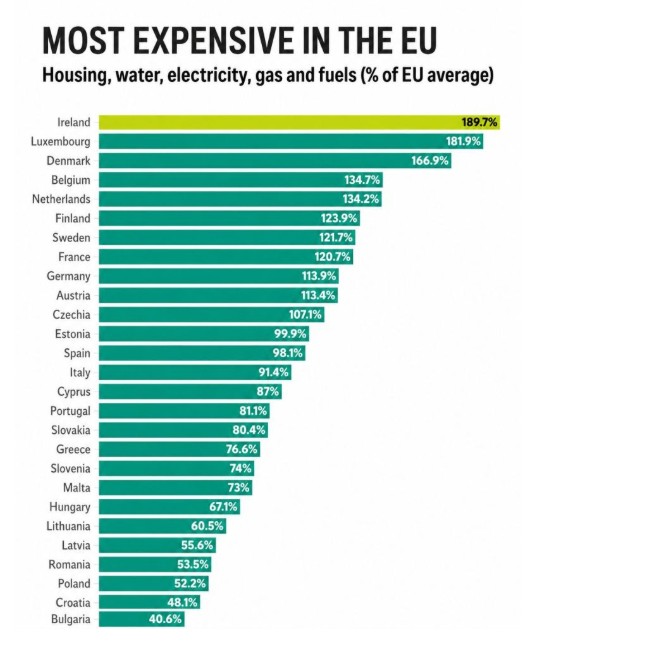
Recently, another table came to our attention that ranks EU countries according to the cost of housing, water supply, electricity, natural gas and fuels relative to the EU average. It is a way of measuring the cost of living.
What emerges from the table? First, Ireland appears to be the most expensive based on this cost of living, as it is almost 90% above the EU average. It is followed by Luxembourg and Denmark at about 82% and 67% above the EU average. By contrast, Bulgaria, Croatia and Poland are the cheapest as they stand at 40.6%, 48.1% and 52.2% of the EU average.
As for Greece, it is among the cheaper countries, as the cost of housing, water supply, electricity, natural gas corresponds to 76.6% of the EU average.
In other words, Greece belongs to the EU countries with lower consumer prices and cost of living compared to the EU average.
Therefore, for a foreign visitor, a tourist coming from the more expensive countries of the EU or the world, e.g. the USA, Greece appears to be a relatively cheap country.
On the other hand, if someone looks at other Eurostat surveys, they should come to the conclusion that it is expensive for its residents, who are paid local wages.
Prices for telephone and internet services are 26% higher in Greece compared to the EU average according to Eurostat. Also, Greece is among the most expensive countries for gasoline in the EU due to high taxes and possibly the structure of the market. Moreover, a quarter of the population and more spends 40% or more of its income on housing.
However, we all know that the declared incomes on which Eurostat bases its statistical surveys in Greece fall quite short of the real ones. This complicates the calculations and is particularly noticeable among professional groups such as the self-employed, farmers, etc., without excluding salaried employees with income from other sources such as rents, etc.
As is well known, the average declared monthly rent approaches 250 euros per month, when everyone in the market knows that the average actual rent is closer to 500 euros, i.e. double.
Furthermore, there are undeclared incomes to a greater extent compared to most EU countries. It is no secret that there are mutually beneficial agreements between private companies and employees for payment of part of the latter's salary in cash (reaching 40% in some cases). In addition, several companies pay meal allowances which are practically income but are not considered as such and are not included.
In other words, Eurostat's income data for Greece underestimate their real level and complicate the calculations when compared with prices and the cost of living.
SOURCE: Alex Chernenko