2026 was not just another year of high returns. It was the year in which markets began to reprice capital: its cost, its duration, its quality and -above all- its ability to generate real cash flows.
For the investor, the conclusion is practical: it is no longer enough simply to be in the market. They must know what risk they are taking, what return they require for the risk they are taking and what event would prompt them to change position.
I. A new order of things
The first nine months of 2026 marked a significant shift. The expectation that higher interest rates would be temporary gave way to the perception that the increased cost of money now constitutes a more permanent structural reality.
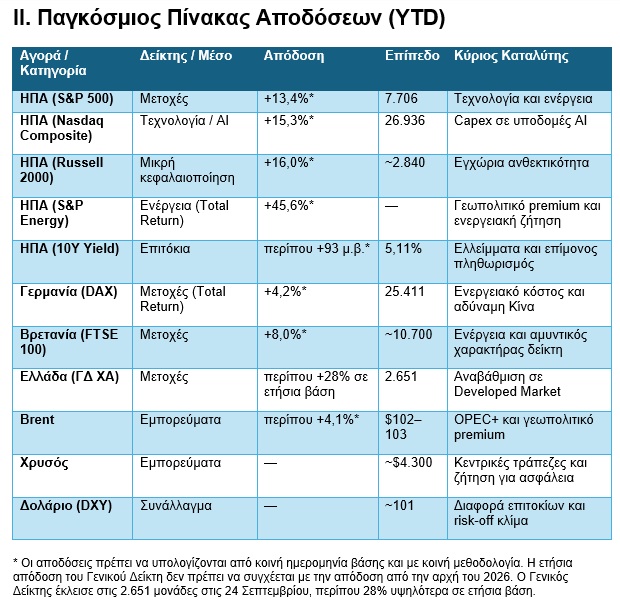
The yield on the U.S. 10-year government bond exceeded 5%, reaching approximately 5.11% on September 24 — the highest level since July 2007. This rise is linked to large fiscal deficits, persistent inflation and increased concerns about the swelling U.S. government debt.
This development coincided with further monetary tightening in Japan, where the Bank of Japan raised its interest rate to 1.25%, the highest level since 1995.
The investment message is clear: 2026 did not reward broad market exposure, but selectivity-liquidity, fixed income, energy, infrastructure and computing power.
The course of the S&P 500, despite its strong annual rise (+13.5%), does not fully reflect the different developments among the individual markets. In the United States, energy, technology and small-cap companies moved at different paces. At a different geographic and investment level, the Athens Stock Exchange stood out as one of the strongest national markets, while on the other hand Germany’s DAX lagged behind.
Three fundamental catalysts shaped the nine-month period:
- AI and energy convergence: The Artificial Intelligence narrative turned into a narrative of increased energy demand and infrastructure investment.
- Greek re-rating: The Greek market left emerging-market status and entered the universe of developed markets.
- Liquidity as an investment class: Cash ceased to be merely a parking place for capital and became an autonomous, competitive allocation category.
III. United States: Behind the shop window
AI and Energy: An Inseparable Bond
The rise of technology moved from expectations to the implementation of significant capital expenditures. The demand of data centers for electricity mainly increases the need for natural gas, nuclear energy, renewables, grids and storage infrastructure.
The impact on oil is more indirect, through the construction and transport of equipment, broader economic activity and the need for backup power. Therefore, the AI trade is not an automatic support mechanism for the price of oil. The strongest direct connection concerns electricity, natural gas and infrastructure.
The energy sector remains a significant beneficiary of technological capex, particularly with regard to natural gas, electricity generation and grids.
Risk: High concentration means that a potential shock to AI earnings or valuations could simultaneously hit technology and part of the energy chain.
Liquidity: A new standalone investment class
With the 10-year near or above 5% and the dollar strengthening, allocations to short-term U.S. government instruments offer high nominal yield with limited duration risk.
They do not, however, constitute an allocation without overall risk. Currency risk for euro-based investors, reinvestment risk, inflation and credit risk remain, depending on the instrument.
This raises the bar for every risky investment decision, especially for equities with high valuations and high sensitivity to the cost of capital.
Long-duration bonds: Significant losses
Those who bet on a rapid fall in interest rates based on estimates from the corresponding period of 2025 suffered significant capital losses, as the 10-year yield moved from about 4.18% at the beginning of the year toward the 5.11% area. The rise in yields hit the prices of long-duration bonds.
The lesson is simple: in an environment of high deficits and increased debt supply, duration is no longer a passive choice. It is an active bet on the path of interest rates.
IV. Europe: Two-speed divergences
The DAX lagged due to the structural loss of competitiveness of parts of German industry, high energy costs and dependence on demand from China.
By contrast, the FTSE 100, relying more on its composition than on the strength of the British economy, with emphasis on energy and the defensive character of several large companies, delivered double the return of the DAX (+8%). The development shows that energy remains an important differentiating factor in Europe as well, without however being the only reason for the British index’s outperformance.
The European picture is not uniform. The same continent includes economies with different energy costs, different exposure to China and different stock-index compositions. Market selection therefore matters more than a general allocation to “Europe.”
V. Greece: Historic transition to developed markets
The ATHEX General Index moved about 28% higher on an annual basis and reached 2,676 points on September 21, the day Greece’s upgrade by FTSE Russell took effect. On September 24 it closed at 2,651 points. This performance αφορά year-on-year change and should not be confused with the return since the beginning of 2026.
FTSE Russell reclassified Greece from Advanced Emerging to Developed Market, while STOXX also proceeded with a corresponding adjustment. This development broadens the investment base of the Greek market and triggers restructurings in international portfolios.
The core of the re-rating remains Alpha Bank, Eurobank, National Bank, Piraeus, OTE, PPC, Metlen, Motor Oil and GEK TERNA.
Has it been priced in? To a significant degree, yes. The market priced in the upgrade before the official implementation date. However, the broadening of the investment base and the restructurings of international indices can support interest in the coming months as well. The inflows, however, will not be linear nor permanently upward.
Where is the risk hidden? If U.S. interest rates remain close to 5%, the increased cost of capital could pressure the valuations of banks and energy companies. As a new developed market, Greece is now entering a different “league,” but it will remain vulnerable to international monetary and interest-rate shocks.
The upgrade opens the door, but does not guarantee continuous repricing upward. This will now be judged by the quality of governance, corporate profitability, and the ability of listed companies to turn capital inflows into sustainable value.
VI. Japan: The macro setup play of the 4th quarter
The Bank of Japan raised the interest rate to 1.25% on September 18, the highest level since 1995. Despite the increase, the yen weakened toward the 157 area against the dollar, as the market had expected even more aggressive monetary policy and clear indications of further hikes.
The positioning: Further acceleration of hikes could strengthen the yen and cause a partial reversal of the carry trade. However, the recent reaction showed that an interest-rate increase by itself is not enough for an immediate and sustainable appreciation of the currency.
Japanese banks remain a likely structural beneficiary of the widening of net interest margins (NIMs), provided that the rise in interest rates does not cause a sharp economic slowdown or significant losses in bond portfolios.
VII. Commodities and safe havens
• Oil (Brent about $102–103): Demand from AI data centers mainly supports electricity, natural gas and investment in grids. For oil, the effect is more indirect. Brent remains influenced by OPEC+, geopolitical developments and global demand. A price above $100 increases geopolitical and inflation risk, but does not by itself create a permanent floor.
• Gold (about $4,300/oz): Despite the recent correction and the rise in U.S. yields, gold remains at historic high levels. Demand from central banks and investors for diversification and protection from geopolitical risks remains strong. At the same time, high real yields and a strong dollar are significant counterweights.
VIII. What does all this mean for the investor?
The main conclusion is not abandoning the markets, but the change in the composition of risk. The new reality favors:
- less dependence on a single investment scenario,
- limited duration in bonds,
- stricter stock selection,
- maintaining liquidity for corrections,
- exposure to companies with real cash flows and strong balance sheets.
The investor does not need to predict the market’s next move with precision. They need to know in advance what development will make them increase, reduce or reallocate their exposure.
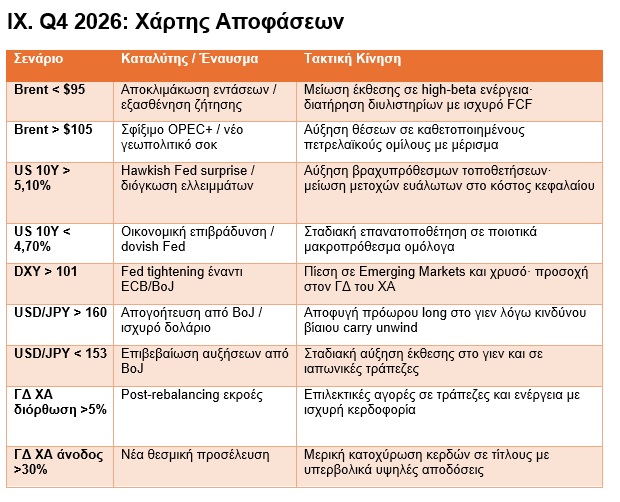
These levels do not constitute mechanical buy or sell signals. They are points for reviewing investment policy. The reaction should be confirmed by the direction of earnings, yields and capital flows.
X. Tactical summary by investment category
• Overall stance: Neutral to selectively positive, not indiscriminately bullish. The market remains investable, but valuations and the cost of capital require a margin of safety.
• Energy globally: Maintain exposure, but with strict security selection. After the sharp rise, take profits in overvalued refineries and shift to integrated groups with sustainable cash flows, strong balance sheets and dividends.
• Allocations to cash equivalents in the U.S.: Remain in short-term instruments with limited duration risk. As long as the 10-year remains near or above 4.90%, short-term instruments remain competitive versus equities for investors with lower tolerance for volatility. For euro-based investors, the cost of hedging the dollar must be taken into account.
• Bonds: Avoid aggressive duration increases as long as the 10-year yield remains above the 5% area. Increase duration only after a clear easing in yields or an indication of economic slowdown.
• Japan: Gradual positioning in yen and banks. Acceleration trigger: USD/JPY below 155, with parallel confirmation of tighter policy from the BoJ.
• Greece: Selectivity and diversification among banks, energy and infrastructure. Preference for companies with strong fundamentals, sustainable profitability and disciplined capital allocation. Avoid indiscriminate buying after the upgrade.
• Gold: Accumulation on corrections, not chasing the price. Acceleration trigger: DXY falling below 99 or easing in real yields.
• Liquidity: Maintain available funds for opportunities and not full investment in a single scenario. Liquidity today is a defensive tool, but also a right to buy when the market reprices risk.
XI. Conclusion: A new “floor”
2026 does not simply mark the end of cheap money. It marks the return of capital discipline as a key investment advantage.
When liquidity yields, duration is punished, debt becomes more expensive and valuations require real profitability, the market no longer rewards mass exposure. It rewards selection.
For Greece, the upgrade to developed-market status ends a decade of isolation and opens a new chapter. It is not, however, a guarantee of lasting rise. The initial inflow of institutional capital may open the door, but only sustainable corporate profitability will keep the market in the room.
The new bet is twofold: Greece must prove that it deserves its new position and investors must distinguish real value from the euphoria of the upgrade.
For the investor, the fourth-quarter strategy is not to predict the next headline. It is to maintain liquidity, limit duration, demand quality and have predefined action levels.
In the new regime, selectivity is no longer a defensive stance. It is the strategy itself.
Sources and Data: Indices and Equities: S&P Dow Jones, Euronext Athens, ATHEX Group, STOXX, FTSE Russell, Macro and Rates: FRED, US Treasury, Bloomberg, CNBC, Reuters, Commodities and FX: Trading Economics, Bloomberg, PriceGold.net, Greece Developed Upgrade: LSEG / FTSE Russell, STOXX, Euronext Athens, Euronews, MSCI, Piraeus Securities, Bank of Japan: Bank of Japan, Reuters, Bloomberg.
Methodology note: Daily prices refer to the close or the last available indication of September 24, 2026. YTD returns should be calculated from the close of December 31, 2025, using the same methodology for all indices — price return or total return.
* Nicholas Havoutis has many years of experience leading strategic financial units, having served as an executive at JPMorgan (New York), Chase Manhattan Bank (London) and Eurobank (Athens). At the same time, he has a significant presence in the media sector. Today, as head of SoZone Limited, he advises businesses and investors on international expansion, organic optimization and mergers and acquisitions strategies.