The General Index of Euronext Athens closes the week at 2,665.93 points, with gains of 25.71% since the beginning of the year.
Behind the average, however, lies a two-speed market. Banks (+39.65%) and financial services (+39.59%) are at the top, with energy-utilities (+37.95%) immediately below. On the opposite side, consumer products are losing 19.92% and real estate 3.01%. The gap between the first and last sector reaches 59.6 percentage points.
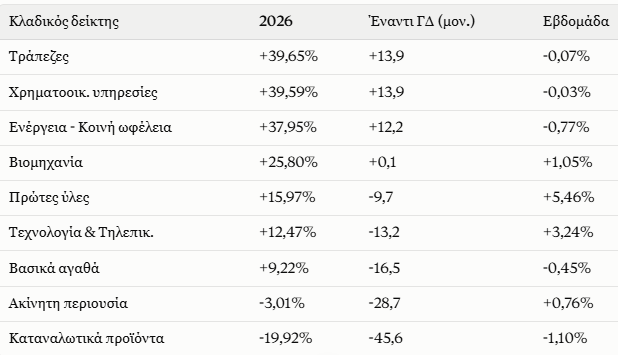
The critical question is whether the sectors that led the way have now become “expensive”. The answer emerges from the comparison with the foreign groups of Beta Securities (FactSet consensus).
Banks rose, the discount remained
The systemic banks are posting weighted gains of 36.08% this year, versus 20.36% for their European bonds. Despite the outperformance of 15.7 points, they are still trading at 11.1 times P/E for 2026, versus 12.2 times in Europe (9% discount). In P/TBV terms the difference is greater: 1.6 versus 2.3 times, that is a 29% discount.
The explanation lies in profitability. The average return on equity of Greek banks is estimated at 13.92% for 2026, versus 16.56% for Europeans. The gap widens to 382 basis points in 2028.
Energy: rally with cheap multiples, but not for long
In the energy sector, Motor Oil (+112.3%) and Helleniq Energy (+105.6%) have doubled since the beginning of the year. Based on consensus estimates, they are still trading at 5.8 times 2026 earnings, with a 24% discount versus European refineries.
The discount, however, concerns only this year’s fiscal period. The weighted P/E of the two companies rises to 10 times in 2028 and the discount narrows to 10%, as estimates incorporate a decline in profits. More conservative are Beta’s own estimates: 2026 P/E of 10.3 times for Motor Oil and 7.7 times for Helleniq.
Different is the picture of PPC (+26.2%). It is trading at a 15% premium in P/E versus European utilities, but at a 43% discount in book value. The premium disappears by 2028, as profits are estimated to increase significantly.
Industry: at the average, with internal divergences
The industrial index is moving practically in line with the General (+25.80%). Among the sector’s stocks, the divergences are large: Cenergy gains 56.5% and GEKTERNA 72.2%, while ElvalHalcor is negative (-2.8%). Cenergy, despite the rally, is trading at a 19% discount in P/E versus Prysmian, Nexans, NKT and Tenaris. At the same time it has a 26% premium in P/BV.
The laggards are also the cheapest
At the bottom of the table, the link between performance and valuation is direct. Greek consumer products (Papoutsanis, Sarantis) are trading at a 38% discount in P/E and 68% in P/BV versus P&G, Unilever, L'Oréal and other groups.
The sector index is losing almost 20%, while foreign groups are marginally positive (+0.37%). Sarantis fell 17.4% in September alone. In retail, Jumbo (-12.0%) is trading at a 41% discount in P/E, while its foreign competitors are gaining 13.28%.
In real estate, Lamda Development (-12.8%) lags European listed companies by about 18 points. It is trading at a 29% discount to book value.
The exceptions
Two sectors do not follow the rule. In staples (+9.22%), Kri Kri gains 62.9% and is trading at a 46% premium versus Danone and Nestlé. Coca-Cola HBC is moving at a 12% premium.
In telecommunications, OTE has a 23% discount in P/E, a dividend yield of 5.13% (versus 4.52% for Europeans) and the lowest debt in the sector. Despite this, the technology-telecommunications sector remains 13 points behind the General Index.