More than 300,000 pensioners continue to work today, in a development that changes the data both in the labor market and in the finances of the social insurance system.
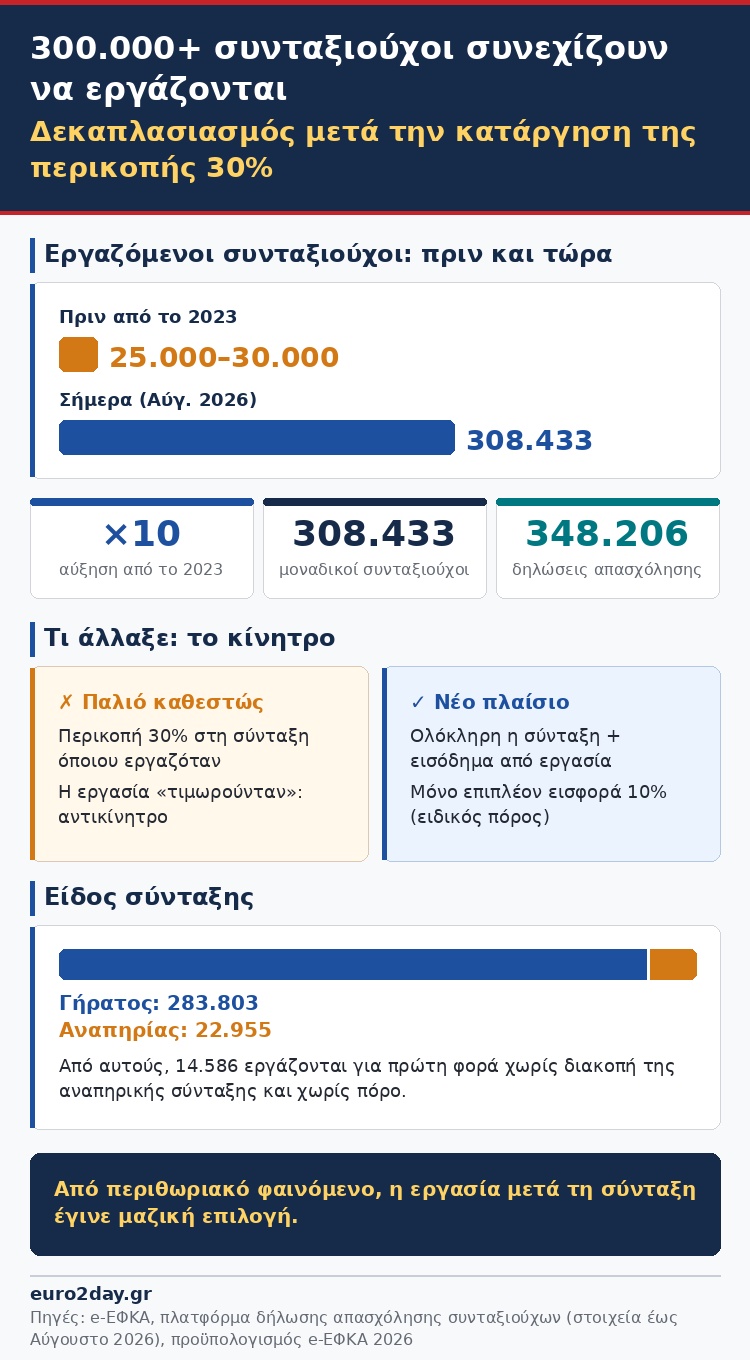
The most recent data from the EFKA electronic platform for declaring pensioner employment are up to August 2026 and reflect in the clearest way a trend that a few years ago was limited: before 2023, declared working pensioners were estimated at just 25,000 to 30,000, while today the unique pensioners who have declared employment amount to 308,433. The declarations, in fact, are even more, as they reach 348,206, which shows that a pensioner may have more than one employment declaration.
This explosive increase is not accidental. The abolition of the 30% cut in the pension for those who continued to work acted as a strong incentive for their return to or stay in the labor market, as the previous regime created a particularly strong disincentive: the pensioner who chose to work lost a significant part of their pension.
Under the new framework, work after retirement became financially more attractive and, at the same time, a model was shaped from which both sides benefit. The pensioner keeps their pension with an additional 10% contribution, and gains additional income from work, while EFKA collects insurance contributions and the special levy provided for working pensioners.
At the top of the list are farmers, who make up almost half of the population of working pensioners. Specifically, 138,381 unique pensioners declare that they are employed as farmers, about 45% of the total. This is a category in which leaving work is not always easy or even practically feasible.
Agricultural activity continues, cultivation does not stop because the farmer has retired, and the family holding often continues to rely on their participation. In many cases, of course, the receipt of some income, e.g. from renting agricultural land, appears as a continuation of productive activity.
The data show that of the 138,381 farmers, 84,169 are pensioners of the former OGA who carry out employment subject to the insurance of the former OGA, while another 55,132 are pensioners of entities integrated into EFKA, including the public sector, with annual income from agricultural activity of up to 10,000 euros. These specific categories are included in the provided exceptions from payment of the special levy.
In the second major category are employees. A total of 96,868 unique pensioners declare that they continue to work as employees, representing about 31% of the total.
Here the financial incentive is particularly strong. For a worker who has reached retirement, the transition from salary to pension can mean a large loss of monthly income. Even more so when the pension awarded is low or when the pensioner is waiting until the process is completed and all the benefits they are entitled to are paid (e.g. supplementary pension).
There is, however, also a second dimension, which concerns the needs of the economy itself. In several sectors, businesses find it difficult to find people with the experience and know-how required for specific jobs.
Business executives who know a company's operation in depth, technicians with specialized knowledge, workers who handle machinery or production processes, and professionals with decades of experience constitute, in several cases, human capital that is not easily replaced. The phenomenon is even more intense in professions in which know-how is acquired mainly through many years of practical experience.
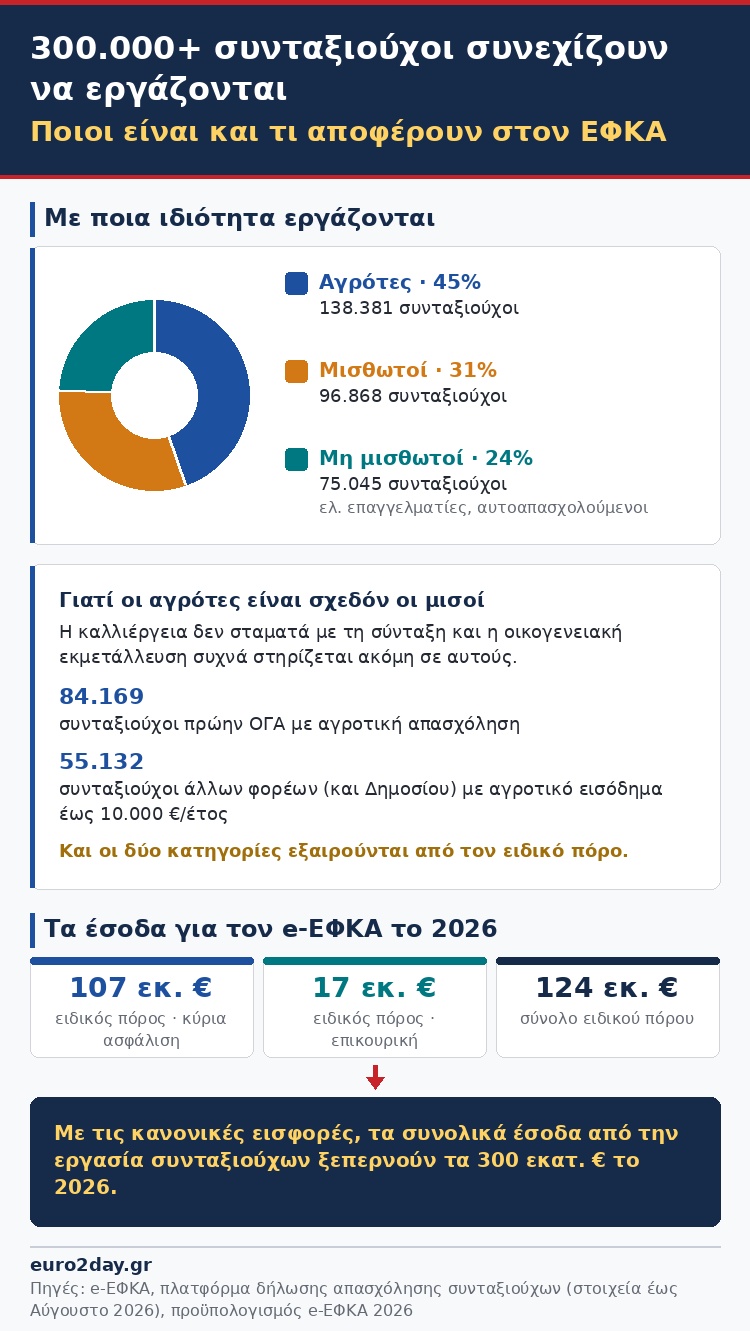
An important part of the new picture is also made up of the non-salaried. A total of 75,045 unique pensioners declare that they continue to work as freelancers or self-employed, about 24%.
This is a category that includes traders, scientists and professionals who have developed their own activity, from lawyers and doctors to engineers and other self-employed persons. For many of them, retirement does not necessarily entail the closure of the profession, office or business. The clientele, professional reputation, experience and personal relationship with clients, but also low pensions, mainly in the case of traders and craftsmen, often make the decision for permanent withdrawal difficult.
The platform's data show that the vast majority of working pensioners are old-age pensioners. The unique AMKA numbers of this specific category amount to 283,803.
At the same time, 22,955 are pensioners due to disability from common illness, work accident, accident outside work or occupational disease. A total of 14,586 working disability pensioners have declared that they fall under the relevant exception, as under the new framework they are allowed for the first time to work without interruption of the disability pension and without payment of a levy.
This change also has a significant fiscal footprint. The e-EFKA budget for 2026 had projected that revenues from the special pensioner employment levy would amount to 124 million euros. Of these, 107 million euros concern main insurance and 17 million euros supplementary insurance.
This is revenue that comes in addition to the insurance contributions that working pensioners pay normally and which, according to estimates, raise the Entity's total revenues from their employment to over 300 million euros for 2026.