1972 was the first full year since American President Richard Nixon abandoned the gold standard and the dollar swam in the deep waters of global foreign exchange markets.From 1972 until today, the average annual return of gold is estimated to be close to 9%, of the global stock market index MSCI World Index close to 9.5% and of the American stock market index S&P 500 a little above 11%.
Also, the average annual total return of the pan-European index Stoxx 600, which officially started in 1987 but for which there is historical data that can be used, is estimated to have been close to 8.8%. An even lower average annual total return close to 7%-7.5% in dollars is estimated to have been recorded by the General Index of the Athens Stock Exchange, showing extreme fluctuations at times.
However, not all decades were the same. More specifically, gold recorded much higher comparative returns in the decade of stagflation from 1970 to 1979 and in the period 2000-2009, which is characterized as the “lost decade” of stocks. In the period 1970-1979 it had a return of 1,300% and in the decade 2000-2009 it had 280% versus negative returns for stocks.
What is happening in the decade we are going through?
From January 2020 until September 2026, gold is ahead with a cumulative return of 182% so far as it went from $1,520 per ounce to $4,200 today.
They are followed by the S&P 500 index with a total return of 162%, the General Index of the Athens Stock Exchange with about 160%, the global stock market index MSCI World with 107% and lagging badly the pan-European index Stoxx 600 with 50%.
Whether gold will be the best investment of the current decade or stocks will, depends of course on their performance in the remaining years.
With bond yields at multi-decade highs and inflation having already risen and showing that it may go higher because of the turmoil in the Middle East and the negative effects on supply that impact food prices, many are talking about a return to the inflation of the 1970s.
In such a case, gold is the favorite over stocks. However, there are some important differences between the current decade and that of the 1970s. Incomes are not rising faster than real GDP, nor are unit product costs. Also, credit expansion toward the private sector is proportionally smaller. On the other hand, debt-to-GDP ratios are at record levels and this favors interventions by central banks so that interest rates do not get out of hand.
The biggest difference is AI. The latter may worsen the outlook for inflation in the short term because of the large investments required, but in the medium term it promises a large increase in productivity. In addition, it reduces the bargaining power of workers. In other words, AI brings deflation.
Therefore, the question is: How many years will be required for such a thing, since in the short term inflation is likely to rise.
The correct answer to the above question answers the question of whether gold or stocks will have the higher return this decade.
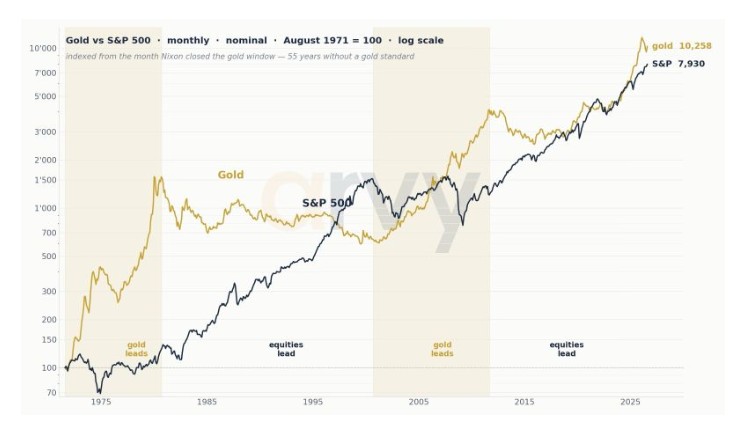
Note: The return of the S&P 500 does not include the reinvestment of dividends
SOURCE: Arvy