2025 was a very good year for the wealth of Greek households. According to Allianz's Global Wealth Report 2026, their financial assets increased by 14.7% and reached 401.9 billion euros.
In real terms the increase was 11.5%, the largest in Western Europe. Since 2019 the real wealth of Greeks has increased by 23%. In Western Europe as a whole, over the same period, the increase was just 0.5%.
Most of the money was not saved, but came from the rise in the markets. Financial wealth increased by about 51 billion euros during the year, while new savings were just 6.3 billion euros. So almost 9 out of 10 euros of the increase came from the appreciation of assets. Globally the ratio is 4 out of 5.
This also explains the 34.4% jump in securities (shares and bonds), which now make up 50.4% of Greeks' portfolios. Greeks used to be among the most "deposit-oriented" peoples in Europe. Today they have a larger share of their money in securities than the Western European average (36.8%) and are approaching the Italians (54%). In 2025 they bought 6.7 billion euros in securities and made net withdrawals of 0.4 billion euros from deposits.
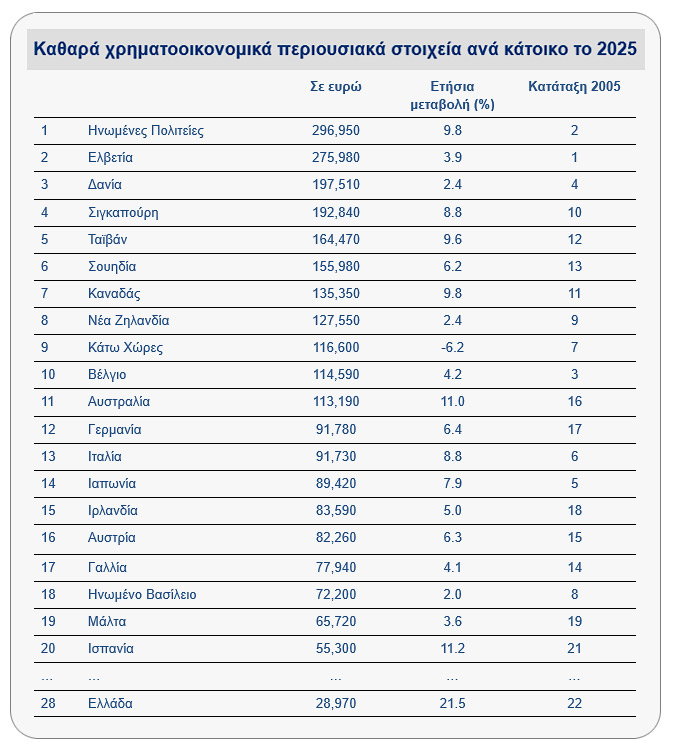
The gap from the South
Despite the leap, Greece is still far behind the other countries of the South. Net financial assets per capita are 28,970 euros. In Portugal they are 39,730 euros, in Spain 55,300 euros and in Italy 91,730 euros. The average Spaniard therefore has almost double the net wealth of the average Greek and the average Italian more than triple. Greece ranks 28th in the world, as it does in gross assets per capita (40,440 euros). In 2005 it was 22nd.
The gap is also evident in comparison with the size of the economy. The gross financial wealth of Greek households corresponds to 161.8% of GDP. In Spain and Portugal it exceeds 200% and in Italy it reaches 287%. In other words, the Greek household still has a long way to go before rebuilding the savings it lost during the crisis period.
Less debt, less inequality
However, there are also two factors that favor Greece. The first is debt. Household liabilities increased by 2.9% and reached 114 billion euros, that is 11,470 euros per capita. They correspond to 45.9% of GDP, a percentage lower than Germany's (49.1%), Italy's (47%), Spain's (47.3%) and especially Portugal's (69.8%) and France's (70.9%).
The second is the distribution of wealth. In Greece the richest 10% of households holds 46.9% of net financial wealth. The average across the 57 countries in the study is 60.9%. Only Malta (42.6%) and Slovakia (44.5%) have a lower percentage. In Germany the corresponding percentage is 59.5%, in Italy 60.6% and in the US 68.2%. However, concentration increased slightly in Greece over the last twenty years: the share of the richest 10% rose by about 2 percentage points compared with 2005.
The price of exposure to the markets
The greater shift toward the markets also carries risk. Allianz warns that household wealth depends more and more on valuations based on expectations for artificial intelligence.
In a scenario of a 15% drop in the S&P 500, the net wealth of American households would decrease by 5.8%. In a 25% drop, 27 trillion dollars would be lost and the American economy would enter recession. Allianz also estimates that artificial intelligence will affect almost one in four jobs in major economies over the next three years.
For 2026, the firm forecasts a 9% rise in global financial wealth. In the medium term, however, it expects more restrained rates, about 5% to 6% per year.