Debtors to the State have at their disposal a new more favorable debt arrangement, compared with the initial one that has been in effect since last July, following the changes announced by the prime minister Kyriakos Mitsotakis at yesterday's cabinet meeting.
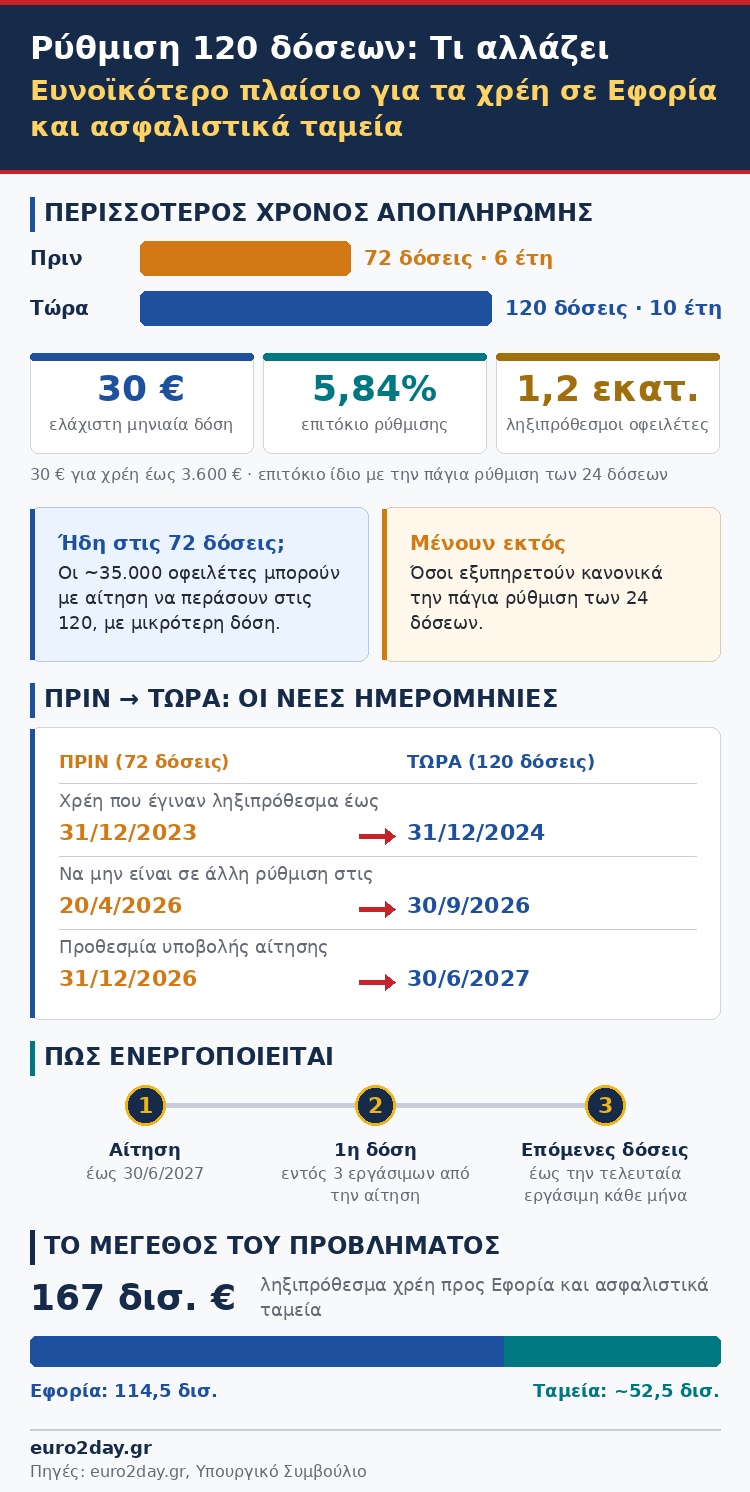
The most important change concerns the increase in the number of installments of the extraordinary arrangement from 72 to 120, while the measure's “umbrella” includes older debts of one additional year, along with an extension of the dates for submitting applications and settling newer debts, as well as the minimum amount of the monthly installment.
Pending the necessary ministerial decisions and interpretive circulars, the at least 1.2 million overdue debtors who theoretically fall within the scope of the arrangement should know that after the “lifting” of the initial framework:
* The maximum number of monthly installments increases from 72 to 120, with a minimum payment amount of 30 euros. Those who have debts up to 3,600 euros can secure the minimum installment of 30 euros. The higher the debt, the higher the amount of the monthly installment.
* Debts to the Tax Office and social security funds can be included in the 120 installments:
- that have become overdue up to and including December 31, 2024, instead of December 31, 2023 which applied to the 72 installments and
- are not under an arrangement status on September 30, 2026, instead of April 20, 2026 provided for by the previous scheme.
This means that natural and legal persons who have already joined the standard 24-installment arrangement and are servicing it normally remain outside the 120 installments.
* The application for inclusion in the arrangement may be submitted until June 30, 2027, instead of December 31, 2026 which was the deadline for the 72 installments. The arrangement is activated with the payment of the first installment within three working days from the submission of the application. The following installments are paid by the last working day of each following month.
In the new scheme
* The approximately 35,000 debtors (to the Tax Office and EFKA) who have already joined the 72-installment arrangement will be able, upon application, to move to the new 120-installment scheme. In this case, the balance of their debt will be spread over more installments, reducing the monthly burden.
* The interest rate of the 120-installment arrangement is set at 5.84%, the same as the interest rate of the standard 24-installment arrangement.
* To join the arrangement, debtors must on the date of submission of the application:
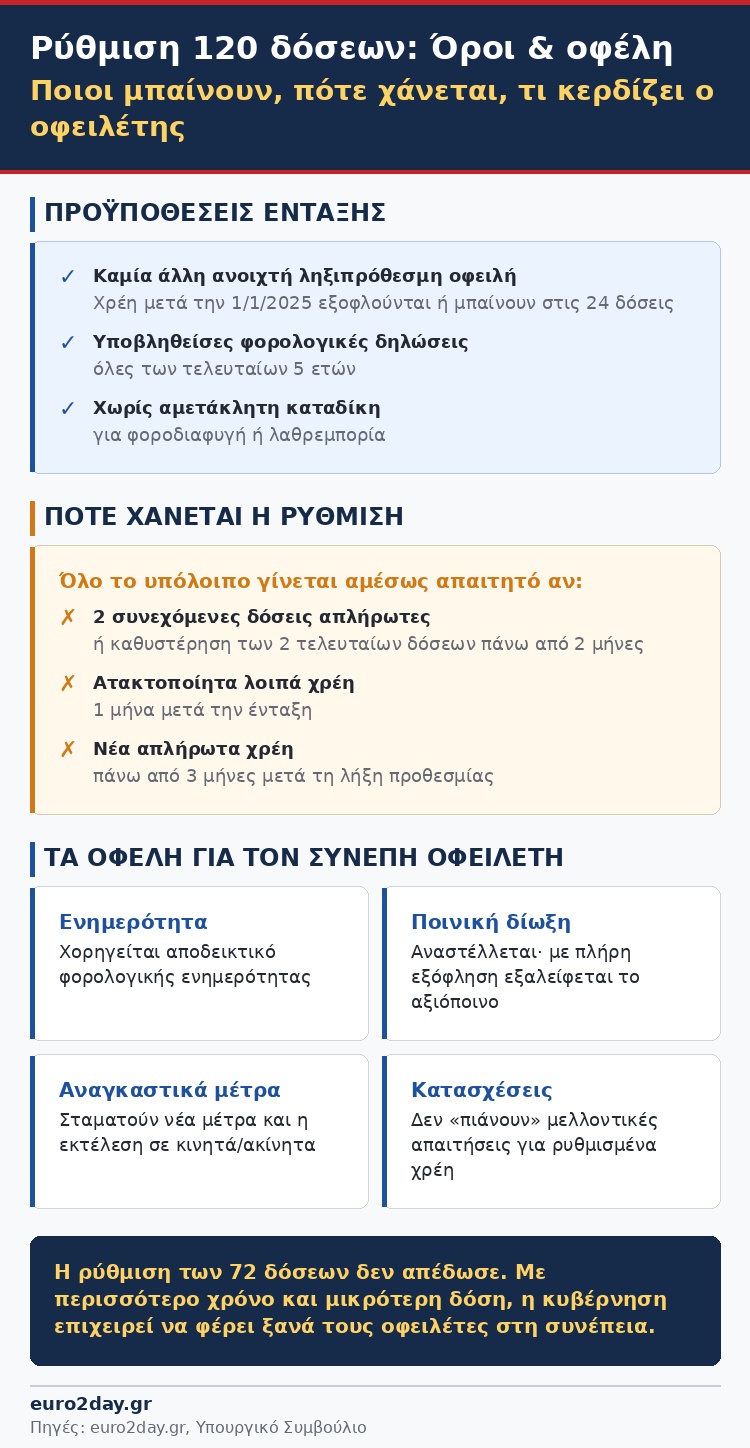
- not have other overdue debts or, if there are debts that cannot be included in the 120 installments, they must have been settled legally, through payment suspension, arrangement, court decision or temporary order. This means that debts created after January 1, 2025 must either be paid off or included in the standard 24-installment arrangement,
- have submitted all income tax returns of the last five years,
- not have been irrevocably convicted of tax evasion or smuggling.
Loss of arrangement
* The arrangement ceases to apply and the remaining debt becomes immediately due if the debtor:
- does not pay two consecutive monthly installments or delays the payment of the last two installments for a period longer than two months,
- after the lapse of one month from inclusion in the arrangement has not paid off, included in the standard arrangement or settled by another legal means the total of the other overdue debts not covered by the 120 installments,
- does not pay off or does not settle, throughout the duration of the arrangement, new debts that do not fall under it, within three months from the expiration of their payment deadline.
The benefits
* Inclusion in and compliance with the arrangement provide the debtor with a series of benefits, as:
- a tax clearance certificate is granted,
- criminal prosecution is suspended for as long as the arrangement is observed and, in the event of full repayment, criminal liability is extinguished,
- the taking of new enforcement measures as well as the continuation of compulsory execution on claims, movable and immovable property is suspended,
- garnishments in the hands of third parties do not cover the debtor's future claims, provided they concern exclusively regulated debts and the relevant release decision is notified to the third party.
In the “red”
The 72-installment arrangement that came into effect last July did not bring the expected results, a development which led the government to the decision to give more time and a smaller monthly burden to debtors (individuals and businesses) to join the new—clearly more flexible—scheme for repaying old debts.
It is worth mentioning that overdue debts to the Tax Office and social security funds now exceed 167 billion euros, with 114.5 of these concerning debts to the Tax Office.