The steepest green electricity tariffs ever recorded are those announced yesterday by providers for October, with the average increasing by 12%, now approaching 24 cents per kilowatt-hour, and the market even seeing charges starting with a three.
This in turn means that since the government is not inclined to immediately reinstate horizontal subsidies on electricity, the 3 million households that insist on the green color will see double-digit increases in their bills, with the only obvious way out being a shift toward blue, which has intensified with the aggressive policy of PPC.
If one looks at the table by company, it is obvious that providers' margins to absorb each month part of the rise in wholesale prices (+17% in September) have narrowed. And although some again shouldered part or even all of their cost, the majority of the market now sells green variable tariffs above 20 cents/ kilowatt-hour.
The new element, in fact, is that for the first time since the colored categories were established in Greece (January 2024, under Th. Skylakakis) we are now seeing charges even above 30 cents/ KWh.
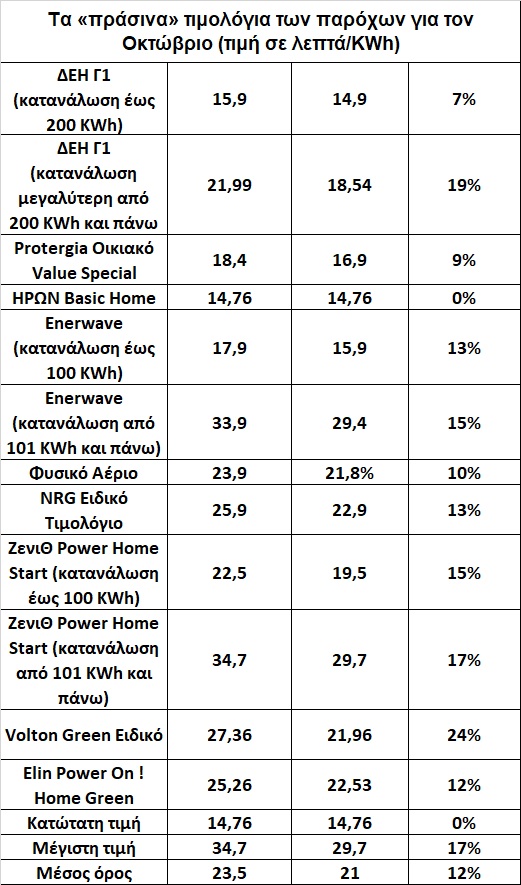
In reality, the picture brings together all the elements for activating the subsidy measure, since although the market offers tools for shielding against high prices (blue tariffs), nevertheless almost 70% of household consumers insist on ignoring them.
This in turn means that although the government has sent in every tone the message that it is against electricity subsidies, nevertheless household inertia and developments may force it to bring them back.
Besides, the movement of so many people to fixed tariffs is practically impossible to happen immediately, while at the same time it does not necessarily imply protection either, as the experience of last spring has shown.
In the real scenario that the energy crisis is prolonged, then when the quantities of energy for which companies have done hedging are exhausted, and consumers are called on to renew their contracts, they will be faced with more expensive ones that will incorporate the increased market cost.
As for the question of when subsidies could return, perhaps the answer will be given next month, provided that the tariff of PPC, (with a 64% share in low voltage), exceeds the barrier of 16 cents. It is the threshold above which the government set in motion the weapon of support in the previous energy crisis of 2022.
At the present stage, for consumption up to 200 KWh, the company maintained the charge at 15.9 cents.
Third straight month with a double-digit rise in wholesale prices
The above is the result of the fact that we are now counting three straight months with double-digit increases in wholesale prices: September's 17% rise was preceded by August with +21% versus July, which in turn had increased 18% versus June, with all that this implies for the companies in the sector.
Looking at the figures cumulatively, the price in the wholesale market has increased over the last quarter by 56%, that is, from 109.95 euros/MWh in July to 157 euros/ MWh at which September closed.
The big shift to blue
In the same period green tariffs have increased by an average of 18%, while including October as well (the category's charges are announced on the 1st of each month), the percentage rises to 30%.
Although the rate of increase is certainly lower than wholesale, as mainly the large providers absorbed part or even all of the increases, everything shows that green tariffs will become even more expensive, with all that this implies for the shift to blue.
Last June the fixed category numbered about 1.88 million households (RAAEY data), that is 32% of the total 5.9 million residential meters, however it is certain that it has increased after the even more dynamic penetration of blue products.
The rise has certainly also been helped by the promotional campaign of PPC, which offers by far the cheapest fixed tariff on the market. According to what the company announced yesterday, the price of 11.5 cents/ KWh with a 3.5 euro fixed fee is maintained for October as well for this specific product, which will remain in force until the end of the month, unless an extension is given.