A noticeable change was recorded by the consumer confidence index, which stood at -41.6 points, compared with -47.8 points in July. However, according to IOBE's "Economic Climate Survey," this month as well Greek consumers appear to be the most pessimistic in the European Union, by a margin over the next ones, with consumers in Romania (with an index level of -32.5) and Bulgaria (-25.9) following.
The individual indicators for household finances are strengthening, while the broader economic situation in the country shows improvement. At the same time, the intention for major purchases is improving, with saving strengthening mildly.
At the lowest positions of this ranking, as also throughout 2025, are Malta (+5.7) and Lithuania (+0.5), with the positive value of the consumer confidence index essentially implying optimism among the country's consumers. The average European indicators stood at -15.8 points in the EU and -16.5 points in the Eurozone.
In more detail:
Slight weakening of consumers' negative assessments of their households' financial situation over the past 12 months
Consumers' negative assessments of their household's financial situation over the previous 12 months declined slightly to -44.4 (from -48.3) points. 60% of households estimated a slight or marked deterioration in their financial situation, while only 3% believe there was a slight improvement. The corresponding indicators in the EU and Eurozone stood at -11.6 and -12.3 points respectively.
Slightly more optimistic forecasts as well for households' financial situation
Consumers' negative forecasts for their household's financial situation over the next 12 months were slightly reduced in September to -41 (from -44.4) points. 55% (from 59%) of households expect a slight or marked deterioration in their financial situation, while 5% foresee a slight improvement. The indicators in the EU and Eurozone stood at -5.5 and -6.1 points respectively.
Significant improvement in forecasts for the country's economic situation
The negative index of households' forecasts for their country's economic situation over the next 12 months was noticeably reduced in September and stood at -45.7 (from -56.1) points. 60% (from 71%) of consumers foresaw a slight or marked deterioration in the country's economic situation, compared with 27% (from 19%) who expect stability. The indicators in the EU and Eurozone stood at -31.1 and -33.3 points respectively.
Strengthening in the intention for major purchases
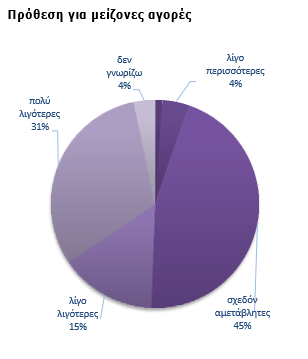
Consumers' intention for significant purchases over the next 12 months (furniture, electrical appliances, etc.) strengthened significantly, with the relevant index standing at -35.4 (from -42.2) points. 46% (from 53%) of consumers foresaw that they would make fewer or far fewer expenditures, while 5% expect the opposite. The European indicators stood at -15.1 points in the EU and -14.4 points in the Eurozone.
Mild strengthening of the intention to save
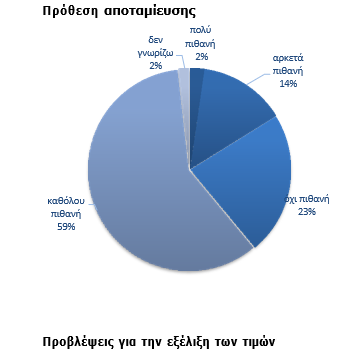
The index of the intention to save over the next 12 months strengthened mildly to -61.6 points from -64.9 in July. 82% of households do not consider saving likely in the next 12 months, while 16% consider it likely or very likely. The relevant indicators stood at +11.1 points in the EU and +10.9 in the Eurozone.
Mild escalation in forecasts for unemployment
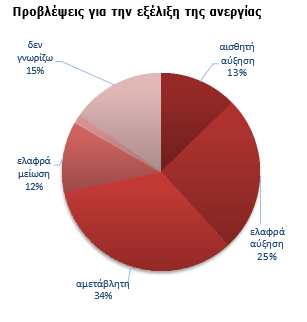
The forecast index for the course of unemployment over the next 12 months rose mildly in July, to +18.2 points, from +17.9 in July. The percentage of households that foresaw a slight or marked rise in unemployment stood at 38%, with 12% of respondents expecting a slight decrease. The corresponding indicators in the EU and Eurozone stood at +27.6 and +28.3 points respectively.
Slight de-escalation of forecasts for rising prices
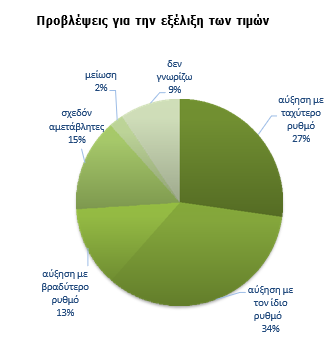
The positive index for forecasts of changes in prices over the next 12 months eased mildly in September and stood at +30 points, compared with +40 points in July. 62% of households foresaw price increases at the same or a faster rate and 17% (from 13%) expect stability. The relevant indicators in the EU and Eurozone stood at +33.9 and 35.2 points respectively.
Maintenance of the percentage that is "just making ends meet"
Regarding estimates of the household's current financial situation, the percentage of consumers stating that they are "just making ends meet" stood at 58%, the same as the previous month, while the percentage of those reporting that they draw on their savings was reduced to 12% (from 13%). Consumers who stated that they save a little or a lot account for 22% of the total, while the percentage of those who stated that they are "in debt" stood at 7%, the same as in the previous period.
Weakening of the percentage of households that are uncertain about their future financial situation
To the question assessing the degree of uncertainty of households regarding future economic developments, 52.4% judged in September that their financial situation can be predicted with difficulty or relative difficulty, down from 59.3% the previous month.