The listed technology companies on the Athens Stock Exchange posted increased revenues almost across the board in the first half of 2026. However, when one reads the financial statements and not the headlines, the picture changes to some extent.
Our analysis is based exclusively on documents published by the companies themselves for the period 1/1–30/6/2026: the financial statements and press releases of Performance Technologies, Space Hellas, Qualco Group, Prοfile, QnR Group and Real Consulting.
CPI has a different fiscal year and reported a half-year through 31/3/2026, based on its press release. The conclusions concern the core of the sector and not its entirety.
Our central finding is that at Space Hellas, Qualco and QnR growth has been bought, through acquisitions, investments and working capital, and has not yet been converted into cash generation.
At Performance, Real Consulting and Profile profits are covered by positive operating flows, with reservations for each: collections that will not recur, non-organic growth, margin compression.
Revenue growth, margin compression
Revenues are increasing in six of the seven companies: QnR +61%, Prοfile +60%, Real Consulting +35%, Qualco +14%, Performance +12.6%, and Space Hellas +8.2%. Only CPI declines (−16.7%). However, growth is not organic everywhere.
Profile incorporated the acquisitions of ALGOSYSTEMS and Contemi, Real Consulting incorporated OTS, and Qualco is growing through acquisitions and investments. At Real Consulting, OTS contributed revenues of 6.6 million and EBITDA of 2.3 million from March 19. Without it, revenues would have been 22.5 million (+4.5%) and EBITDA 4.9 million (+36%): the improvement is real, but smaller than the headlines suggest.
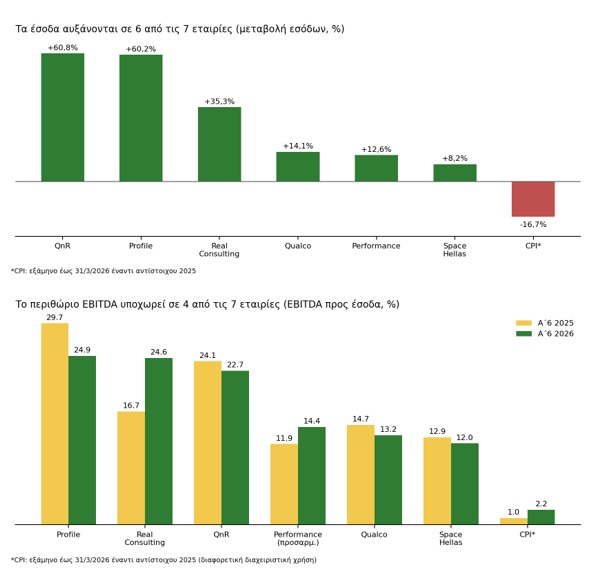
The pattern is clear in most cases: companies that buy growth pay with EBITDA margin, which is being compressed.
At Prοfile, the EBITDA margin falls from 29.7% to 24.9% and the gross margin from 42.8% to 38.1%. At Qualco, EBITDA rises only 2.8% with revenues up 14%, while depreciation increases to 9.2% of revenues from 7.8% and financial expenses by 63%. At Space Hellas, EBITDA is almost flat (9.30 versus 9.27 million) and EBIT declines from 5.80 to 5.46 million.
At QnR, the EBITDA margin falls to 22.7% from 24.1%, despite the large jump in gross profit (+83.5%). Adjusted EBITDA (3.56 million) maintains a margin of 25.6%. By contrast, Real Consulting’s EBITDA margin rises to 24.6% from 16.7%, and CPI improves its EBITDA by 77% to 193 thousand with lower operating costs and a higher share of services (29% of revenues from 25%).
Performance is the exception in the opposite direction: its gross margin rises from 29.9% to 35.4% and adjusted EBITDA increases 37%. Here, however, the word “adjusted” carries weight.
The share-based payment expense (IFRS 2) reached 1.97 million from 0.6 million, and net profits fell 8.8% to 2.4 million, while the effective tax rate rose to 35.4% from 24.6%. Without this non-cash expense, profits would have been 4.3 million versus 3.2 million.
We believe that the investor should read both figures, because the share-based payment expense is equivalent to about 30% of adjusted EBITDA. Without the adjustment, EBITDA is 4.65 million (+10%) and its margin remains almost unchanged (10.2% versus 10.4%). Management estimates that the burden in the second half will fall to 0.41 million.
Quality of earnings and cash flows
In our view, this is where the most important finding of the half-year lies. Of the six companies for which we examined operating cash flows, three had a negative sign.
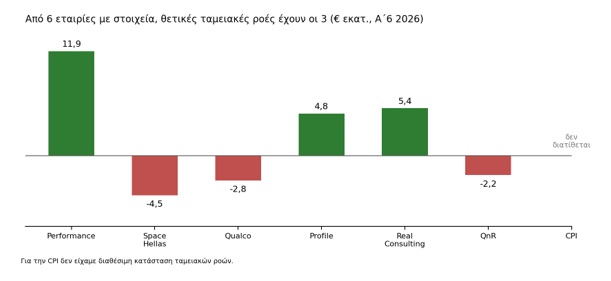
Performance has the strongest result: 11.9 million versus 1.0 million last year, that is about 1.8 times adjusted EBITDA, mainly from collections of receivables (13.7 million), which more than offset the reduction in liabilities (6.0 million).
Without the net release of working capital (6.5 million), flows would have been about 5.4 million, that is 0.8 times adjusted EBITDA. Net cash (after leases) reached 18.1 million from 10.5 million at the end of 2025. The collection is not expected to recur at the same scale and the second half will show whether it is maintained.
At Space Hellas, cash flows turned negative (−4.5 million from +9.2 million), because receivables increased 19.5% to 97.2 million.
At Qualco, operating cash flows were also negative (−2.8 million from +6.5 million last year), despite EBITDA of 13.4 million. Working capital absorbed about 14.9 million, mainly due to a reduction in other liabilities (11.3 million) and an increase in contract assets (5.5 million).
Management attributes this to payment delays from the Greek public sector and the Middle East and to capacity investments ahead of revenues from new contracts. Investments in fixed and intangible assets were 10.1 million, that is 10% of revenues and 75% of its EBITDA, so together with operating flows the company absorbed about 13.0 million.
Its cash fell by 34.1 million, from 55.1 to 21.0 million: total investing flows, including acquisitions and stakes in associates, were −15.7 million and financing flows −15.6 million (loan repayments 6.4 million, leases 2.9 million, interest 2.1 million and dividends to minority interests of subsidiaries 4.4 million). Management expects positive operating cash flows for the full year.
Profits also do not come everywhere from operations. At Space Hellas, EBT rises because fair value gains (+0.42 million versus −0.26 million) and lower financial expenses cover the decline in EBIT. Without the fair value gains, EBT would have been 11.5% lower. At Prοfile and Real Consulting, profits have greater cash coverage, as shown below.
Profile generates positive operating cash flows of 4.8 million (3.6 million last year), that is about 60% of its EBITDA (8.0 million). Conversion is lower than Performance’s, because liabilities (excluding bank liabilities) decreased by 2.5 million, while the change in receivables added 1.8 million.
On the balance sheet, however, trade receivables increased 28% to 15.7 million, probably due to the consolidation of the acquisitions. Investing flows were −2.3 million: acquisitions of subsidiaries 1.9 million and investments in fixed and intangible assets 1.2 million, partially offset by proceeds from securities.
Financing flows were −1.1 million (treasury share purchases 0.9 million, loan repayments 1.5 million and grants +1.7 million), versus +2.8 million last year, with no new borrowing. Cash and cash equivalents reached 27.3 million from 25.7 million at the beginning of the year, meaning the acquisitions were financed mainly from the company’s own cash reserves.
QnR has the most negative cash flows relative to its profitability: −2.2 million (−0.6 million last year) despite EBITDA of 3.16 million. According to the cash flow statement, receivables absorbed 8.5 million, partially offset by an increase in liabilities of 3.5 million, while on the balance sheet trade receivables increased to 6.7 million from 4.0 million.
Investments in fixed and intangible assets were 1.4 million (10% of revenues) and acquisitions 0.9 million. Cash and cash equivalents fell to 3.7 million from 6.2 million, although 5.5 million was collected from the capital increase, because borrowing was reduced significantly (from 8.5 to 5.2 million). The capital increase, and not operations, therefore financed the acquisitions and the reduction of debt.
Real Consulting has strong cash flows: 5.4 million from operations (2.0 million last year), that is about 75% of its EBITDA (7.2 million), despite the increase in receivables by 2.0 million. Investments in fixed assets were only 0.6 million (2% of revenues) and financing flows −4.4 million, mainly from dividends of 3.1 million and net loan repayment of 0.8 million.
Cash reached 9.0 million from 4.4 million, but the increase is due to the 4.5 million incorporated with OTS: without this, cash would have been almost unchanged (4.5 million).
Balance sheets and leverage
On the balance sheet, the difference between the companies is greater than in the results. Performance has net cash of 18.1 million, corresponding to 48% of its equity, and a current ratio of 2.2 times.
Profile has cash and short-term investments of 32.3 million versus bank borrowing of 14.5 million, that is net cash of about 17.8 million, debt to equity of 34%, current ratio 1.5 times and equity covering about 43% of assets.
These are the two companies with the most comfortable financial position, and this leaves them room for acquisitions without pressure on financing. QnR has a smaller balance sheet (assets 38.4 million) and net debt of 1.45 million, following a capital increase of 5.5 million that raised equity to 14.7 million from 6.7 million.
Real Consulting also has a strong balance sheet (loans 0.6 million versus cash 9.0 million, current ratio 1.4 times), but goodwill, after the acquisition of OTS, reached 53.8 million from 16.4 million, that is 50% of assets and about 76% of equity.
Qualco has the most sensitive profile among the companies with a serious capital base. Net debt (including leases) rose to 66.9 million from 39.6 million. Excluding leases and the unused proceeds of the public offering, management calculates it at 1.3 times twelve-month adjusted EBITDA, from 0.8 times at the end of 2025.
Coverage of net financial expenses (2.3 million) by EBIT (4.2 million) is only 1.8 times. The company has already announced new acquisitions (Lever, Multiverse) and new loans totaling 10 million from Piraeus after the period end. Management’s target for an EBITDA margin of about 20% for the year means that the second half must have EBITDA of about 36 million, that is an increase of more than 20% versus the corresponding half of 2025. We consider this ambitious.
Space Hellas is the most fragile case. Net debt to equity is about 2.0 times and equity corresponds to only 18.8% of assets. Short-term borrowing increased to 37.8 million from 26.0 million, while the current ratio declined to 1.25 times from 1.39.
The proposed dividend of 0.16 euros per share corresponds to about 62% of profits, in a period of negative operating cash flows. This concerns us, without meaning there is immediate risk: the company borrows at an average cost of 4.5%. The parent is doing better than the group (net profits 2.76 million versus 1.92 million), and the pressure comes from the subsidiaries, such as SingularLogic.
A look at each company
Performance Technologies. Staff increased 18.7% to 368 people, and this cost is already visible in the results. Net cash corresponds to about 1.25 euros per share, a figure that gives the company flexibility for acquisitions or distributions. In the half-year it distributed dividends of 1.9 million, bought treasury shares of 0.4 million and paid 1.5 million for the acquisition of Ascentum, a company that owns its office building. The balance sheet shrank slightly (total assets 69.6 million from 73.3 million), as receivables were collected and liabilities reduced, without new borrowing.
Space Hellas. The parent increases its revenues to 67.5 million from 56.8 million, while the rest of the group declines: their revenues fall 31.7% and their EBITDA 23.8%. The group’s picture therefore depends on how quickly the subsidiaries stabilize. Inventories fell to 10.4 million from 13.2 million, but this reduction is not enough to offset the increase in receivables.
Qualco Group. Revenue for the last twelve months reaches 228.2 million and adjusted EBITDA 43.6 million. By activity (revenues before intercompany transactions), PaaS generates 56 million of revenues with EBITDA of 8.3 million, the S&T segment 32 million with EBITDA of 3.3 million and Portfolio 19 million with EBITDA of 1.8 million. The company reports assigned revenues of 762 million, supporting revenue visibility. The period loss was limited to 0.6 million from 5.2 million, but the loss attributable to parent shareholders is 4.6 million, because minority interests absorb about 30% of EBITDA.
Prοfile. Other operating income contributes to operating profitability, reaching 1.06 million from 0.35 million: the net result of other operating items was +0.93 million versus about zero, that is about 16% of EBIT. We did not check whether these are recurring. The effective tax rate fell to 12.4% from 17.5%, which is why net profits (+63%) increase faster than profit before tax (+53%).
The company distributes a dividend of 2 million euros (0.08 euros per share), about 40% of net profits, and bought treasury shares of 0.9 million. Financial expenses fell to 0.27 million from 0.57 million and depreciation rose 21.5% to 2.1 million. Management did not provide numerical targets for the year.
Real Consulting. Revenues increased 35.3% to 29.1 million, gross profit 42% to 12.0 million, operating profits doubled to 6.4 million (3.1 million) and profit before tax reached 6.4 million (+189%). Net profits almost tripled (4.9 million versus 1.5 million), because the effective tax rate fell to 23.6% from 33.1%. Profit before tax also includes 0.24 million from other financial results, related to the valuation of derivatives.
Staff doubled to 543 people from 267, after the incorporation of OTS. The acquisition was financed with a share capital increase of 46.9 million (share capital and share premium), and the company itself distributed a dividend of 3.1 million, that is about 63% of half-year profits.
QnR Group. Group revenues reached 13.9 million (+60.8%) from 8.6 million, gross profit 5.8 million (margin 41.7% from 36.5%) and profit before tax 2.04 million (+87.9%). Net profits almost triple (2.17 million, +190%), because tax became a credit (+0.13 million versus a charge of 0.34 million last year).
Growth was accompanied by an increase in group staff to 153 people from 134 and was financed by a share capital increase of 5.5 million. Net debt (excluding leases) is 1.45 million from 2.3 million at the end of 2025, meaning the company operates with minimal leverage. Management presented a strategic growth plan through 2030, without us having seen numerical targets.
CPI. The company presented results for the half-year through 31 March 2026 and not for the first half of the calendar year, therefore it is not fully comparable. Revenues declined 16.7% to 8.68 million and gross profit 7% to 1.65 million, while EBITDA reached 193 thousand. Losses before tax were limited to 164 thousand from 248 thousand. Management reported a 15% increase in revenues in the January–March quarter and expects a positive pre-tax result for the year.
Stock returns: The market is already differentiating
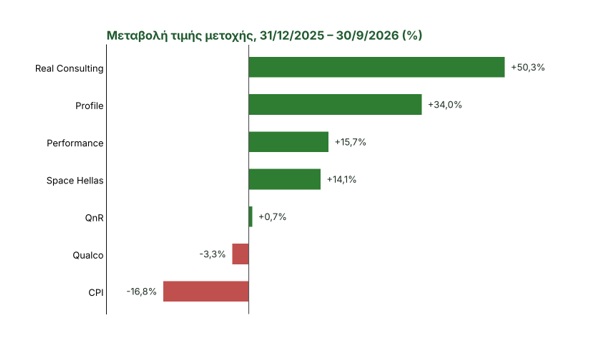
The differentiation we see in the balance sheets is also visible in stock prices. From the end of 2025 to 30/9/2026, returns range from +50.3% (Real Consulting) to −16.8% (CPI). The three companies with positive operating cash flows (Real Consulting, Profile, Performance) are also the three with the highest returns: +50.3%, +34.0% and +15.7% respectively. The exception is Space Hellas, which gains 14.1% despite negative flows, while Qualco (−3.3%) and CPI (−16.8%) are in negative territory.
QnR is moving marginally positive (+0.7%). Returns concern price change and do not include dividends.
| Company | Price 31/12/2025 (€) | Price 30/9/2026 (€) | Change |
|---|
| Real Consulting | 5,80 | 8,72 | +50,3% |
| Prοfile | 8,03 | 10,76 | +34,0% |
| Performance | 8,75 | 10,12 | +15,7% |
| Space Hellas | 7,94 | 9,06 | +14,1% |
| QnR | 1,3035 | 1,312 | +0,7% |
| Qualco | 6,55 | 6,3365 | −3,3% |
| CPI | 0,624 | 0,5189 | −16,8% |
Conclusions and what we are watching in the second half
We believe that the first half of 2026 showed a sector that is growing quickly but with an increasing cost of growth. Three points summarize the picture:
- Revenue growth is not accompanied by corresponding profitability. EBITDA margins decline in four of the seven companies (five, if Performance is measured without the IFRS 2 adjustment): Space Hellas, Qualco, Profile and QnR.
- Cash lags results. In three of the six companies with available data, operating cash flows are negative and in several net debt is increasing.
- Profits are affected by non-operating items, such as fair value gains (Space Hellas) and the IFRS 2 expense (Performance).
In the second half we are watching four things: whether Performance maintains its collections, whether Profile shows margin stabilization after integrating the acquisitions, whether Space Hellas converts receivables into cash without further increasing short-term borrowing, and whether Qualco achieves the sharp EBITDA improvement implied by its target.
For the investor, the practical consequence is selectivity. The sector is no longer valued only on the basis of growth, and we believe that the market will place increasing weight on liquidity, leverage and the conversion of EBITDA into cash.
Companies with net cash and positive operating flows have the advantage, while those that borrow to grow will be judged by whether margins recover. The nine-month results and announcements for fiscal year 2026 will be the next test.
Sources (company documents): Financial statements and company press releases
* Director of Research at Solidus Securities S.A., leads portfolio analysis and asset allocation optimization, developing comprehensive financial models for risk assessment and forecasting market trends. President of EEPAMA - HACSA.
** This article is for informational and educational purposes and does not constitute investment, tax or legal advice. The data are indicative, based on publicly available historical data and do not guarantee future returns. Before making any investment decision, consult a certified investment advisor.