With at least one major asterisk, which concerns the course of energy prices, the draft budget for 2027 is being submitted to Parliament today, which -in a difficult economic environment- aspires to balance between fiscal stability, maintaining the economy’s growth momentum, controlling the intensifying inflationary pressures, but also the faster de-escalation of public debt.
The course of the global economy in uncharted waters inevitably affects the domestic one as well, increasing the degree of uncertainty and consequently the possibility of revising the main figures of the draft until the final text of the budget is submitted to Parliament in the third ten-day period of November.
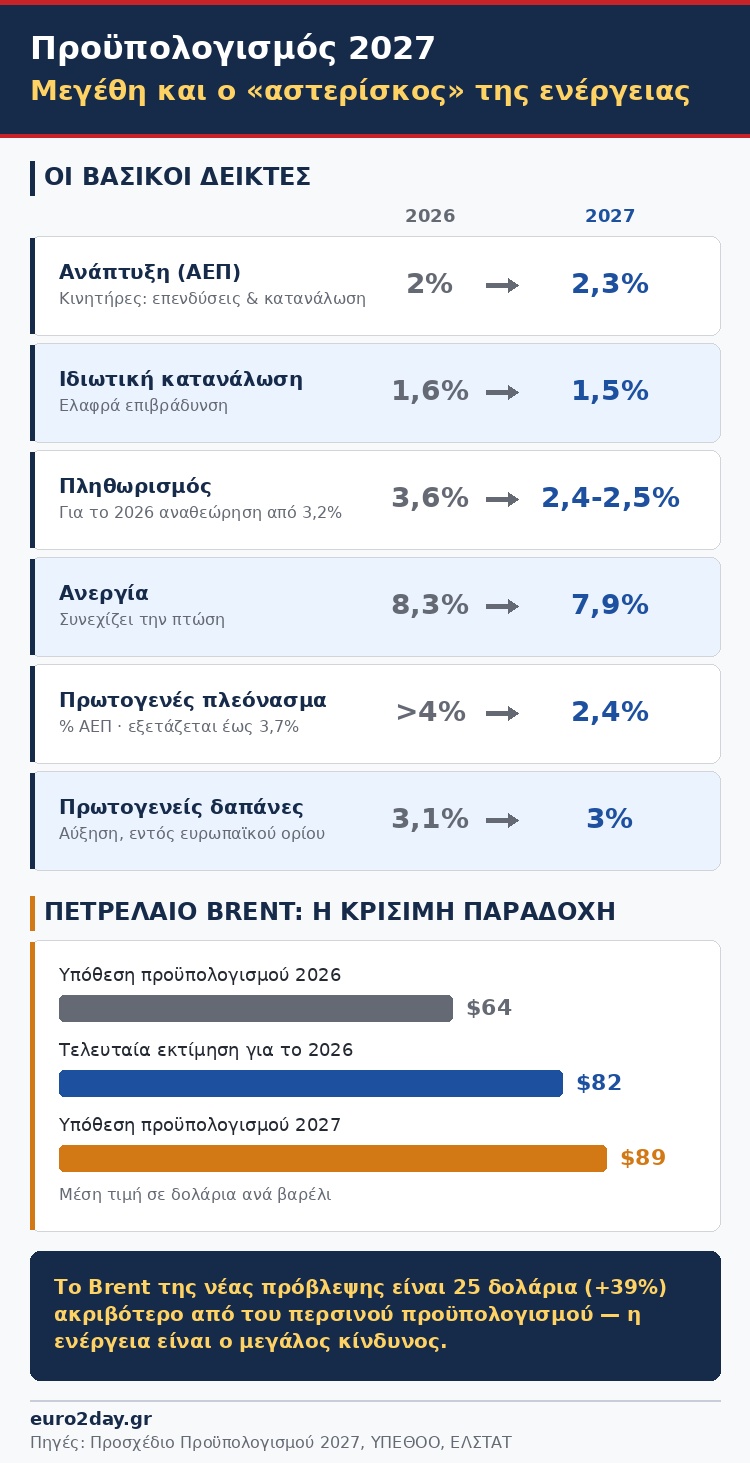
As regards the main figures, the draft budget forecasts an acceleration of growth to 2.3% in 2027, from 2% this year, with the main drivers being investments and private consumption.
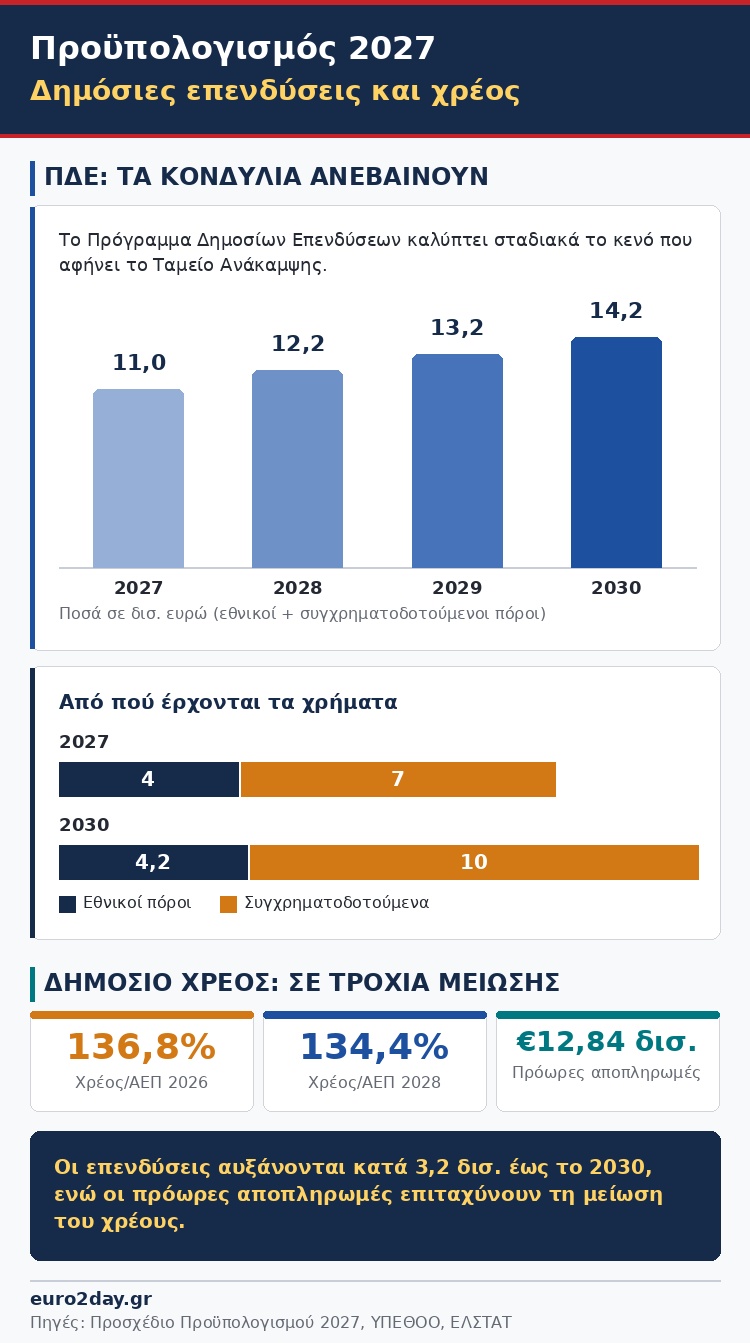
The Public Investment Program undertakes to cover a significant part of the gap gradually left behind by the Recovery Fund, with the plan providing for a gradual increase in available capital.
In 2027, 11 billion euros are expected to be made available to the market, of which 4 billion euros will come from national resources and 7 billion euros from co-financed programs. The amount rises to 12.2 billion euros in 2028, to 13.2 billion euros in 2029 and reaches 14.2 billion euros in 2030.
At the end of the four-year period, national resources are shaped at 4.2 billion euros, while co-financed expenditures reach 10 billion euros.
Private consumption, although expected to slow slightly, will continue to move at high levels, at a rate of 1.5% in 2027 versus 1.6% this year. Exports of goods and services are forecast to increase by 4.2%, with tourism and industry contributing to the improvement of the picture, while imports will also move at high speed.
Inflation the “thorn”
Inflation remains a major source of concern. Despite the income support measures, energy expensiveness, beyond fuel prices, acts additively to an intensifying wave of price increases.
The economic staff proceeds to a new downward revision of the inflation forecast this year, placing the bar at 3.6% from 3.2%, while for 2027 a de-escalation to 2.4%-2.5% is forecast.
Of particular interest is the assumption that the budget is being drafted with a forecast for an average Brent oil price at 89 dollars per barrel, significantly higher than the latest revised estimate of 82 dollars for 2026. Indicatively, last year’s budget had been drawn up with an assumption for an average Brent price of just 64 dollars.
In the labor market, unemployment is estimated to continue its downward course, falling to 7.9% in 2027 from 8.3% this year, according to ELSTAT’s Labor Force Survey.
Primary surplus
At the fiscal level, the budget starts with a primary surplus of 2.4% of GDP in 2027, while at the General Accounting Office a target of up to 3.7% of GDP is being examined, with the main argument being the strong course of tax revenues and especially the increased VAT receipts. Estimates for the current year, moreover, show that the primary surplus will exceed 4% of GDP versus the latest forecast of 3.2% of GDP, creating additional fiscal space.
Primary expenditures are forecast to increase by 3% in 2027, versus 3.1% this year, following the expenditure ceiling provided for by the new European fiscal framework.
Public debt will remain on a path of de-escalation, with the debt-to-GDP ratio falling from 136.8% in 2026 to 134.4% in 2028. Further reduction is also expected to be contributed by the new early repayment moves, which this year amount in total to 12.84 billion euros.
Tax relief
The draft incorporates the package of tax relief and income support measures announced at the TIF, amounting to 1.9 billion euros, the majority of which will be implemented from the new year.
They will be preceded next month, November, by the 400-euro support to all pensioners over 65 years old (regardless of income threshold), and the rent refund to more than 1 million households.
The total cost of the 2 measures exceeds 1 billion euros.
The bill with the new interventions is expected to be put to public consultation in the coming period and will then be submitted to Parliament for voting.
The main interventions provide for:
- The exemption of approximately 156,000 consistent self-employed professionals from the surcharges based on turnover and staff payroll in the calculation of the minimum net income.
- The zeroing of the tax rate up to 20,000 euros for professional farmers and parents with three children.
- The increase of the permanent November support for pensioners, persons with disabilities and uninsured elderly from 300 to 400 euros net, as well as its expansion to all pensioners over 65 from November 2026.
- The establishment of a Christmas holiday allowance of 500 euros gross for public employees from 2027.
- The establishment of a special investment account for infants during the first two years from their birth, into which the state will deposit an amount equal to what the parent contributes each year, up to 1,200 euros annually and until the age of 18.
- The reduction of social security contributions by 0.5 percentage points from April 2027 for the private sector.
- The abolition of the business tax from 2027, for tax year 2026, in the Region and in Thessaloniki, its reduction by 50% in Attica in 2028 and its full abolition in Attica in 2029.
- The reduction of the tax prepayment from 55% to 50% for self-employed professionals from tax year 2027 and the gradual reduction by 5 percentage points annually of the tax prepayment for legal entities from tax year 2028, so that from 80% today it gradually falls to 50%.
- The establishment of accelerated depreciation over 6 years, from 10 years today, for business investments in mechanical equipment.
- The indexation of disability benefits, and,
- the abolition from 2027 of ENFIA for primary residences worth up to 400,000 euros in settlements of up to 2,000 inhabitants and up to 2,200 inhabitants in Western Macedonia.