Three measures due to take effect gradually in 2027 will reshape private-sector pay, bringing smaller or larger increases for hundreds of thousands of private-sector employees.
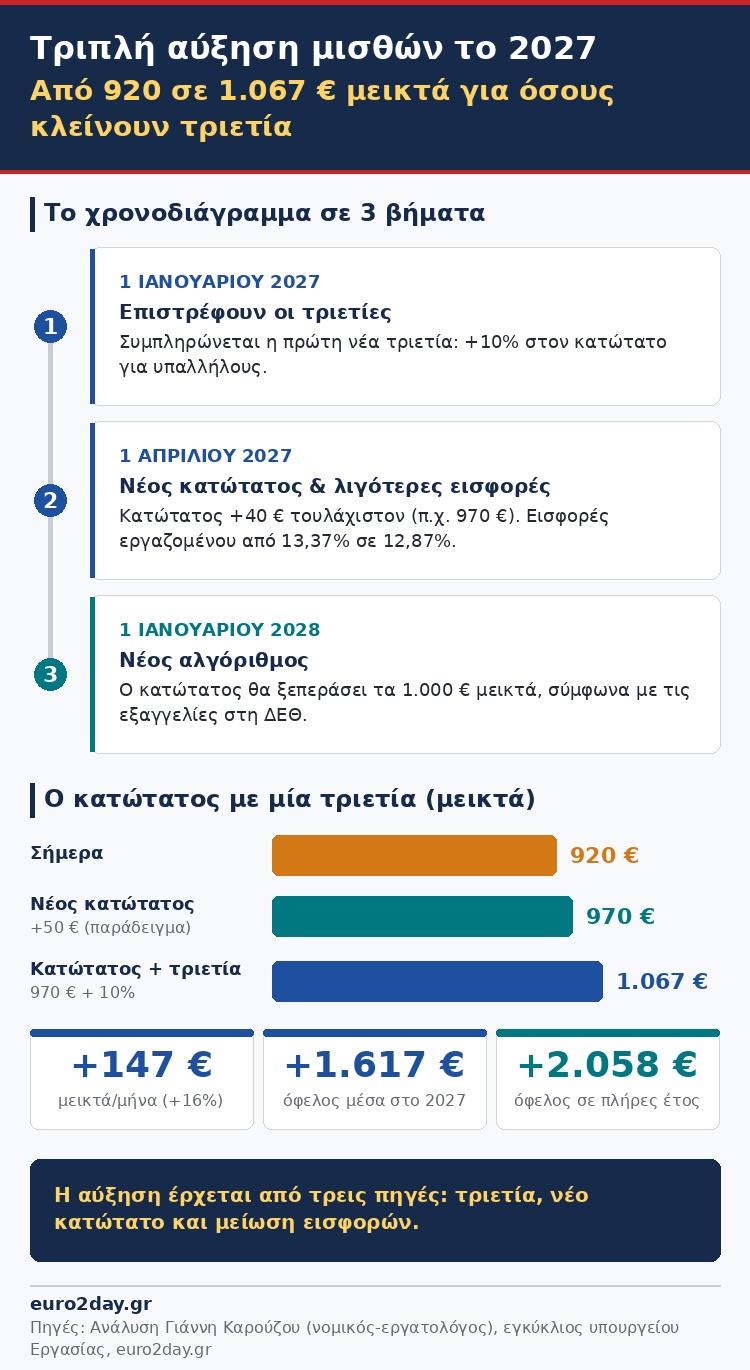
A three-pronged mechanism for raising private-sector pay is expected to be activated, with a particular focus on those earning close to the minimum wage. As a result, an employee currently earning €920 gross will reach €1,067 gross in April, before taking into account the benefit of lower contributions.
First, pay is expected to rise from January as employees complete three years in the job.
Next, on 1 April, the minimum wage will rise by at least €40, while a cut in the social security contributions deducted from employees is also expected to take effect at the same time. Indeed, according to Prime Ministerial announcements made by Kyriakos Mitsotakis at the Thessaloniki International Fair, the minimum wage increase due on 1 January 2028, under a new formula, will take it above €1,000 gross.
The crucial point for the domestic labour market in the period ahead is that the changes will not come all at once, and the same percentage increase in the minimum wage will not translate into the same benefit for everyone.
Length of service, current pay, tax status and social security deductions will ultimately determine how much of the headline increase reaches an employee’s pocket. For those earning just above the minimum wage, the question is—and will remain—whether an increase in the minimum wage will also push their pay higher, with collective bargaining and collective agreements seen as decisive.
Employment lawyer Giannis Karouzos explains the timetable for the changes and gives examples of how much employees will ultimately take home.
The first change comes on 1 January 2027, when the first full three-year period since seniority increments were reinstated is completed. The increments had been “frozen” in February 2012, and the clock for qualifying for new increases began running again on 1 January 2024.
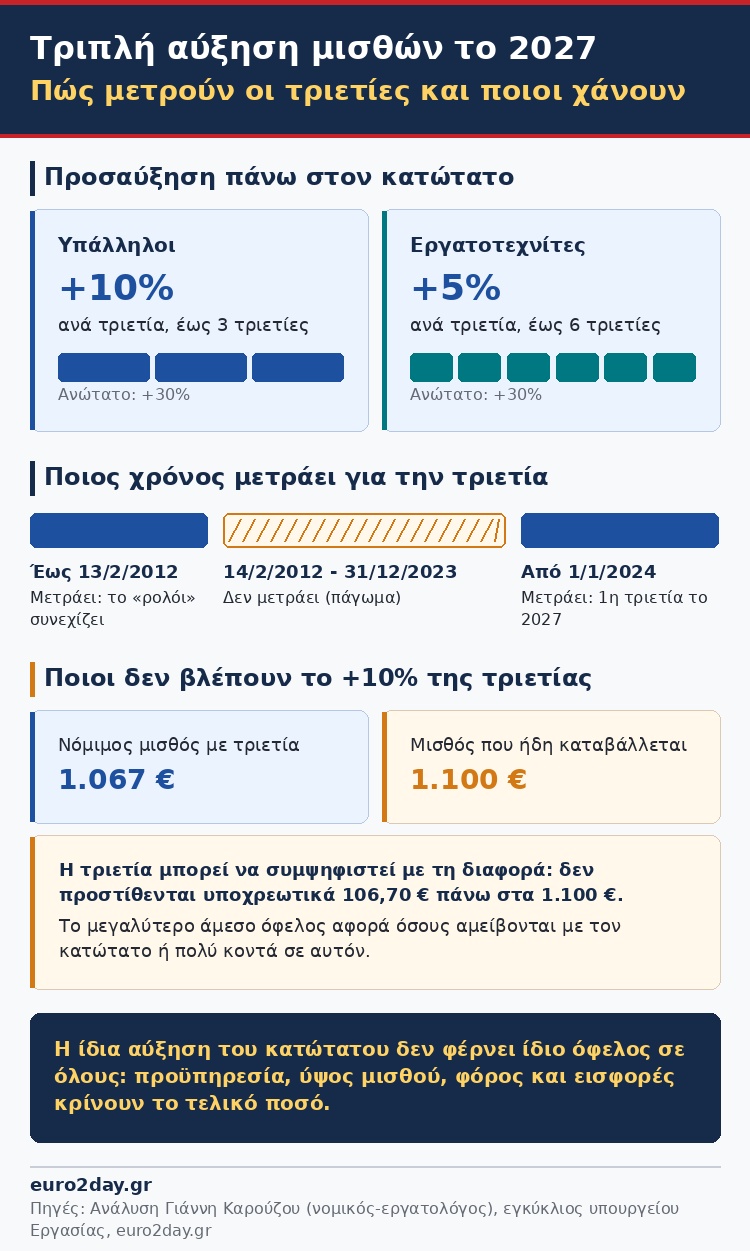
This means that those who began accumulating recognised service from that date can complete their first new three-year period in 2027. For employees paid the statutory minimum wage, the increase is 10% for each three-year period, up to three periods and a total of 30%. For manual workers, the increase is 5% per three-year period, up to six periods and a total of 30%. The crucial detail is that not all employees are treated in the same way. Those with recognised service before 14 February 2012 do not start from zero. The time they had accrued by then remains relevant, and the “clock” picks up where it stopped. By contrast, the period from 14 February 2012 to 31 December 2023 does not count towards qualifying for a new three-year increment.
The next step comes on 1 April, when the minimum wage will rise by at least €40 and the social security contributions borne exclusively by employees will be cut by 0.5 percentage points. For some categories of employees, therefore, the increase in net pay will come from three different sources. Those earning the minimum wage who complete a three-year period will see an increase of €1,617 in 2027 (nine months plus the 13th and 14th salaries) and €2,058 on a full-year basis.
For example, an employee without a three-year increment currently earns the minimum wage of €920 gross. If they complete their first qualifying three-year period by 1 January 2027, they are entitled to a 10% increase. And if, from 1 April, the new minimum wage is set at—say—€970, their new minimum pay will be calculated as follows: €970 + 10% = €1,067 gross. In other words, their pay will rise from €920 to €1,067. The total difference is €147 gross a month, or about 16%.
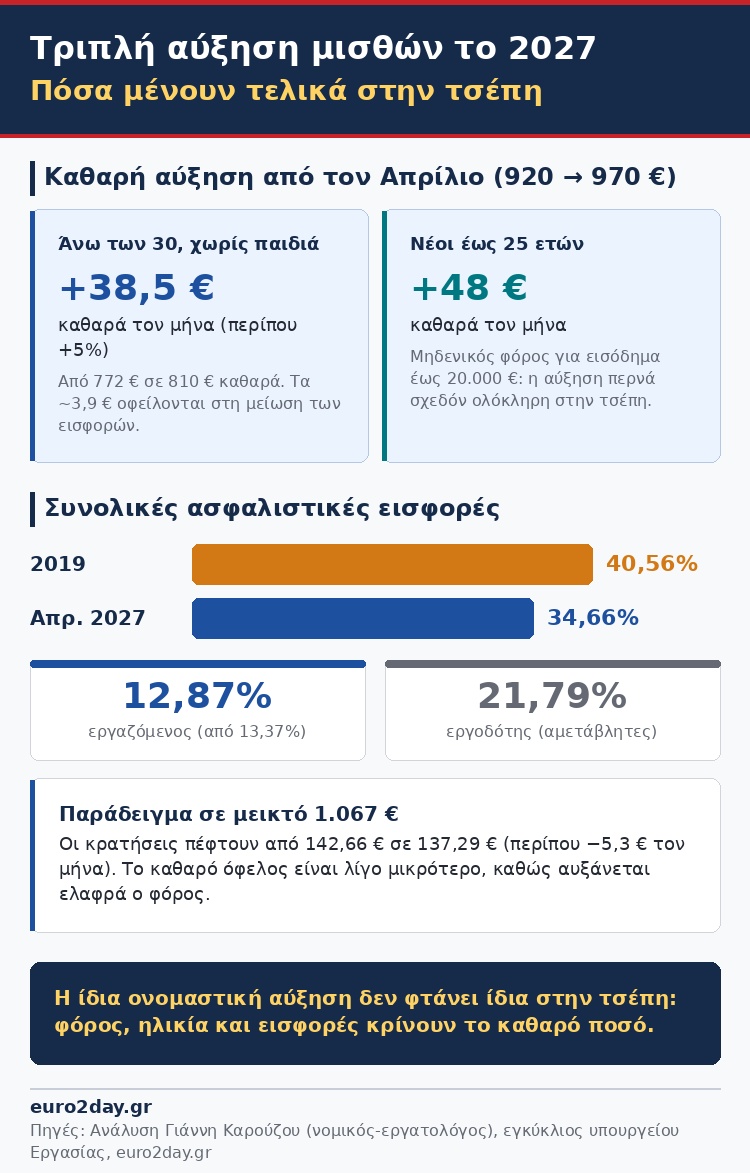
The new cut in employee social security contributions will also apply to this higher amount. Employee contributions will fall from 13.37% to 12.87%, while employer contributions will remain at 21.79%. Total social security contributions will therefore come to 34.66%, down from 40.56% in 2019.
An employee whose pay rises to €1,067 gross as a result of the first three-year increment and the new minimum wage will also have less social security contributions withheld from April. At the current rate of 13.37%, employee contributions on €1,067 amount to about €142.66. At the new rate of 12.87%, they fall to about €137.29. That is a difference of €5.34 a month in social security deductions. The net amount ultimately left in the employee’s pocket will, however, be slightly lower, as the reduction in social security contributions increases their tax liability.
Thus, an employee earning close to the minimum wage, aged over 30 and with no children, who currently earns €920 gross and €772 net after contributions and tax, will receive €970 gross and €810 net from 1 April. The move from €920 to €970, together with the cut in contributions, will therefore add about €38.5 to monthly take-home pay, an increase of about 5%. Most of that will come from the minimum wage increase, while about €3.9 net a month will come from lower social security contributions.
The increase will be even greater for those aged up to 25, as the tax reform provides for a zero tax rate on income of up to €20,000. Their take-home pay will therefore rise by about €48 a month. This is because these employees do not face the same tax “leakage”: almost all of the gross pay increase and the reduction in contributions will go straight into their pockets.
Who will miss out on the three-year increment?
Completing a three-year period does not automatically mean a 10% increase in every employee’s actual pay. As the respected lawyer Giannis Karouzos explains, a circular issued by the Labour Ministry provides that, where an employer is already paying regular wages above the statutory minimum, increases arising from three-year increments may be offset against the difference between the pay received and the statutory rate.
For example, if the new statutory minimum for an employee with one three-year increment is €1,067 but they already earn €1,100, the increment does not necessarily mean an additional €106.70 on top of their €1,100. That is why the immediate impact of the “three-pronged” mechanism will be greatest for those earning at or very close to the prevailing statutory minimums.