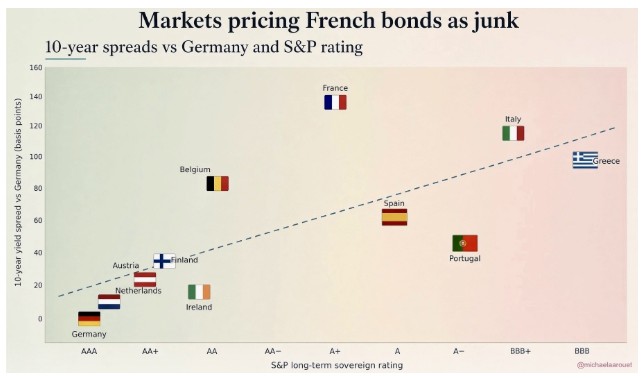
The rating agency S&P rates Greece’s long-term creditworthiness at “BBB,” Italy’s at “BBB”” and France’s at “A+.” More or less the same is done by the other agencies. However, the market has a different view, judging by the yield spread of the 10-year bond of the above countries versus that of Germany. Thus, the French spread stands at 140 basis points, the Italian at 115 basis points and the Greek at 86 basis points.
The rating agencies cannot ignore pricing by the markets, the demonstrations and unrest in the country, the large fiscal deficit of 5.4% of GDP with government spending at 57% of GDP, the large debt at 119% of GDP and the political deadlock.
Sooner or later they will logically have to proceed with a downgrade of France and this cannot leave its banks unaffected. This will have effects on the financing of its economy, GDP and so on, a few months before the presidential elections in April and with an electorate that does not seem to understand the country’s situation.
Some are already talking about debt crisis No. 2 in the eurozone but some are not waiting, liquidating their positions in French bonds. We are referring to the Japanese fund, Sumitomo Mitsui DS Asset Managment, which announced its sale and its reallocation into German bonds and short-term Japanese ones.
This is not accidental. With Japanese bond yields having risen, the investment in 10-year French bonds with currency risk hedging is now smaller compared with the 10-year Japanese bond yielding above 3% for the first time since August 1996.
The same is happening with U.S. bonds according to a Deutsche Bank analyst and partly explains the first wave of sales from Japan and the repatriation of their capital.
Japan is the largest foreign holder of U.S. bonds. Therefore, the U.S. would not want it to liquidate a significant part of them at this juncture. This is why they helped Japan defend the yen in late July–early August because they feared that otherwise the Japanese would sell U.S. bonds to get dollars and support the yen.
Speaking in front of a university, on September 8, U.S. Treasury Secretary Mr. Bessent stated that he was the “house” because he had asymmetric information and challenged traders to bet against him.
Some 2.5 weeks later, the “house” offered to buy back long-term bonds worth $4 billion and saw bids exceed $10 billion. On the same day, the yield on the 30-year U.S. bond rose to the highest level of the last 22 years and the yen weakened against the dollar from the level it was at when Mr. Bessent challenged the market to bet against him.
The weakening of the yen creates pressure on Japan for more sales of U.S. bonds while giving private Japanese investors an incentive to repatriate their money.
For decades, Japan has supplied liquidity to the global economic system through borrowing in the low-interest yen for placements in other currencies. The restriction of liquidity through the closing of yen positions will have victims and it is already showing.