The Hellenic Fiscal Council (HFC) adopts the macroeconomic forecasts on which the 2027 Draft State Budget (DSB 2027) is based, as they fall within a range of acceptable values. Also, after evaluating the fiscal forecasts, it finds compliance with the specific numerical fiscal rules.
Growth and inflation
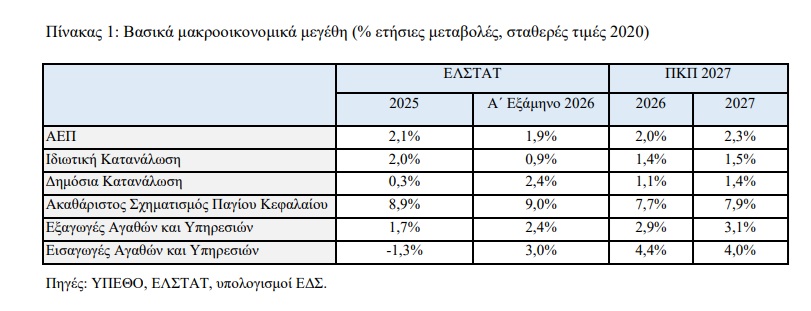
For 2026, the HFC forecasts GDP growth of 1.9%, in alignment with the forecast of the Ministry of National Economy and Finance (2.0%). For 2027, the DSB forecast (2.3%) lies within the HFC’s estimate range (2.0%).
The forecast for an increase in investments by 7.9% in 2027 is higher than the estimates of international organizations, and the transition to the new national and European financing tools is critical, especially after the completion of the Recovery Fund and the recent increase in ECB interest rates. Inflation is forecast at 3.6% in 2026 and 2.4% in 2027. The rise in energy prices entails a risk of persistence of inflationary pressures.
Fiscal figures and debt
The primary surplus is estimated at 3.6% of GDP in 2026, revised upward, and at 3.3% of GDP in 2027. The General Government balance remains in surplus in both years. The seven-month execution data, with a primary surplus of 8.9 billion euros, reinforce the estimate that the 2026 target is achievable.
The debt-to-GDP ratio is expected to decline from 146.1% in 2025 to 136.8% in 2026 and to 128.8% in 2027. However, it remains the highest in the EU, a fact that requires constant fiscal vigilance.
Within the EU economic governance framework
After an increase in net expenditure lower than the limit in 2025, the increase in net primary expenditure is estimated at 8.0% in 2026, against a recommended limit of 3.6%, and at 3.6% in 2027, against a limit of 3.1%.
In cumulative terms, over the period 2024-2027 it reaches 14.9%, against a limit of 13.7%. Thus, the balance of the control account is shaped at 0.3% of GDP in 2026 and at 0.5% in 2027. However, when the flexibility of the national escape clause for defense and energy security is taken into account, the balance of the enhanced control account is reduced almost to zero.
This flexibility covers the increase in defense spending, by about 0.4% of GDP in 2026 and 0.3% in 2027, and the energy measures, costing 0.2% of GDP in 2027. The national fiscal rule is fully observed.
Uncertainty-Risks
Fiscal credibility, debt de-escalation and the improvement of the credit rating constitute a critical advantage for the growth of the economy and the support of vulnerable social groups in an environment of rising interest rates.
On the negative side, the global economy remains in a period of intense uncertainty. Geopolitical tensions, from Ukraine to the Middle East, where the recent escalation led to a new rise in energy prices in September 2026, and the rise in borrowing interest rates internationally, create significant challenges for economic activity, high prices, public finances and national security.
A coordinated European response to the energy issue is critical, as fragmented national interventions entail higher fiscal costs and risks of distortion of the single market.
Finally, any slowdown in structural reforms, especially in view of the pre-election period, could limit the benefits for productivity and damage the credibility of economic policy.