According to the latest report by the World Gold Council (World Gold Council), “global gold-backed ETF 1 added $18 billion in August, marking the second-largest monthly inflow in value terms ever recorded.
The increase in inflows was mainly driven by funds listed in North America and Europe. North America recorded the third-largest monthly inflow ever recorded, while Europe recorded the largest.
Positive flows, combined with the higher gold price, increased global Gold ETF assets under management (AUM) by 16%, to $615 billion. Collective holdings rose by 121 tonnes, to 4,189 tonnes, the highest level ever recorded.
Since the beginning of the year, global Gold ETF inflows reached $29 billion, equivalent to an increase of 160 tonnes in holdings. Asian-listed mutual funds remained the largest contributor to global inflows during the period, followed by Europe.
Flows in North America turned moderately positive, thanks to the strong performance in August, although the region remains the only one with negative net demand since the beginning of the year, as it continues to recover from the March decline”.
Western investors are returning strongly
“Global Gold ETF inflows accelerated sharply in August, likely reflecting three related developments:
- Intervention in the yen and concerns about exchange-rate policy: US intervention to support the yen on July 31 likely extended into early August, fueling concerns about broader policy interventions in foreign exchange markets
- Concerns over fiscal markets and bond markets intensified: The rise in long-term yields and the intervention by the US Treasury Department, on August 19, increased concerns about fiscal sustainability and dominance, while also reviving fears of a possible dollar devaluation.
As gold posted gains and an upward breakout above key technical levels, the momentum of the move likely attracted additional tactical and institutional demand,” it notes.
Meanwhile, Chinese imports of gold are this year at record levels, boosted by the sharp drop in international prices and a stronger yuan. Purchases through August exceeded 1,000 tonnes, surpassing the total recorded for the whole of 2025, according to the latest customs data.
On the other hand, global debt (public and private) rose to the historic record of $365.5 trillion in the first half of the year, according to the official “Global Debt Monitor” report by the Institute of International Finance (IIF), up by $10 trillion compared with the first quarter and reaching 310% of global GDP, versus 305% in the first quarter.
It is noted for clarification that the IIF (Institute of International Finance) is the global association of the financial sector and works closely with international organizations, but it is an independent body and not a special department of the IMF.
The breakdown of global debt by sector was as follows:
- Public / government debt: $110.5 trillion, with 1/3 of this relating to US debt.
- Non-financial corporate debt: $105.1 trillion.
- Financial sector debt: $84.3 trillion.
- Household debt: $65.7 trillion.
“High debt levels, high interest rates, increased bond yields and higher borrowing costs constitute the new normal, which is not expected to change over at least the next two years,” S&P pointed out, warning of a much more difficult 2027.
The picture in Greece
Turning to the domestic front, the retreat in the price of gold from its consecutive historic highs of the first quarter of 2026, the fear of a new increase in interest rates by central banks, but also the continuing high spread maintained by the Bank of Greece and Piraeus Bank between the purchase and sale of the gold sovereign, combined with the rise of the dollar as well as yields in the government bond market, made “lovers” of the yellow metal particularly hesitant.
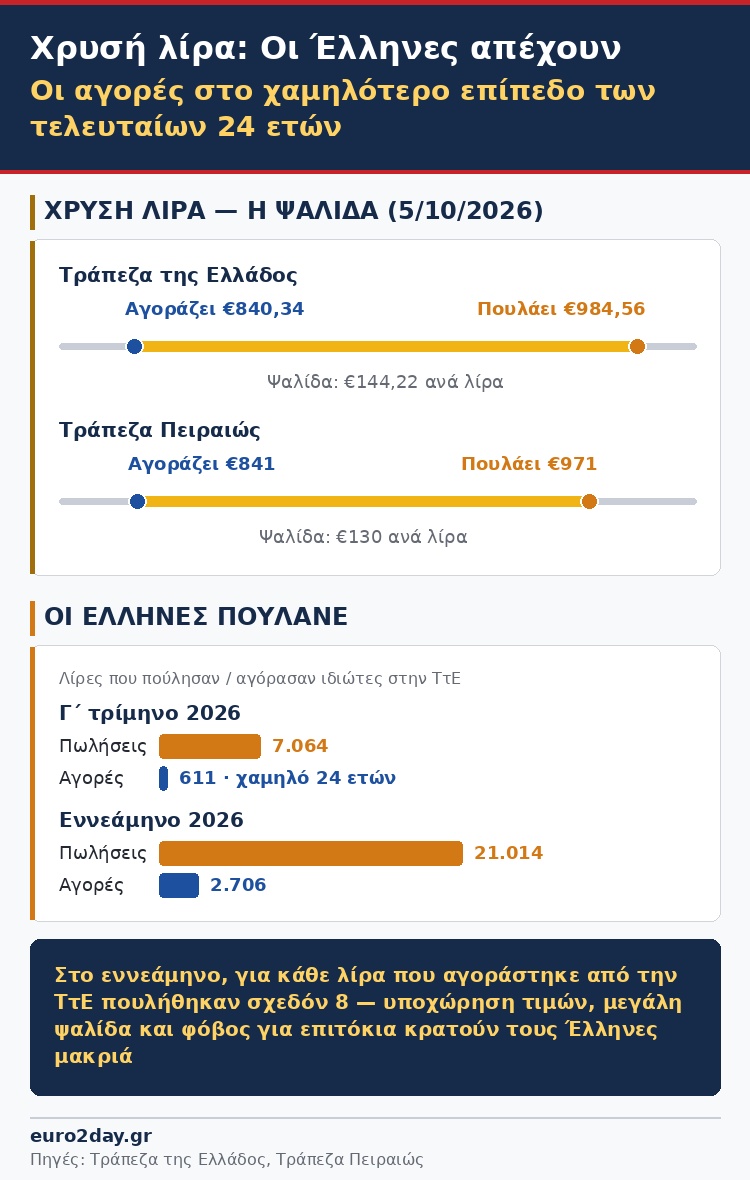
It should be noted that according to the daily bulletin of 5/10/2026, the Central Bank was buying the gold sovereign at 840.34 euros and selling it at 984.56 euros, while Piraeus Bank was buying at 841 euros and selling at 971 euros.
The end of the third quarter of 2026 found Greek investors having bought just 611 pieces, which is a new negative 24-year record (since 2002, when official data from the BoG exist), while they sold 7,064 gold sovereigns.
In the total of the first nine months, purchases from the BoG reached 2,706 gold sovereigns and sales to the BoG 21,014 gold sovereigns.