In an environment of increased uncertainty, Piraeus' investment strategy for the 4th quarter favors selective placements. The resilience of the global economy and strong corporate profitability coexist with persistent inflationary pressures, geopolitical tension in the Persian Gulf, and more expensive money.
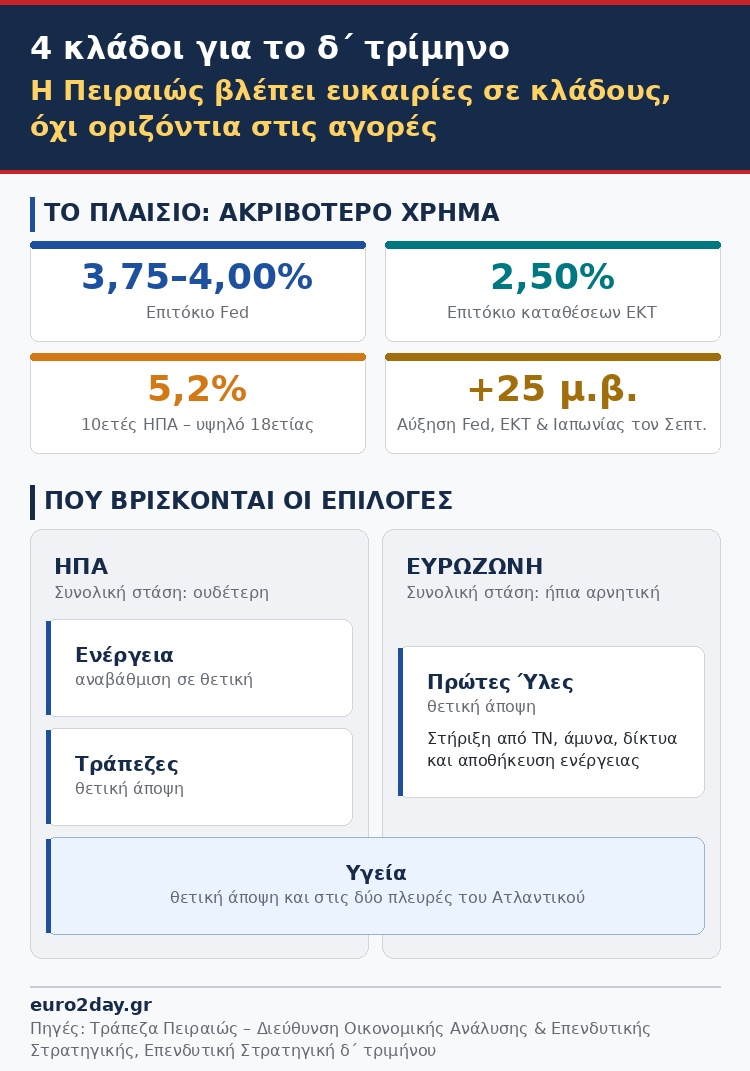
In September, the Fed, the ECB and the Bank of Japan all raised their interest rates by 25 bps. The Fed's rate is now at 3.75%–4.00% and the ECB's deposit rate at 2.50%, while the yield on the US 10-year is at 5.2%, an 18-year high.
The main message of the analysis by the Directorate of Economic Analysis and Investment Strategy, headed by Chief Economist Elias Lekkos, is that the opportunity does not lie horizontally across the markets, but in specific sectors. The overall stance for US equities remains neutral and for Eurozone equities mildly negative. Within these markets, however, four sectors receive a positive assessment.
1. Energy in the US
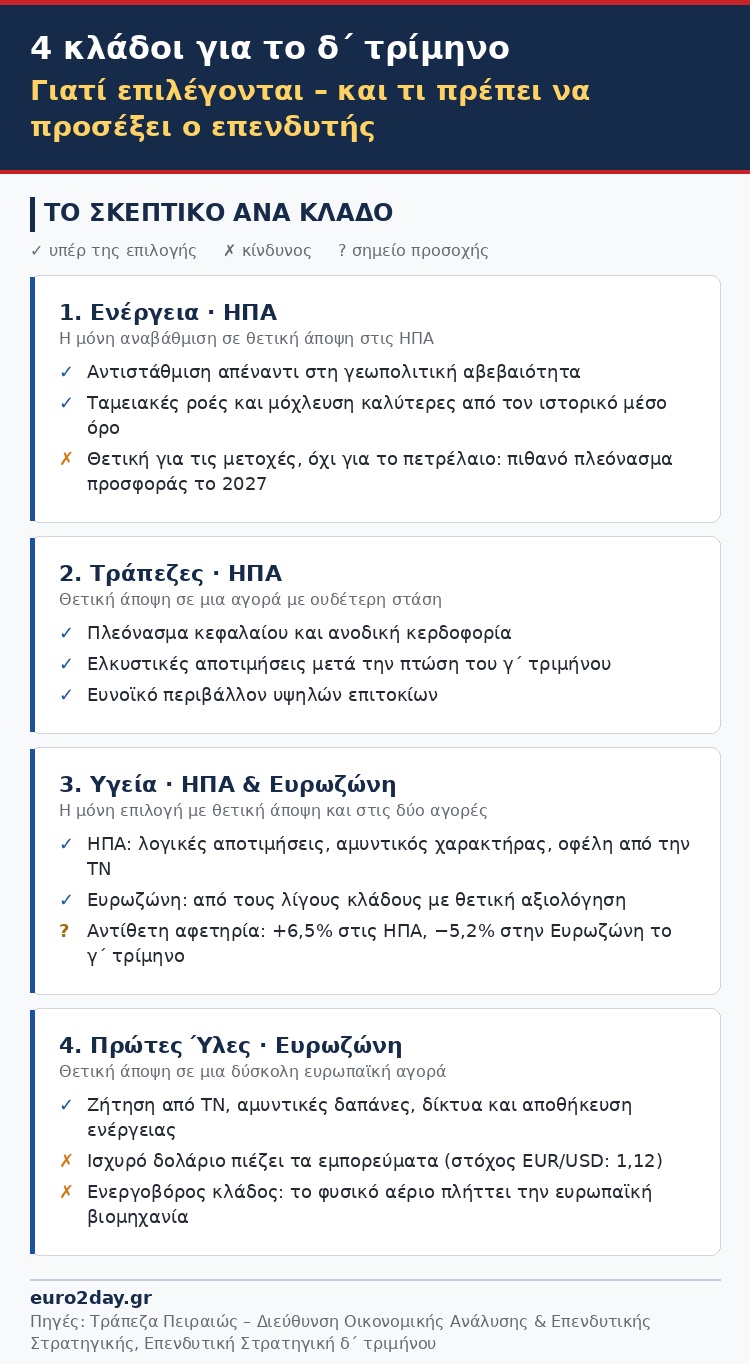
Energy is the only upgrade to a positive view in the US for the last quarter of the year. Piraeus sees the sector as an attractive hedge against geopolitical uncertainty, with fundamentals, cash flows and leverage better than the historical average.
The choice is directly linked to the main macroeconomic risk of the period. The course of energy prices will largely determine both inflation and the extent of monetary tightening. A new escalation in the Middle East would increase the risk of stagflation and would lead to interest rates much higher than those currently priced in by the markets. In such a scenario, exposure to the sector partly offsets the losses of the rest of the portfolio.
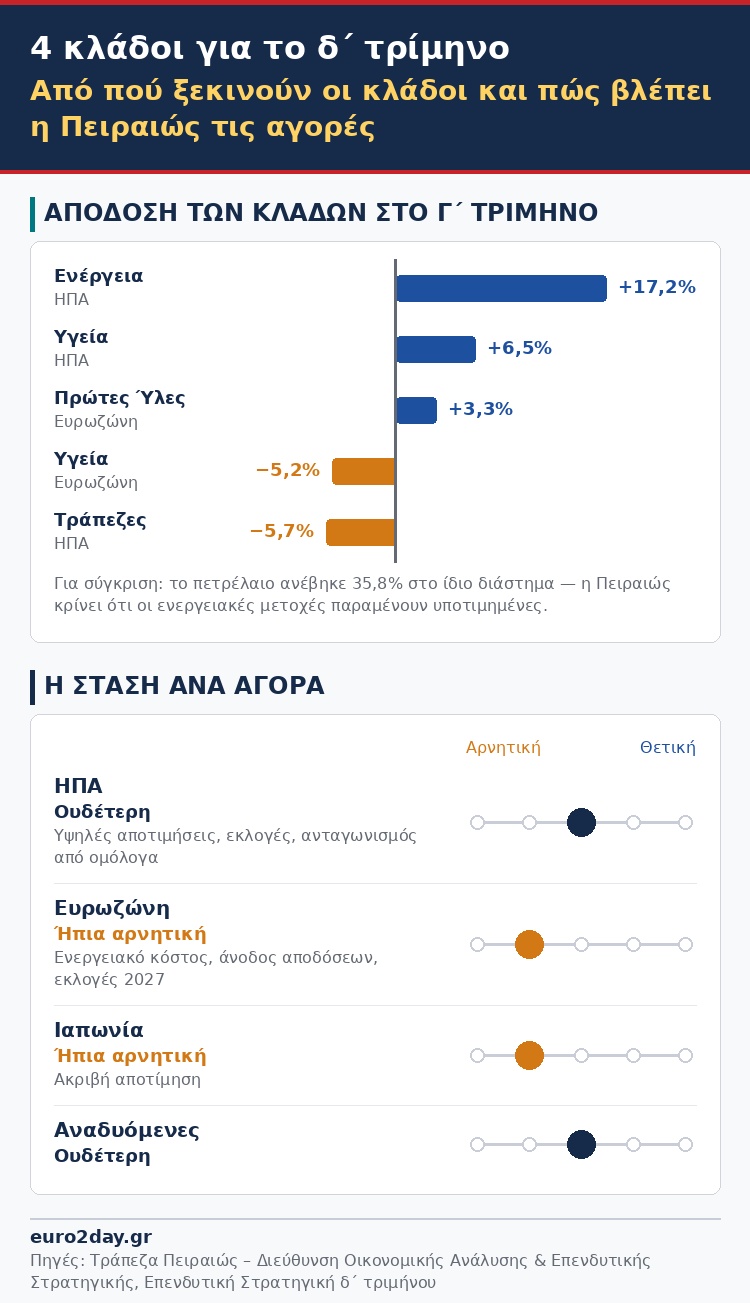
The sector has already moved strongly: it gained 17.2% in the third quarter, with oil rising 35.8%. The report argues, however, that energy stocks remain undervalued relative to the rise in the price of oil.
A distinction is nevertheless needed. The positive view concerns the sector's stocks, not the price of oil itself, for which Piraeus remains neutral. It even notes that an overweight position in oil would lose out if a ceasefire confirmed the scenario of a supply surplus in 2027, estimated by the International Energy Agency and the US EIA. Energy is therefore proposed as a risk hedge within a portfolio, not as a bet on a further rise in crude.
2. Banks in the US
Piraeus maintains a positive view on US banks. It bases it on excess capital, rising profitability, attractive valuations and the favorable environment of high interest rates. The valuation argument is reinforced by recent performance: the sector fell 5.7% in the third quarter.
The choice is of particular importance, as the overall stance on US equities is neutral. Valuations remain high, the midterm elections are approaching and bond yields are now competing with the expected returns of equities. Instead of broad exposure, the strategy prefers sectors with stronger fundamentals and greater resilience to the increased cost of money.
On the other hand, small-cap companies and Utilities are downgraded from mildly positive to neutral view. The reason is their sensitivity to financing costs and refinancing needs.
3. Healthcare in the US and the Eurozone
Healthcare is the only one of the four choices that is rated positively in both the US and the Eurozone.
In the US, the positive position is based on reasonable valuations, the defensive characteristics of the sector and the benefits it can derive from artificial intelligence. The sector gained 6.5% in the third quarter.
In the Eurozone, Healthcare remains one of the few sectors with a positive assessment, despite the mildly negative overall stance on European equities. Here the quarterly picture was the opposite: the sector declined 5.2%, among the market's worst performances. The same choice therefore starts from very different points on the two sides of the Atlantic.
4. Raw Materials in the Eurozone
The fourth choice is Raw Materials in the Eurozone, where Piraeus maintains a positive view. It sees structural demand from artificial intelligence, defense spending and investments in grids and energy storage, also supported by high commodity prices. The sector gained 3.3% in the third quarter.
The choice becomes interesting because the overall picture of the European market remains difficult. High energy costs, rising bond yields and political risk, with elections in 2027 in France, Italy, Spain and Greece, are putting pressure on valuations. Raw Materials are estimated to be able to benefit from the new cycle of investments in AI, defense and energy infrastructure.
Two points from the report itself act as a counterweight. First, Piraeus estimates that as long as the strengthening of the dollar continues, commodity prices will remain under pressure, with a year-end target for EUR/USD of 1.12. Second, natural gas disproportionately hurts European industry, and part of the Raw Materials sector is particularly energy-intensive.
It is also worth noting one more move in the Eurozone. Technology is upgraded from neutral to mildly positive, thanks to steady demand for IT services and the pivotal positions of European companies in the semiconductor chain. By contrast, Real Estate, Utilities and Communication Services are downgraded from mildly positive to neutral.
The geography of the choices
The picture that emerges is quite clear:
- US: Energy and Banks
- US and Eurozone: Healthcare
- Eurozone: Raw Materials
At the market level, the strategy maintains a neutral stance on US equities and a mildly negative one on Eurozone equities. For Japan, the view remains mildly negative, due to expensive valuation, while for emerging markets it is neutral.
The report identifies two forces that could overturn the markets' positive narrative. The first is a crack in estimates for the productivity of AI infrastructure, which would moderate the investment wave and the momentum of the US economy. The second is a new rise in energy prices due to the Persian Gulf, which would raise interest rates and put pressure on profitability and valuations.