For the ECB, the digital euro will be the eurozone’s biggest step towards independence from foreign payment systems. But for Europe’s commercial banks, it poses a threat: for the first time, some deposits will be held not in their own accounts, but in accounts at the central bank.
Banks have resisted the creation of a digital euro for years. This undeclared war between the ECB and the eurozone’s commercial banks entered a new phase a few days ago. The ECB presented the results of a special stress test conducted at the request of the European Parliament to assess how the introduction of the digital euro would affect banks’ deposit bases and, more broadly, their liquidity.
The ECB’s stress test
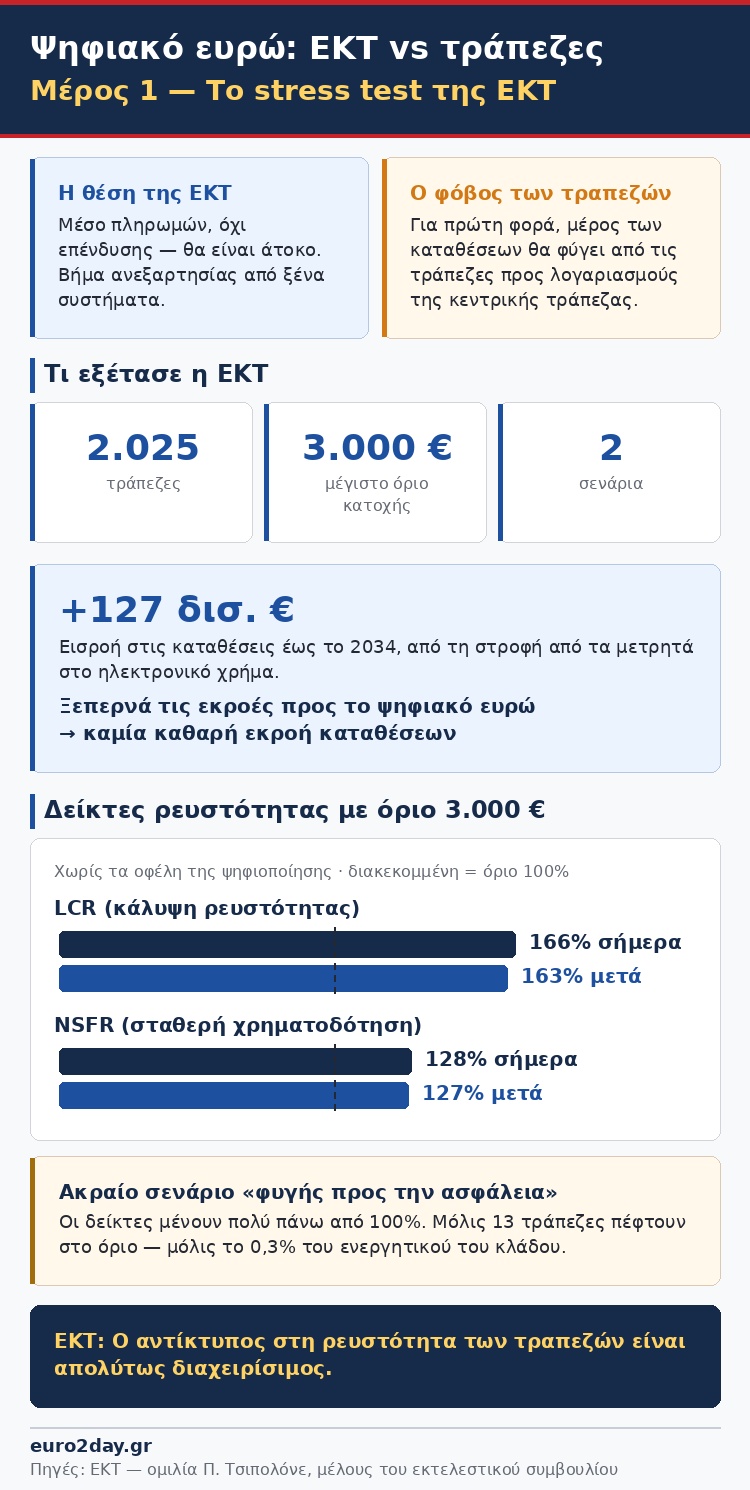
In contrast to the findings of a study presented in 2023 by the European Banking Federation (EBF), the ECB’s test found that the digital euro would have little effect on commercial banks’ liquidity. Its results were presented on Tuesday in a speech by Piero Cipollone, a member of the ECB’s Executive Board. As the senior ECB official reiterated, the digital euro will be a means of payment, not an investment: its key difference from bank deposits is that it will be non-interest-bearing.
The ECB ran a simulation to assess the potential effects of hypothetical holding limits for digital euros, ranging from €500 to €3,000, on the balance sheets of 2,025 banks. According to the results presented by Cipollone, the impact is considered entirely manageable, both under “business-as-usual conditions” and in an extreme “flight-to-safety” scenario.
Specifically, the ECB’s analysis found the following:
- Under business-as-usual conditions, the introduction of the digital euro is expected to have an extremely limited impact on banks’ liquidity and funding ratios.
- The shift from cash to electronic money (digitalisation) itself supports bank deposits, potentially bringing an inflow of €127 billion by 2034.
- This inflow, equivalent to 1.5% of retail sight deposits, exceeds the estimated outflows into digital euros for holding limits of up to €3,000, so no overall outflow of deposits from the system is expected.
- Excluding the positive effects of digitalisation, introducing the digital euro with a holding limit of €3,000 per depositor would edge down the aggregate Liquidity Coverage Ratio (LCR) from 166% to 163%, and the Net Stable Funding Ratio (NSFR) from 128% to 127%.
- Even in the extreme crisis scenario, aggregate regulatory liquidity ratios remain well above the 100% safety threshold.
- With a holding limit of €3,000, the liquidity coverage ratio would fall to 100% for just 13 banks, which account for 0.3% of the banking sector’s total assets.
What banks fear
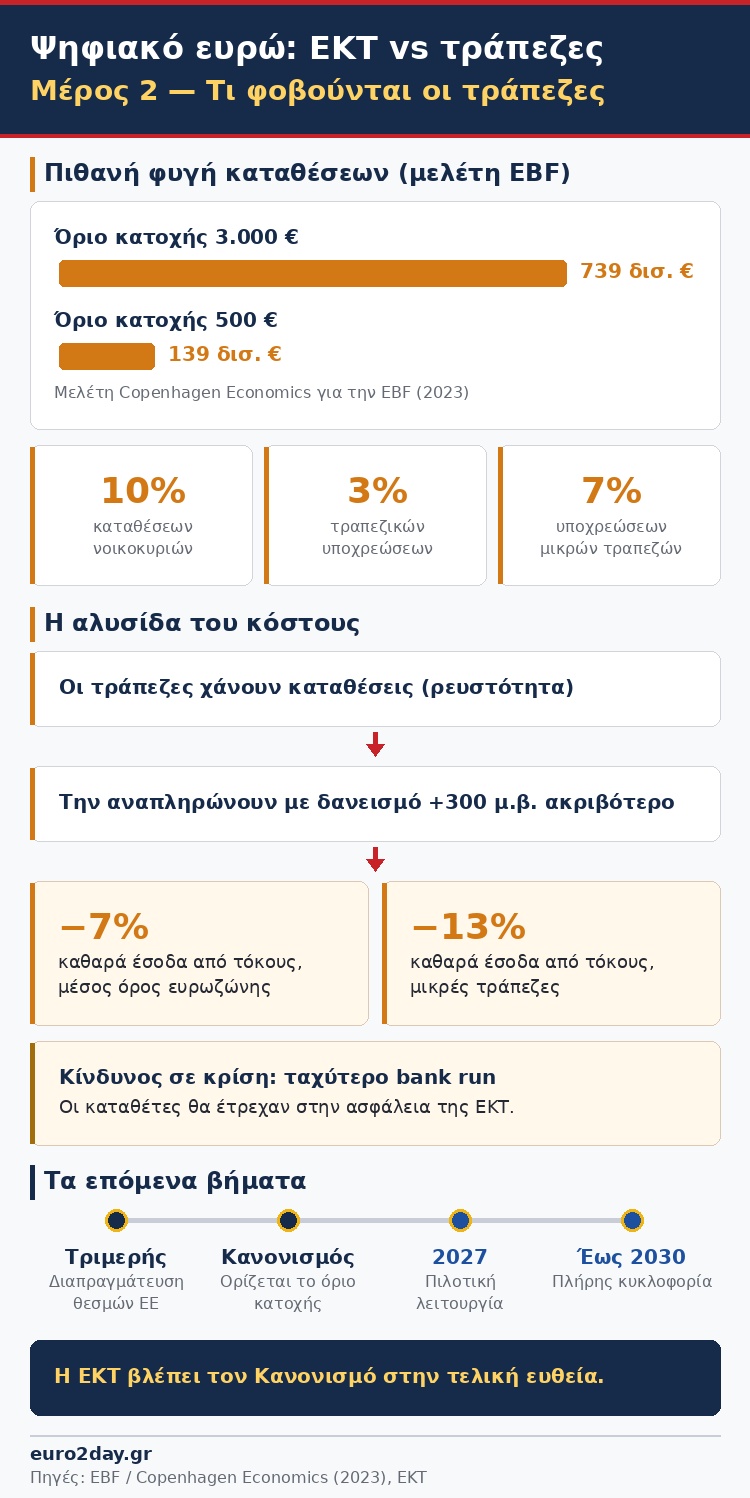
By contrast, Europe’s banking system sees risks in the introduction of the new digital currency. A study by Copenhagen Economics, published by the European Banking Federation (EBF) in 2023, warned that the digital euro could trigger a large outflow of deposits and seriously undermine banks’ ability to finance the economy and support critical goals such as the green transition.
The EBF study found:
- If the holding limit were set at €3,000, the eurozone banking system could face a huge deposit outflow of up to €739 billion.
- This amount is equivalent to 10% of the total household deposit base and 3% of total bank liabilities.
- Even with a more conservative holding limit of around €500, deposit losses could reach €139 billion, an 81% reduction compared with a €3,000 limit.
- The impact would be much greater for smaller banks, where outflows could reach 7% of total liabilities, more than twice the average.
- In periods of extreme stress on the financial system, the digital euro could accelerate and exacerbate bank runs as customers opt for the absolute safety of deposits at the central bank over deposits at a commercial bank.
- Banks’ need to replace lost liquidity with funding from alternative sources would increase their funding costs. Full use of the digital euro could force banks to replace lost liquidity with borrowing that is 300 basis points more expensive, reducing net interest income by an average of 7% across the eurozone (and by 13% for small banks).
With the ECB’s presentation of the special stress test findings, the central bank has addressed the most serious concern raised by MEPs. The ECB is now optimistic that trilogue negotiations among the EU institutions—the Council of the EU, the European Commission and the European Parliament—will move on to the final stage of negotiations on the digital euro regulation, where key “details” such as the holding limit for digital euros will also have to be set.
The aim is to launch a pilot of the new means of payment in 2027 and have it in full circulation across the eurozone before the end of the decade.