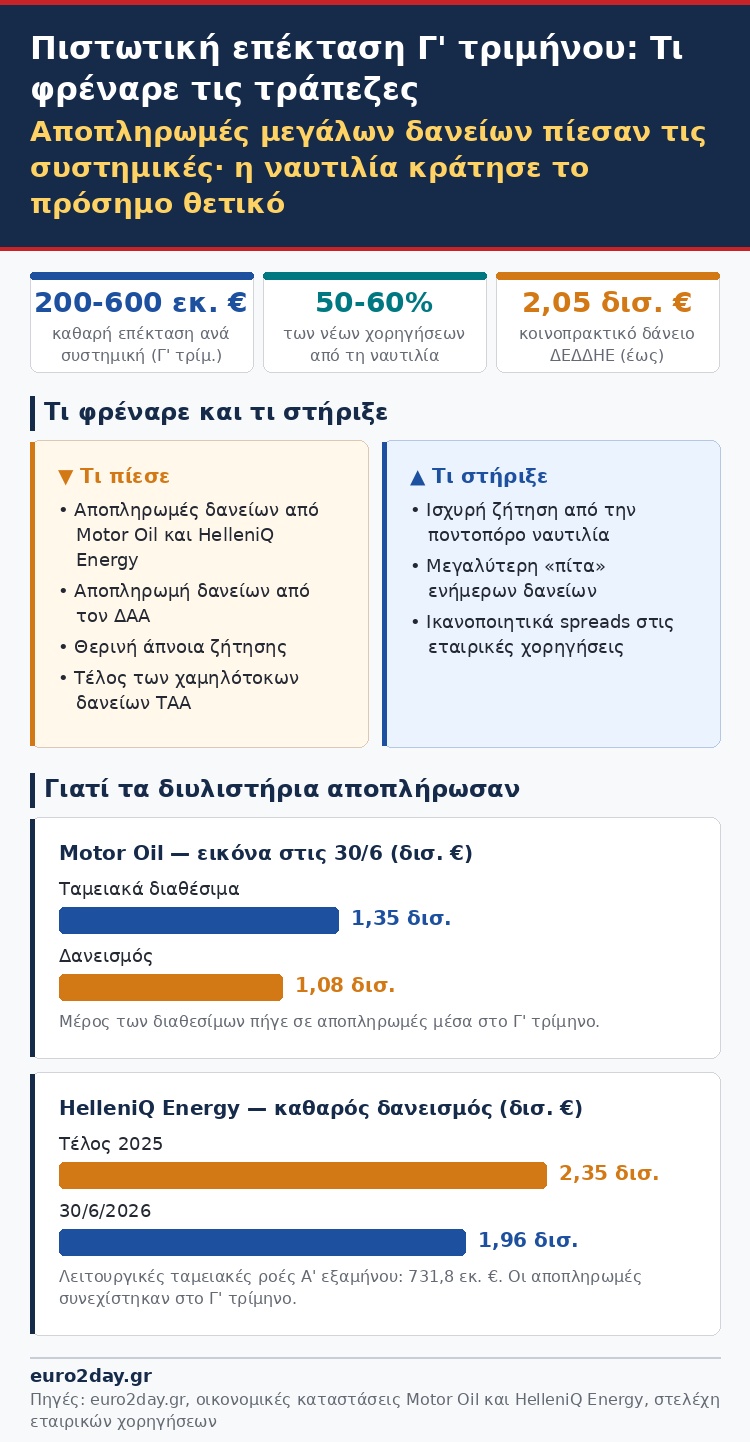
Credit expansion at the systemic banks moved at different speeds during the third quarter of the year, as the temporary absence of general demand, due to summer and the completion of the low-interest loan leg of the Recovery Fund (RRF), with the exception of shipping companies, intensified the impact of individual factors, such as large loan repayments by refineries and AIA and participation in large issuances.
The impressive widening of refining margins and the surge in profitability and cash flows at refineries, due to supply problems, led Motor Oil and HelleniQ Energy to loan repayments during the third quarter, which put pressure on the systemic banks almost across the board.
Motor Oil, at company level, had borrowings of 1.08 billion euros on 30/6, lease liabilities of 32.8 million euros and cash reserves of around 1.35 billion euros, part of which it used in the third quarter for loan repayments.
HelleniQ Energy posted, in the first half, net cash flows from operating activities of 731.8 million euros, proceeding with loan repayments, resulting in net debt falling to 1.96 billion euros from 2.35 billion euros at the end of 2025.
The repayments continued in the third quarter as well. Athens International Airport (AIA) also proceeded with loan repayments within the third quarter, a development that also put pressure, across the board, on the systemic banks.
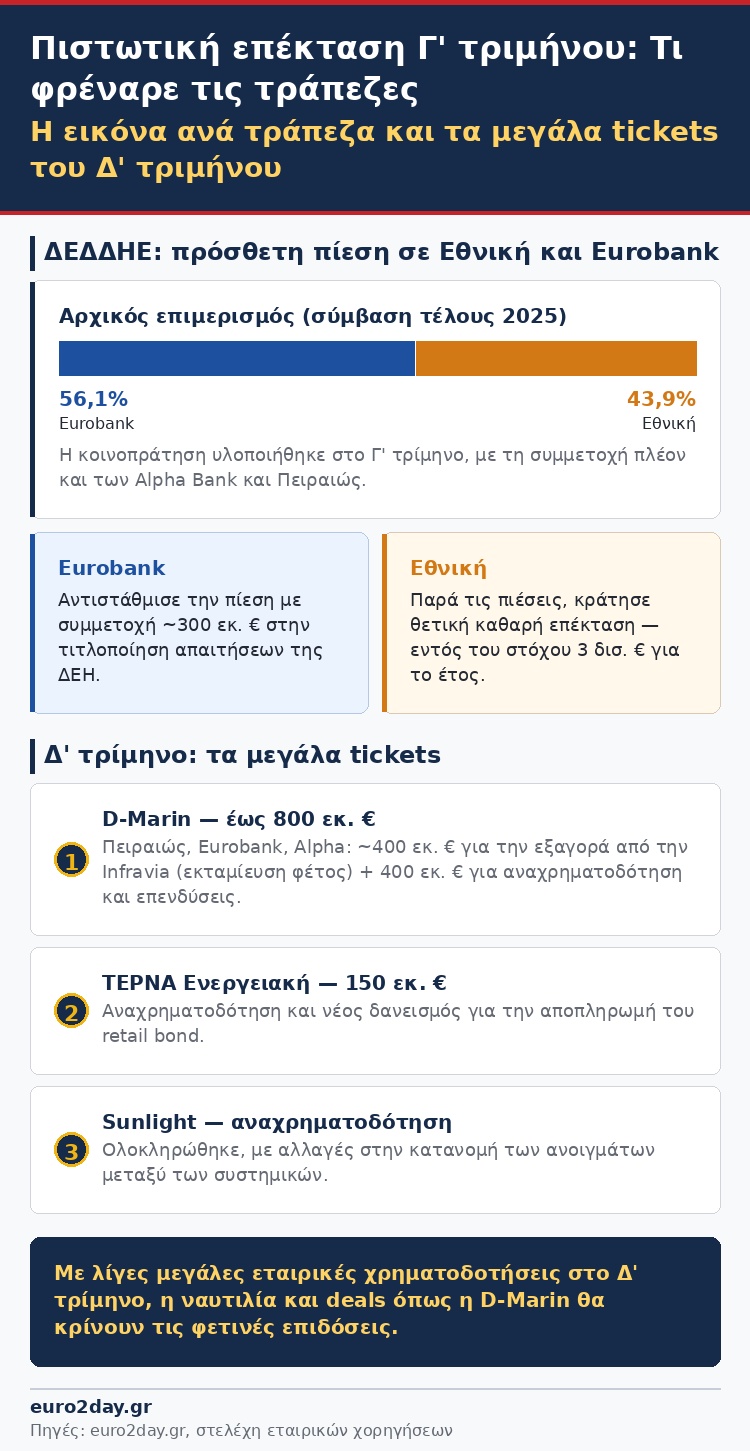
National and Eurobank came under additional pressure from the implementation of the planned syndication of a loan of up to 2.05 billion euros to HEDNO. The two banks had signed the loan agreement with HEDNO at the end of 2025, undertaking 56.1% (Eurobank) and 43.9% (NBG) of the potential exposure, but during the third quarter the syndicate was expanded, with the participation of Alpha Bank and Piraeus.
Eurobank offset the pressure from refinery repayments and the HEDNO loan syndication with the securitization of PPC receivables, in which it participates, according to information, with exposure of around 300 million euros. National, despite the above difficulties, managed to maintain net credit expansion, remaining within the annual target (ed. note: 3 billion euros).
50% to 60% of corporate lending from Shipping
Overall, in Greece the third-quarter performance of the systemic banks ranged between 200 and 600 million euros, thanks to strong loan demand from deep-sea shipping companies. 50% to 60% of the period’s financings came from Shipping, according to corporate lending executives, a development that contributed both to the growth of the performing loan pie and to the maintenance of a satisfactory corporate lending spread.
The big tickets of the fourth quarter
In the current fourth quarter of the year there are very few corporate financings that are expected to play a role in shaping this year’s performance. The most important of these concerns the financing of the acquisition price of D-Marin by the French private equity company Infravia Capital Partners.
Piraeus, Eurobank and Alpha will finance part of the acquisition price (ed. note: approximately 400 million euros), an amount expected to be disbursed this year upon completion of the transaction, while another 400 million euros will be provided by the syndicate for refinancing D-Marin’s debt and investments.
Also of interest is the combination of refinancing and obtaining new borrowing by TERNA Energy for the repayment of the retail bond, with a nominal value of 150 million euros. Finally, recently, the process of refinancing Sunlight's debt was completed, with changes in the allocation of exposures among the systemic banks.