The initial impression from the half-year results is positive. All six companies we examined (Ilyda, Quest, Dotsoft, Softweb, Vidavo and Logismos) increased sales, and none reported a loss. But a closer look at profits, cash flows and balance sheets reveals wide differences between them.
Which companies are we comparing?
The companies in the sample are not directly comparable. Quest has a market capitalisation of about €814m, several times that of the others, which range from €10m to around €110m. It is also a group with activities beyond IT, including product trading, courier services and energy. We include it as a benchmark, not as a like-for-like comparison with the smaller software companies.
We have left OTE out. It is generally classified in the technology sector, but with a market capitalisation of about €7.6bn, its figures are not comparable with those above, so we will examine it separately. We also note that Dotsoft and Logismos publish company-only financial statements, while Quest and Softweb publish consolidated ones.
Sales and profits
Softweb increased sales by 57% and Dotsoft by 39%, while Ilyda was up 16%, Quest 10% and Logismos 3%. At Vidavo, sales rose to €2.05m from €0.12m a year earlier, a jump that says little because the base was close to zero.
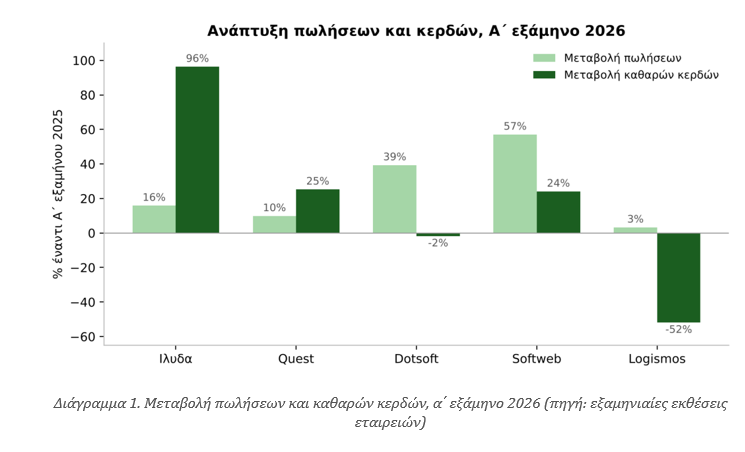
Profits, however, did not rise across the board. Dotsoft’s remained at €2.41m, down 1.8%, despite a 39% increase in sales. Logismos’s fell 52% to €0.15m. Quest increased net profit by 25% to €28m, with its IT services division standing out: sales of €159m, up 21%, and pre-tax profit of €12.6m, up 33%. Its order backlog exceeds €650m, with about half the division’s revenue coming from abroad.
Ilyda reported a 96% increase in net profit to €3.13m. Much of this was due to the comparison base: the first half of 2025 was affected by a non-cash expense of €0.79m from share options. Excluding this, profit growth was about 31%, which is still very strong.
Softweb requires a different reading. Its sales growth was mainly due to its January acquisition of 51% of Alphabit, for €1.22m, funded through a capital increase. Goodwill rose to €1.69m, while the group’s equity stands at €3.87m. Profit attributable to shareholders of the parent fell to €88,000 from €108,000.
Profit margins
Ilyda operates like a pure software company, with an EBITDA margin of 72% and a net margin of almost 60%. Logismos, Dotsoft and Vidavo have EBITDA margins of 27% to 32%, Softweb 14% and Quest 7%, as would be expected for a group with a large trading business.
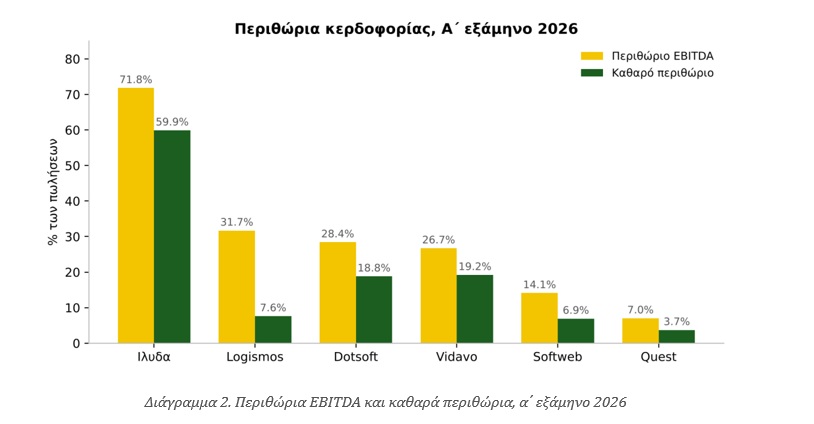
At Dotsoft, the EBITDA margin fell from 39% to 28%. Its gross margin dropped from 50% to 41%, as fees for third parties and subcontractors almost doubled, to €3.9m from €2.0m. Management attributes the difference to financial costs and tax.
Cash
If we had to choose one measure to distinguish between the companies, it would be operating cash flow relative to net profit. Ilyda converted its profit into cash 1.10 times over, and Vidavo 1.89 times. Quest is lower, at 0.24, which the company attributes to the seasonality of working capital. Softweb stands at 0.47.
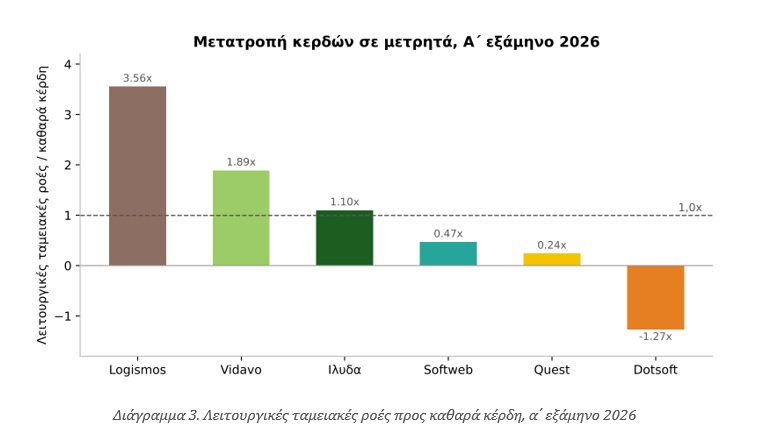
Dotsoft is the case that warrants caution. With profits of €2.4m, it had negative operating cash flow of €3.1m. Receivables and contract assets reached €24.6m, roughly equivalent to a full year’s sales, and 86% of sales come from the public sector. Cash fell to €1.58m from €3.91m and debt increased. If the receivables are collected soon, the picture may prove transitional. If collection is delayed, sales growth will count for less.
At the other end of the scale, Logismos shows a ratio of 3.56 times, mainly because depreciation is high relative to its modest profits. The company capitalised a further €311,000 in development costs, about 51% of its EBITDA, and has an impairment provision of €2.28m against gross receivables of €2.92m, unchanged over the half-year.
Balance sheets
Five of the six companies have net cash. Vidavo and Ilyda have net cash equivalent to 60% and 47% of their equity, respectively. Quest has a lower proportion, at 9%, but this amounts to €31.3m, after a dividend of €42.3m and the acquisition of a 12.56% stake in Fourlis, which cost about €28m. Dotsoft is the only company with net debt, at about €3.3m; at the end of 2025, it had a small net cash position.
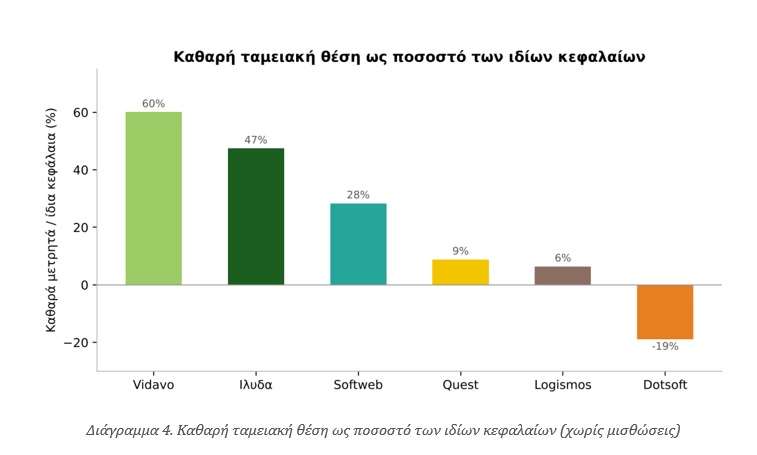
Ilyda has €8.5m in cash, after paying a dividend of €1.21m. But the plan it announced in July with ACT and GVSOFT to develop an automotive software platform envisages an investment of about €4m, almost half that cash balance. Another point we are monitoring is the company’s reliance on public-sector bodies: legal entities governed by public law account for 42% of service revenue.
What the market is paying
According to international data, Quest trades at 13.4 times earnings and Ilyda at 15.1 times. Dotsoft is at 15.5 times (trailing P/E). The European software sector average is 23.2 times, while the average for Ilyda’s peers is 25.9 times. Logismos trades at 30 times, because its profits are small.
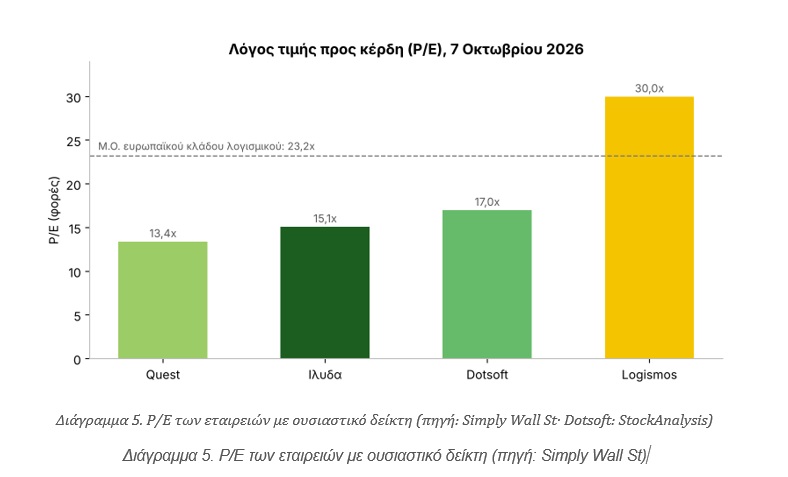
Based on the half-year figures, Ilyda is cheaper than its sector, but it is not the cheapest in the sample, with Quest slightly lower. At 15.1 times earnings, it trades well below the average for its peers and the European sector, despite its 72% EBITDA margin and net cash.
This is partly explained by its small size, low liquidity and reliance on the public sector. But that is not enough to justify the entire gap, particularly if the new investment in automotive software delivers.
What we will be watching
At Dotsoft, collections of receivables and the gross margin in the second half. At Ilyda, execution of the DMS investment and profit growth excluding one-off items. At Softweb, how much Alphabit contributes and whether the goodwill holds its value. At Vidavo, whether new contracts continue to be converted into cash, given that the collection period remains 195 days.
One final point about the data themselves. In several reports, we found tables that do not tally with one another. They do not change the overall picture, but anyone relying on the figures should bear this in mind.
* Director of Research at Solidus Securities SA, overseeing portfolio analysis and asset-allocation optimisation, and developing integrated financial models to assess risk and forecast market trends. President of HACSA.
** This article is for informational and educational purposes only and does not constitute investment, tax or legal advice. The figures are indicative, based on publicly available historical data, and do not guarantee future returns. Before making any investment decision, consult a certified investment adviser.