When a continent faces years of anaemic growth, continually loses ground in international competition and sees social discontent swell, logic demands substantial policy changes.
In Europe, however, something paradoxical is happening. The political leaders of most countries, who make up the much-vaunted “broad centre”, continue to follow much the same course, with only minor variations. As if they expect the problems to solve themselves…
This is a policy that is taking on increasingly “suicidal” characteristics at this particularly critical juncture.
That is why its price is likely to become clear over the next 18 months, not only in the economy but also in a dramatic shift in Europe’s political landscape in the elections ahead.
The energy and inflation crisis is already accelerating events, now also through the bond market.
The warning signs are there for all to see
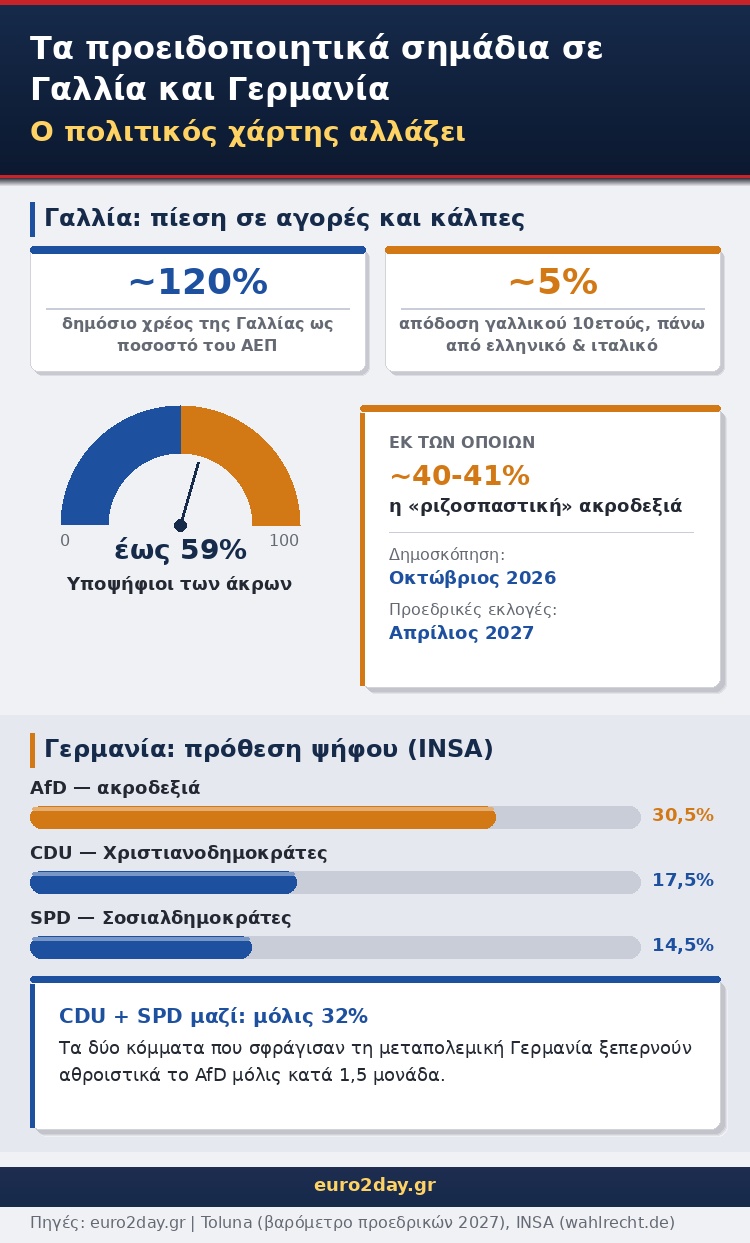
In France, public debt is approaching 120% of GDP, 10-year bond yields have neared 5%, surpassing even Greek and Italian equivalents, while social protests and clashes in the streets expose the dead ends of economic policy.
The eurozone’s second-largest economy is caught between a rock and a hard place. On one side, markets are demanding fiscal adjustment. On the other, significant sections of society refuse to bear its cost, while the political “centre” has all but vanished because it failed to halt the decline.
All this is happening as the April 2027 presidential election approaches, with anti-establishment political forces vying for a decisive role. Recent polls put support for candidates from far-right political groups as high as 59%, with the “radical” far right polling at around 40-41%.
Germany, too, once the engine of the European economy, is facing serious industrial malaise, with the car industry, chemicals and other traditional sectors under pressure from energy costs and international competition.
The political consequences are already striking. According to a recent INSA poll, the AfD leads the CDU by 13 points, on 30.5%, while the Social Democrats are on 14.5%. In other words, the two major parties that shaped postwar German history now command a combined total of just 32%!
Polling trends in these and several other countries have for a long time shown that this is not a passing bout of discontent, but the political expression of a deeper crisis that Europe’s elites continue to underestimate.
Two costly failures
But how did we arrive at the decline reflected in these figures, alongside generally anaemic growth and a near-constant rise in debt and deficits?
The first major failure was purely strategic. Europe failed to recognise in time that China’s emergence as a global industrial superpower would overturn the balance on which its postwar prosperity had been built.
It found itself caught between the US, which is increasingly using its economic and technological power to serve national interests, and China, with its enormous production capacity, lower costs and coherent industrial strategy.
Now that Europe is at least tentatively waking up to the danger, it may already be too late.
European leaders also underestimated the long-term economic and geopolitical consequences of their involvement in the war in Ukraine. Russia’s invasion certainly left no room for indifference.
But there is a difference between providing necessary support to a country under attack and adopting a wholly “unyielding” policy without adequately accounting for its economic cost, its duration or the conditions for a sustainable diplomatic way out.
The result is that Europe has lost access to cheap Russian energy, undermined its industrial competitiveness and taken on almost the entire financial burden of the war.
Moreover, as tensions with Russia escalate, the EU (or at least its northern part) feels compelled to ramp up defence spending by several… trillion euros over the coming years.
That is despite already spending three times as much as Russia in nominal terms and 60% more in purchasing power parity (PPP) terms.
EU support for Ukraine tops €300bn
According to the European Commission, total European support for Ukraine, including military, financial and humanitarian aid, as well as refugee-related spending, has already reached €227.4bn.
Meanwhile, a new €90bn loan programme for 2026–2027 has been approved, of which €15.7bn has already been disbursed. The remaining €74.3bn takes total recorded aid and outstanding loan commitments to more than €300bn.
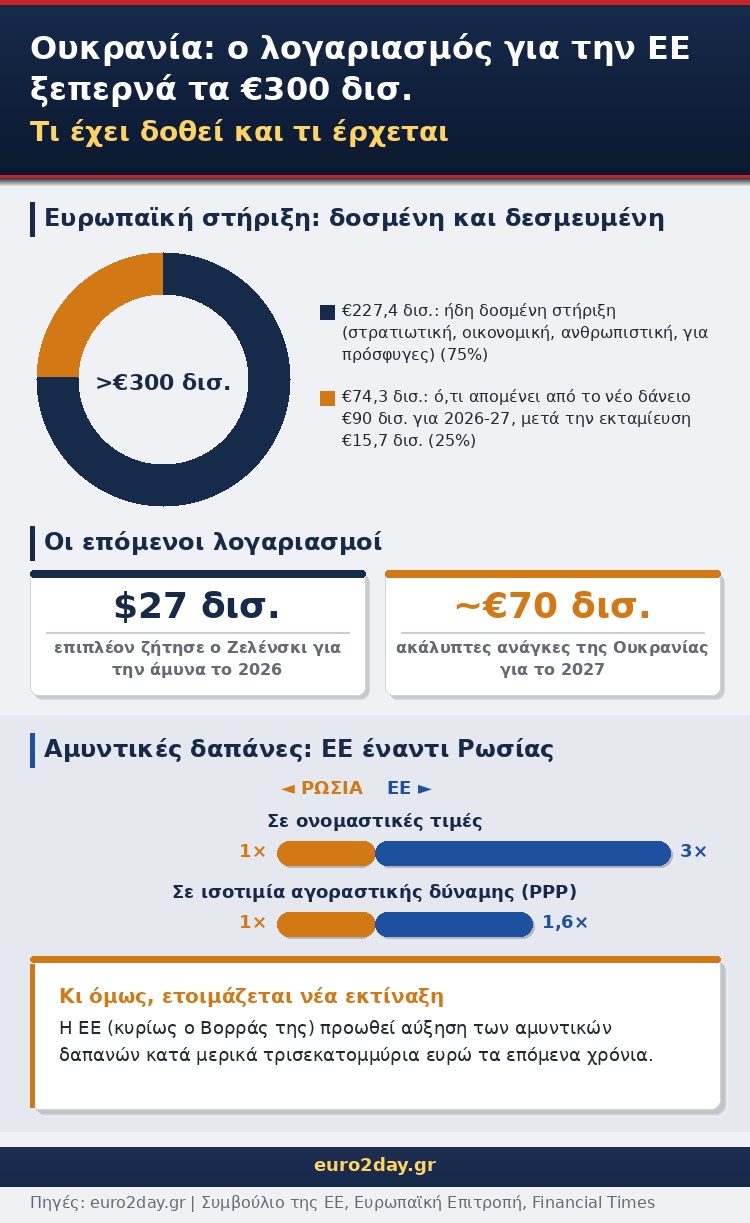
The bill continues to grow. Zelensky urgently requested an additional $27bn to meet Ukraine’s defence needs in 2026, while the European Commission announced on 1 October that it had found ways to cover the shortfall using “available resources”.
And then there is 2027, when Ukraine’s total unfunded financing needs are already estimated at around €70bn.
The green transition and China’s paradox
The second major failure concerns energy and industrial policy. For many years, Europe has made the green transition a top priority. But it failed to ensure that its businesses would remain competitive throughout the process.
The result is almost farce. The EU is vying for the title of world champion in the green transition, but China is the country that has won even this particular industrial battle.
According to the International Energy Agency, China dominates solar panel production, accounts for about three-quarters of global electric car production and more than 80% of battery production, and has a very strong position in the wind turbine supply chain.
In other words, Europe sets the rules and deadlines, while China builds and sells the technologies needed to implement them! At the same time, European industries continue to pay electricity prices many times higher than those in the US.
So the much-vaunted energy transition (which is of course necessary, but on different terms) has turned from a growth opportunity into a mechanism for deindustrialisation.
The luxury of inaction is over
Worst of all, despite the seriousness of the problems, Europe’s traditional slowness in decision-making persists. It is an endemic — or, more accurately, structural — feature of the EU’s make-up.
There is no shortage of assessments, repeated every few months. Reports such as Mario Draghi’s on competitiveness spell out the risks clearly.
But meaningful decisions continue to be delayed, trapped by national divisions and Brussels’ complex mechanisms.
The world is changing at a pace Europe can no longer afford to ignore. Tackling this crisis requires far more than the “corrective measures” Brussels favours.
It requires a rethink of energy and industrial strategy, realism in geopolitics and, above all, decisions that restore competitiveness and the prospect of prosperity for European societies.
Otherwise, change will come regardless. Not because today’s leaders choose it, but because voters will impose it.
And then perhaps even the most starry-eyed people who shy away from criticism, hoping that “the problems are temporary”, will grasp the central point.
That the greatest cost of inaction is political, just as the greatest threat to Europe’s continued existence is political. At least in the form we once all envisioned.