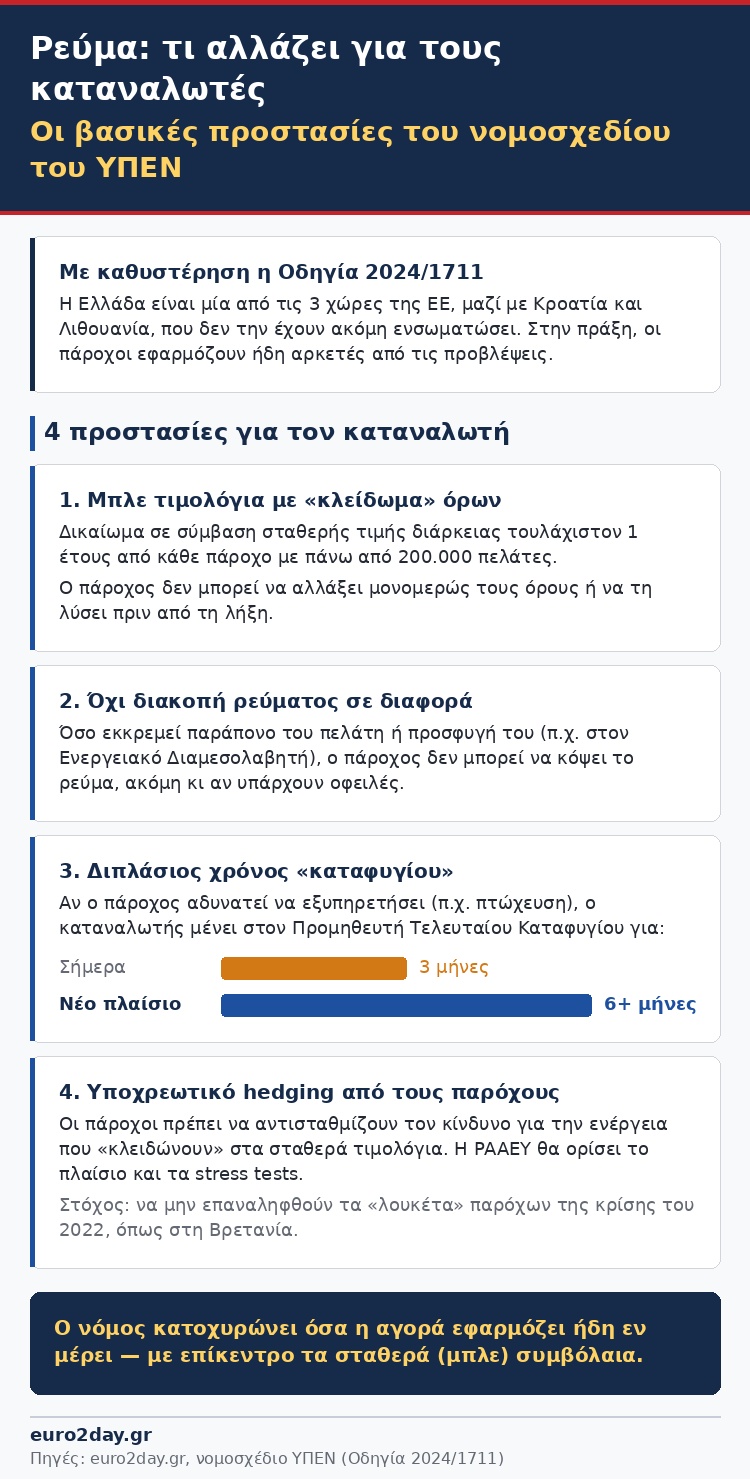
The government is seeking to encourage consumers to switch to fixed-term electricity contracts. It is enshrining in law suppliers’ obligation to offer blue tariffs lasting at least one year and strengthening consumer protection against unilateral changes to the terms of these contracts.
At the same time, it is introducing rules that make hedging by suppliers legally mandatory for the volumes of energy they provide through their fixed tariffs. The aim is to prevent supplier bankruptcies such as those seen in 2022 in Great Britain (and elsewhere) during the previous energy crisis.
These are among the changes the omnibus bill from the Ministry of Environment and Energy put out for consultation on Saturday will bring to the electricity market. The bill transposes Directive 2024/1711 into national law to strengthen consumer protection and widen the choices available to consumers in electricity supply contracts.
In practice, domestic suppliers have already incorporated many of these provisions into their day-to-day operations, and the electricity market has been working along these lines for some time, despite Greece having delayed transposing the Directive into national law.
Greece is one of three countries, alongside Croatia and Lithuania, that have yet to adopt the Directive, as the relevant table shows.
A closer look at the bill reveals six key provisions that directly or indirectly affect consumers.
Protection against changes to blue tariff terms
The law establishes that all consumers can ask any supplier with more than 200,000 customers to enter into a fixed-term contract for electricity supply at a fixed price, lasting at least one year.
Suppliers may not unilaterally change the terms and conditions of these contracts or terminate them before they expire.
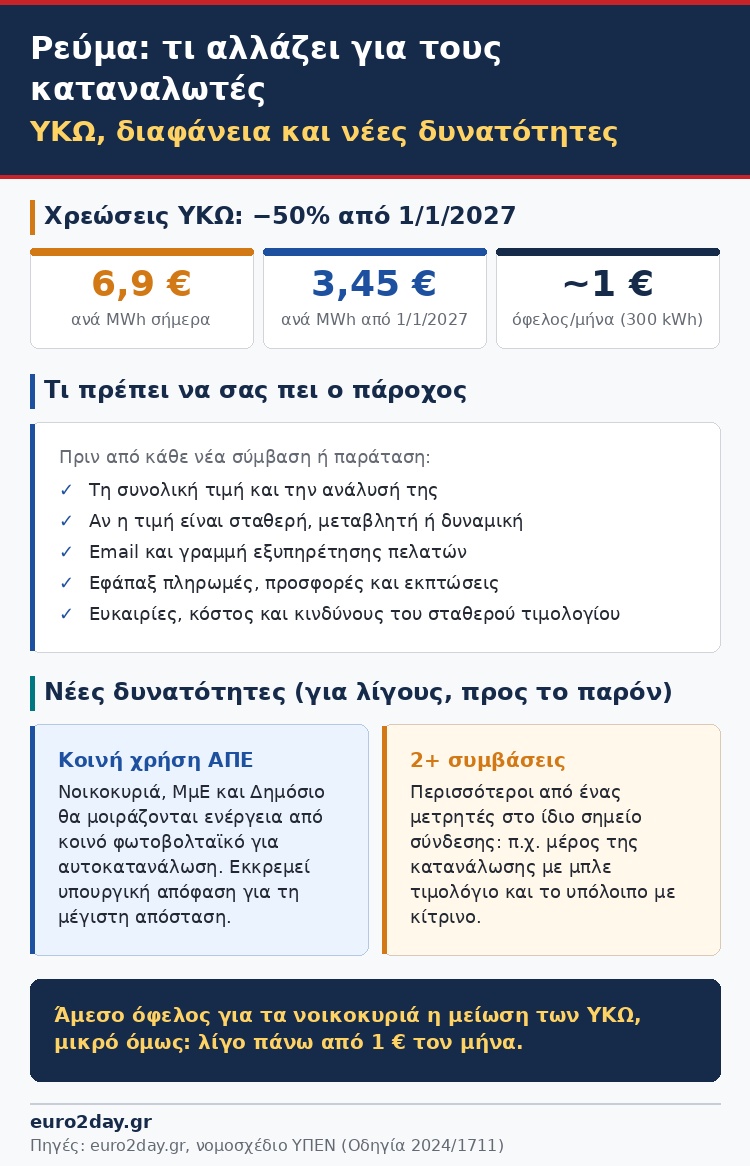
Before entering into or renewing any contract, they must inform their customers about:
the total price and its breakdown
whether the price is fixed, variable or dynamic
the supplier’s email address and details of its customer support line, and
where applicable, information about one-off payments, offers, additional services and discounts.
They must also provide customers with comprehensive information about the opportunities, costs and risks involved in a fixed-term contract at a fixed price.
Protection against power disconnections
If a dispute-resolution process is under way, the supplier may not disconnect a customer in arrears.
This consumer protection applies while the customer is awaiting a response from the supplier to a request or complaint (provided it has not been submitted more than twice), or while a case brought by the customer before the Energy Ombudsman, the Independent Authority for Market Oversight and Consumer Protection or another out-of-court dispute-resolution body remains unresolved.
Longer access to the Supplier of Last Resort
The period during which a consumer can buy electricity or natural gas from the Supplier of Last Resort is being extended from three to at least six months if, through no fault of their own, their previous supplier is unable to provide the service (for example, because it has gone bankrupt).
Mandatory hedging by suppliers
Although companies are already doing this, transposing the Directive into Greek law aims to make risk hedging by suppliers a legal requirement. The aim is to reduce the risk of supplier collapses, such as those seen during the 2022 energy crisis, when a wave of suppliers shut down in various countries, and to prevent costs from being passed on to consumers.
Under the Directive, suppliers must take steps to limit their exposure to large swings in wholesale prices through hedging. Their obligations will naturally increase in line with the volumes of energy they lock in to supply customers on fixed tariffs.
Immediately after the law is passed, the Regulatory Authority for Waste, Energy and Water (RAAEY) will set out in detail the framework for risk management by players in the Greek market, as well as the stress tests they will face to assess whether they can continue to offer fixed tariffs during periods of energy crisis.
Under a decision by RAAEY, the following will be determined:
appropriate hedging strategies to limit the risk that fluctuations in wholesale electricity supply pose to the financial viability of their customer contracts, while maintaining liquidity and price signals from short-term markets,
reasonable measures to limit the risk of supply being interrupted,
the process for conducting stress tests and the circumstances in which they are required.
The Directive also brings into Greek law a number of provisions that are relatively advanced by the standards of the Greek market and currently concern only a few people, including the following.
Sharing energy from renewable sources
Households, small and medium-sized businesses, and the public sector will be able to share energy from renewable energy sources (RES) generated by owned or leased solar panels. This will allow two or more consumers to cut their costs through self-consumption—offsetting the energy they use for their own needs and selling surplus generation back to the grid.
This will be permitted as long as it is not their main business activity. A ministerial decision is still pending on the area within which consumers must be located relative to the solar panels (for example, within the same city block or a specified distance).
In effect, this expands the framework for self-consumption announced months ago by the Ministry of Environment and Energy.
More contracts at the same connection point
Subject to certain conditions, a consumer will be able to have more than one supply contract or energy-sharing arrangement through different meters at the same connection point.
In practice, the Directive will allow a consumer to cover part of their consumption with, for example, a blue tariff and the rest with a yellow one, and so on.
50% cut in PSO charges
The Environment and Energy Ministry’s omnibus bill also gives effect to Prime Minister Kyriakos Mitsotakis’ announcement at the Thessaloniki International Fair that Public Service Obligation (PSO) charges on electricity bills for all household supplies will be cut by 50% from 1 January 2027, from €6.9/MWh to €3.45/MWh.
For average consumption of 300 kilowatt-hours a month, the saving is estimated at just over €1 a month.