The impact of the ongoing energy crisis on the performance and prospects of the Greek economy is reflected in the International Monetary Fund’s forecasts: it has lowered its growth outlook and raised its inflation forecast, while still expecting unemployment to continue to fall.
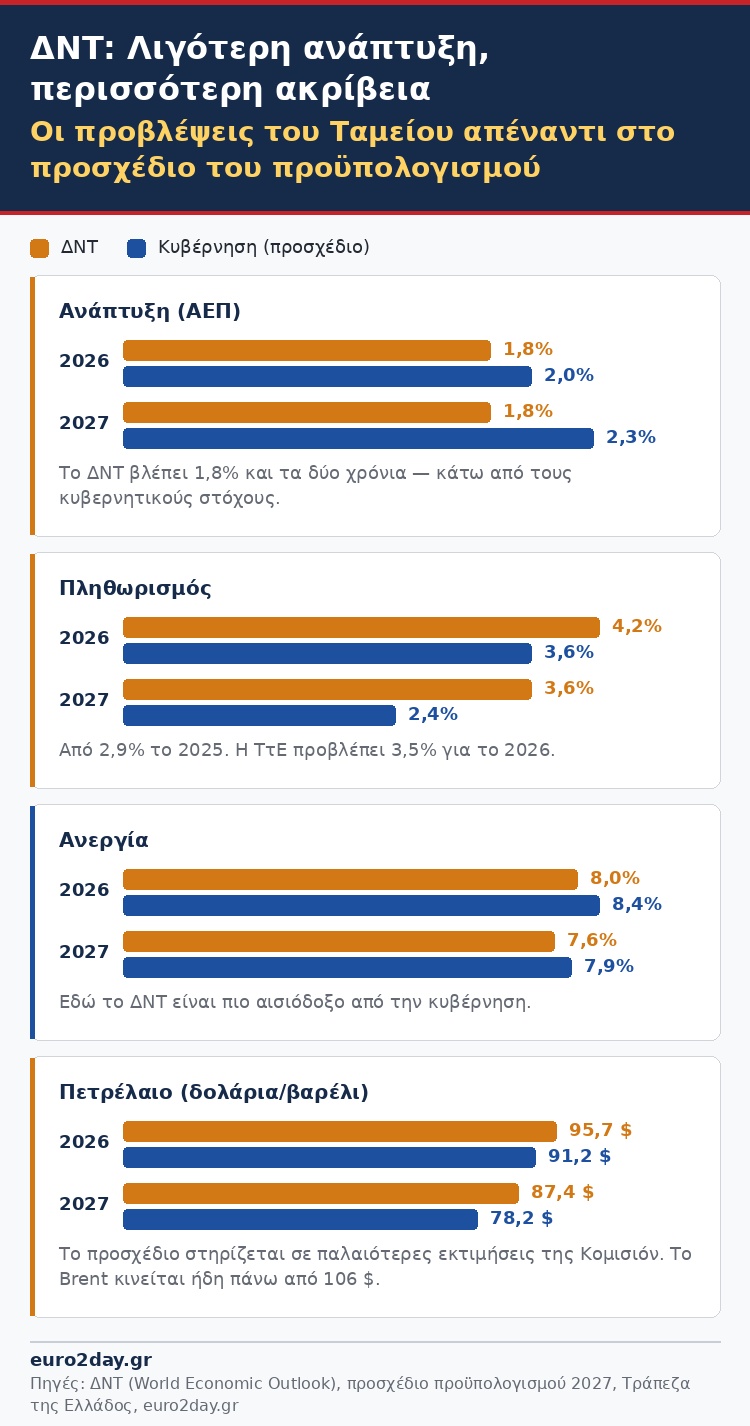
In its report (WEO – World Economic Outlook), the international financial institution sees the Greek economy growing by 1.8% in 2026 and 2027, well below the government’s targets in its draft 2027 budget, which forecast growth of 2% this year and 2.3% next year.
The divergence highlights the risks to the Greek economy from rising energy prices, weaker external demand and the impact on consumption and tourism.
More importantly, it reflects higher assumptions for fuel prices than those in the draft budget: the IMF forecasts an average international price of $95.74 a barrel this year and 87.39% in 2027, while the finance ministry has included earlier European Commission forecasts of $91.2 a barrel for oil in 2026 and $78.2 in 2027.
Inflationary pressures
The path of prices for goods and services is a major concern. The IMF estimates that inflation in Greece will rise to 4.2% in 2026, from 2.9% in 2025, as energy price increases gradually feed through to the wider economy, burdening businesses and consumers. It expects inflation to ease to 3.6% in 2027, though pressure on purchasing power will remain.
The finance ministry, by contrast, is more optimistic. Its draft budget forecasts that domestic inflation will ease to 3.6% this year and fall to 2.4% in 2027. For the harmonised index, which allows comparisons between European Union member states, the corresponding estimates are 3.8% and 2.6%.
The Bank of Greece, in its Inflation Monitor, records a significant acceleration in inflation in Greece, driven mainly by rising energy prices and sharp increases in services prices. It forecasts annual inflation of 3.5% in 2026, compared with 2.9% in 2025.
The gap between the forecasts is particularly significant, as the duration of the energy turmoil will largely determine how prices evolve and the scale of any additional support measures.
The government is expected to announce its first package of measures tomorrow, Wednesday, including subsidies for heating oil and road diesel, aimed at limiting the burden on households and businesses. The international price of Brent rose above $106 a barrel yesterday, fuelling concerns about further increases in fuel prices and their knock-on effects across the market.
Unemployment set to fall
By contrast, the IMF is more optimistic about the labour market. It forecasts that unemployment will fall to 8% in 2026 and 7.6% in 2027, compared with the government’s estimates of 8.4% and 7.9%. If borne out, this would be a positive development for employment, though it would not automatically offset the loss of purchasing power caused by rising prices.
International transactions
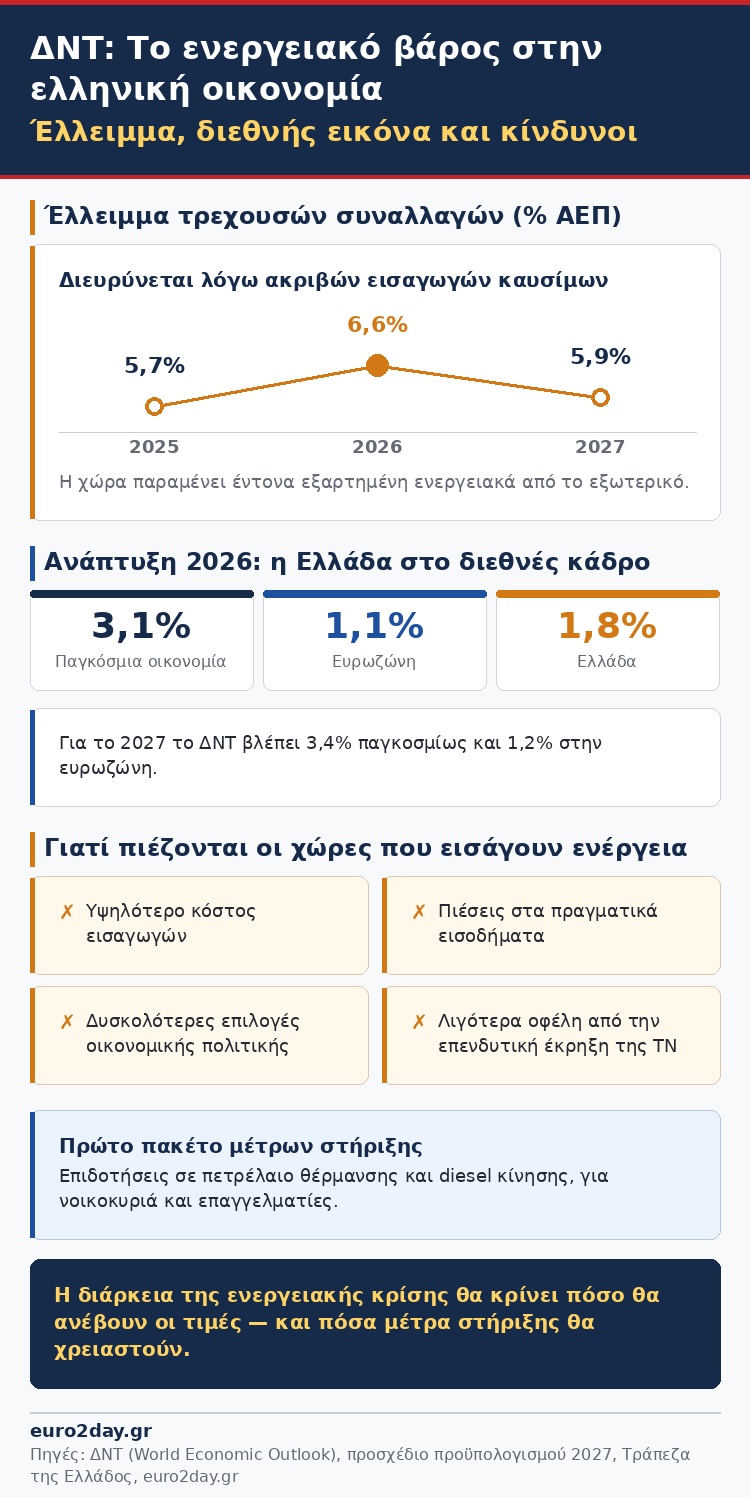
The surge in energy prices and costly fuel imports will have a heavy impact not only on imported inflation but also on the country’s economic drain through its current account balance. The IMF forecasts that the deficit will widen from 5.7% of GDP in 2025 to 6.6% in 2026, before narrowing only partially to 5.9% of GDP in 2027.
The IMF’s forecast suggests that, despite continued growth and the expansion of renewable energy at the expense of fossil fuels, the Greek economy will remain heavily dependent on energy imports.
An unfavourable combination
The same report (World Economic Outlook) notes that energy-importing economies with limited links to the global artificial intelligence value chain face a less favourable combination: higher import costs, pressure on real incomes, tougher economic policy choices and fewer offsetting benefits from the technology investment boom.
The Fund forecasts global growth of 3.1% in 2026 and 3.4% in 2027, but stresses that risks remain tilted to the downside, owing to higher energy and food prices, geopolitical tensions, fiscal pressures and the possibility of another market sell-off.
For the eurozone, the IMF forecasts growth of just 1.1% in 2026 and 1.2% in 2027.
In Thailand
The forecasts were presented ahead of the annual meetings of the IMF and World Bank in Bangkok, Thailand, from 12 to 18 October. The meetings are attended by the Minister of National Economy and Finance and Eurogroup president, Kyriakos Pierrakakis, at a time when energy security, fiscal resilience and the global growth outlook are high on the agenda of international discussions.