The draft 2027 budget submitted to parliament reveals a structural mismatch in the domestic economy. Despite the upward trajectory of nominal pay, real wage increases remain anaemic, lagging even behind growth in labour productivity.
So while labour productivity continues to grow, the real purchasing power of pay is increasing at a markedly slower pace, keeping unit labour cost growth in check.
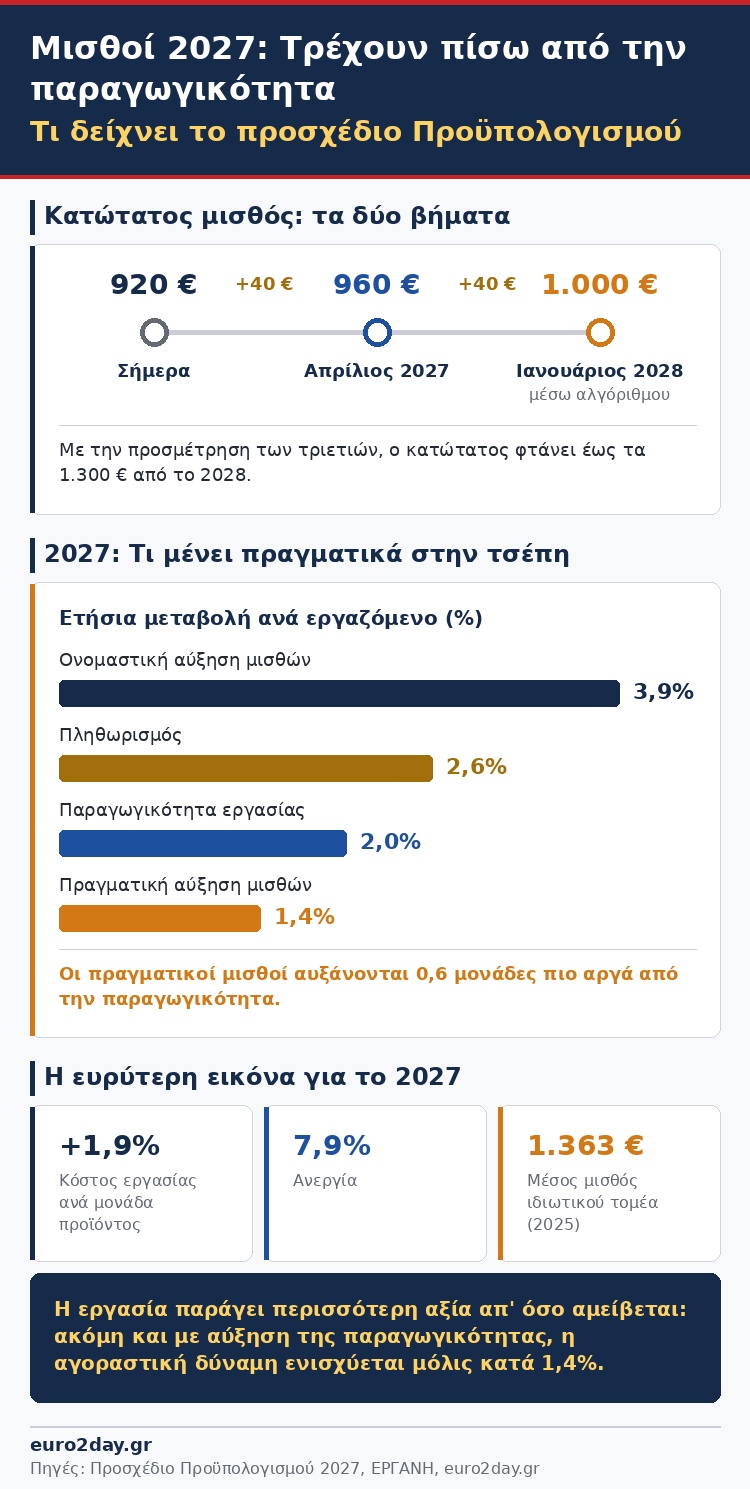
In the draft submitted to parliament, the finance ministry sets out an increase in the minimum wage to €960 for 2027, effective from 1 April next year, and forecasts a further rise in 2028, which will formally be determined by a special algorithm, bringing it to €1,000 (and up to €1,300 when three-year seniority increments are included).
As detailed in the fiscal measures, the move from the current €920 to the final target will take place in two successive steps, in April 2027 and January 2028, effectively ushering in a new mechanism and timetable for adjustments.
But despite this progress and the nominal rise in the average private-sector wage (which stood at €1,363 in 2025, according to the ERGANI system), the 2027 budget makes clear that workers’ real prosperity continues to be squeezed between inflation and wages lagging behind productivity.
In 2027, nominal compensation of employees per worker is forecast to rise by 3.9% (from 3.7% in 2026), while total compensation will increase by 4.6%. At the same time, inflation, although easing, is projected at 2.6%.
The real increase in compensation per worker is therefore limited to just 1.4 percentage points — one-third of the nominal increase. Despite some support for disposable income from a half-percentage-point cut in social security contributions and the introduction of a holiday bonus in the public sector, the purchasing power of wage earners is increasing at an extremely slow pace.
Productivity
The most interesting finding, however, comes from comparing pay increases with productivity indicators. The draft budget forecasts that labour productivity will rise by 2.0% in 2027 (from 1.5% in 2026). The real increase in pay (1.4 percentage points) will therefore fall markedly short of productivity growth.
This finding overturns the central argument of employers’ organisations, which routinely argue in public debate that wage increases should be strictly linked to productivity growth. That is because, while raising productivity remains an enduring challenge — and one that depends not only on workers’ efforts but also on investment, technology and infrastructure — the budget figures show that even when productivity does increase, it does not translate into a corresponding rise in real incomes.
Labour generates more added value, but is paid at a rate below its productivity, keeping growth in unit labour costs to 1.9%.
In the broader macroeconomic picture, employment is expected to continue growing at a modest pace (by 0.4% overall and 0.7% among wage earners), bringing the number of wage earners close to 4 million and total employment to 5.3 million, while unemployment falls to 7.9%. Private consumption is forecast to grow by 1.5%.