In a year when foreign investment fell across Europe, Greece was one of the few countries to buck the trend. At the same time, foreign companies’ intention to invest in the country reached its highest level since the EY Attractiveness Survey Greece began in 2019.
The picture, however, is not without its shadows. Foreign investors recognise the country’s progress, but identify three key areas in need of improvement:
- the regulatory environment
- innovation and research and development
- energy costs
Progress in numbers
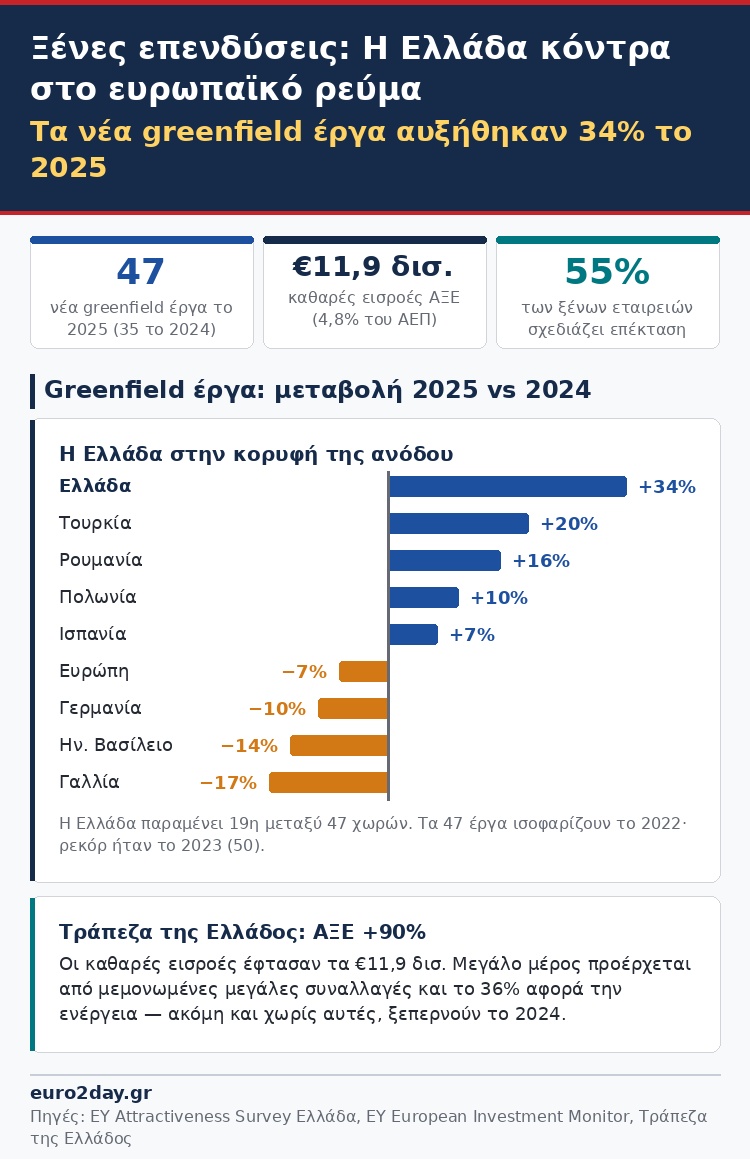
EY’s European Investment Monitor database recorded 47 greenfield investment projects in Greece in 2025, up from 35 in 2024. That represents an increase of 34%. The figure matches the 2022 level and is the second highest since 2000, behind only 2023, when there were 50 projects. The rise, therefore, mainly marks a return to 2022 levels after a weak year.
Over the same period, the number of corresponding projects in Europe fell by 7%, its third consecutive annual decline. The drop was steep in the major economies: France -17%, the UK -14% and Germany -10%. Increases were recorded in Turkey (+20%), Romania (+16%), Poland (+10%) and Spain (+7%), as well as Greece. Greece ranked 19th among 47 countries, as it did in 2022 and 2023.
Bank of Greece figures for total net foreign direct investment (FDI) inflows present a different picture. They rose by about 90% in 2025 to €11.9 billion, equivalent to 4.8% of GDP. A significant part of the total was accounted for by large individual transactions, while 36% related to energy. Even excluding these transactions, however, inflows exceeded 2024 levels.
Investment intentions
Investors’ intentions are encouraging. Of the 250 foreign company executives who took part in the survey, 55% plan to establish or expand operations in Greece over the next 12 months. This is the highest proportion since 2019, when it stood at 30%. The figure is close to the European average of 54%, but the trend is the opposite: in Europe, the proportion has fallen from 72% in 2024, while in Greece it is rising. The shift is particularly pronounced among companies that do not yet have a presence in the country: 51% say they intend to establish operations in Greece, compared with 22% in last year’s survey.
At the same time:
- Just 22% postponed, cancelled or scaled back investment plans, compared with 34% across Europe.
- Some 68% expect the country’s attractiveness to improve over the next three years, up from 63% last year.
- Some 82% consider investment promotion policy effective. The figure is unchanged from last year and is the highest recorded by the survey, although only 23% describe it as “very effective”.
There are, however, signs of fatigue. The proportion of respondents who say their view of Greece has worsened over the past year rose to 20%, from 13% last year.
How high-quality is the investment?
The increase in the number of projects is not, on its own, enough to capture the quality of investment. According to EY, the 2025 greenfield projects were distributed as follows:
- support services: 36%,
- sales and marketing: 28%, twice the average for the previous three years (14%),
- industrial production: 15%,
- research and development: 11%.
According to EY, sales and marketing have a more limited impact on the local economy. Industrial production, although higher, remains well below the European average of 28%. In addition, 79% of projects were concentrated in Attica, compared with an average of 57% over 2022-2024.
First obstacle: Bureaucracy and regulation
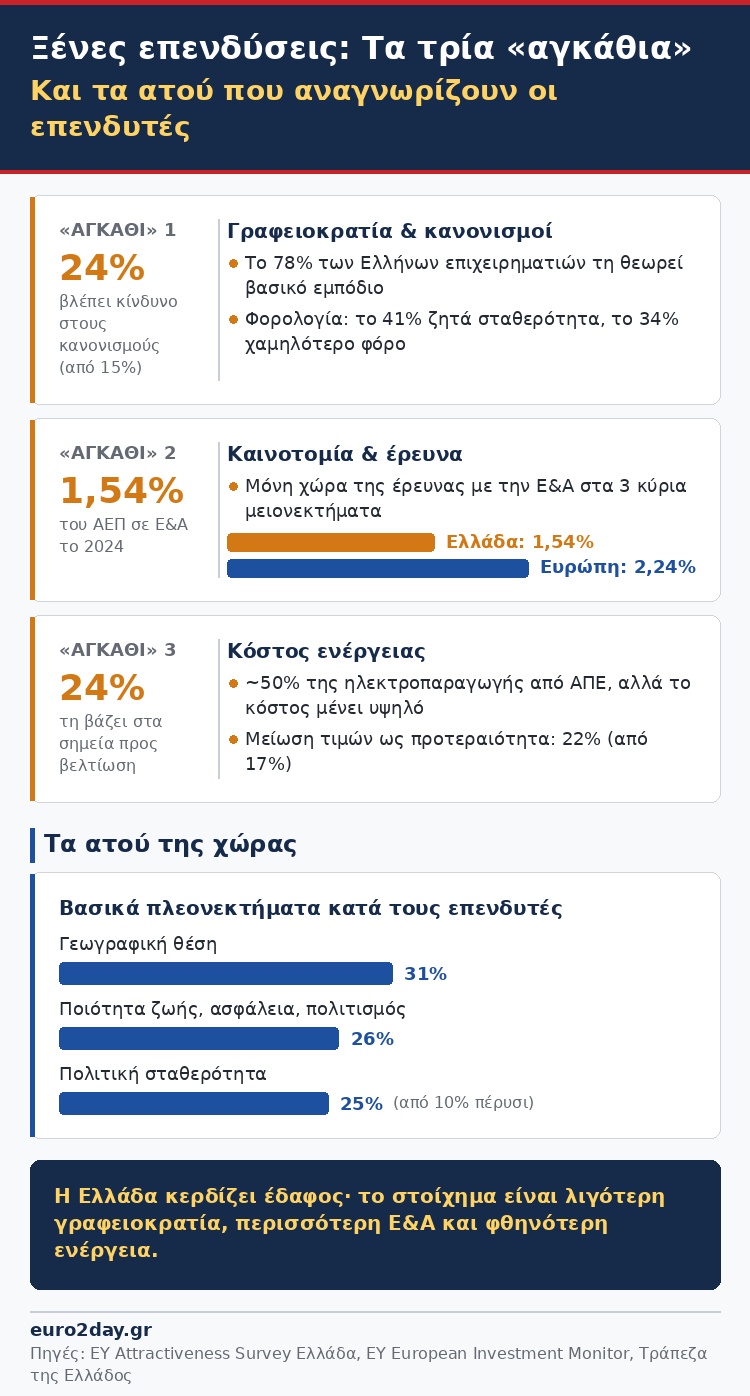
The regulatory environment emerges as the most important area in need of improvement, and concern is mounting. The large number and complexity of regulations are cited as a risk to the country’s attractiveness by 24% of investors, up from 15% last year. This year’s EY Entrepreneurship Barometer confirms the picture: 78% of Greek business owners cite bureaucracy and the complexity of the regulatory framework as a key obstacle.
EY recommends:
- fewer permits and approvals,
- faster licensing,
- eliminating overlaps between authorities,
- clear compliance rules.
On taxation, investors are calling primarily for stability, not lower rates. Some 41% identify predictability and legal certainty as a key priority, while 34% opt for a cut in corporate tax.
Second obstacle: Innovation and research
Greece is the only country in the survey where innovation and research and development rank among the three main weaknesses. R&D spending as a proportion of GDP has almost doubled over the past decade, reaching 1.54% in 2024. It nevertheless remains below the European average of 2.24%.
Third obstacle: Energy costs
The country has strengthened its position in the green transition: about 50% of electricity generation in 2025 came from renewable energy sources. Even so, energy costs remain a key challenge for competitiveness.
- Some 24% of investors rank them among the areas in need of improvement.
- In a separate but related question, 26% consider rising operating costs, including energy, a key risk to the country’s attractiveness.
- Lower energy prices rose to 22% as a priority, from 17%.
EY’s recommendations include:
- developing long-term power purchase agreements (PPAs),
- reducing dependence on natural gas,
- establishing a single framework for fast-track licensing for storage projects.
The country’s strengths
By contrast, investors recognise the following as Greece’s main advantages:
- its geographical location (31%), making Greece the only country in the survey where this factor ranks among the three most important advantages,
- quality of life, safety, diversity and culture (26%),
- political stability (25%, up from just 10% last year).