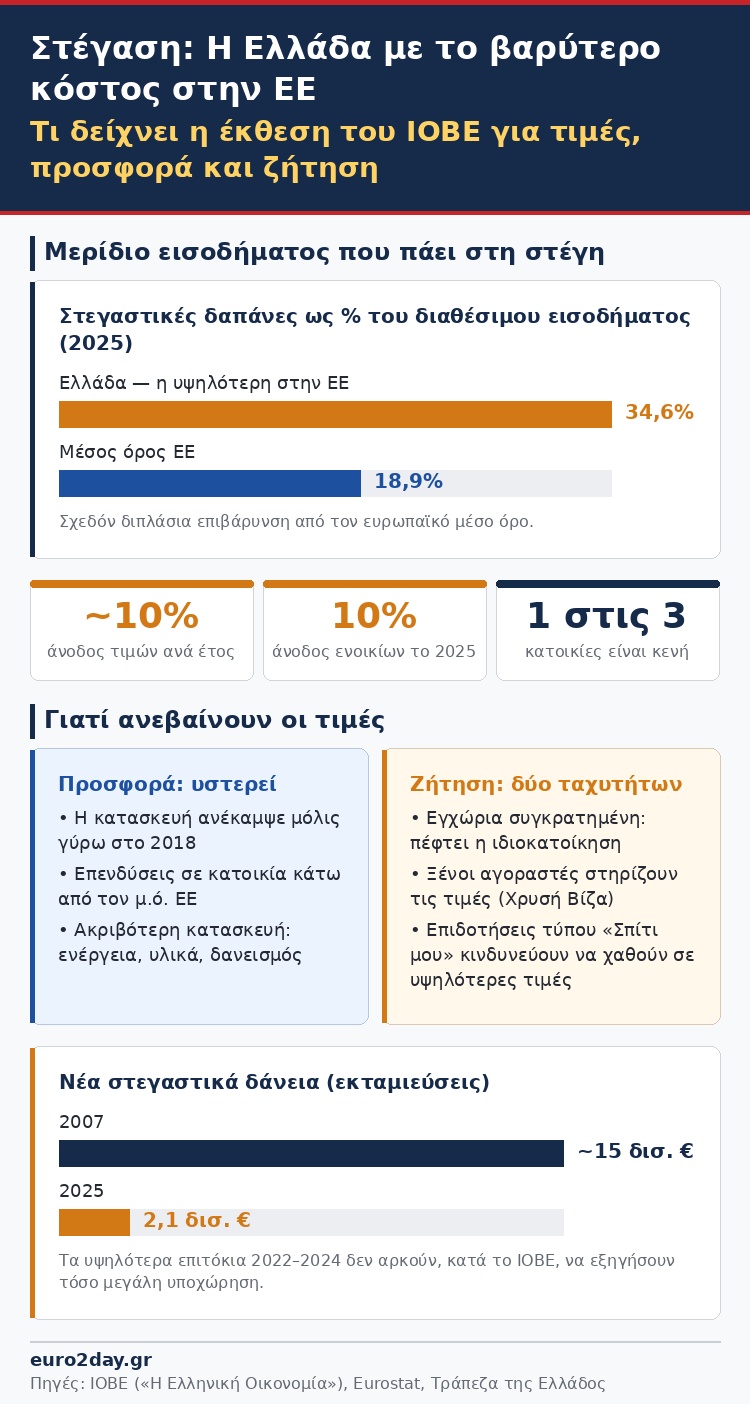
Greece faces the most severe housing cost burden in the European Union. According to Eurostat, households spent 34.6% of their disposable income on housing costs in 2025, compared with 18.9% in the EU.
Meanwhile, house prices have surpassed their previous all-time high, reached before the economic crisis, while the burden is no longer confined to low-income households.
The picture is set out in the chapter “Housing in Greece: challenges and policy proposals” of the quarterly report “The Greek Economy” by the Foundation for Economic and Industrial Research (IOBE).
The chapter brings together findings from two studies by the foundation that have already been published: a study for diaNEOsis on the housing market and a study for the Bank of Greece on the housing cost burden on households. It links those findings to the National Housing Policy Strategy, which was completed in summer 2026 and whose design IOBE itself helped shape.
Supply remains constrained
Property prices lost more than 40% of their value during the crisis. They have risen steadily since 2017, and the increase did not slow even during the pandemic. In recent years, the annual rate of growth in the Bank of Greece’s house price index has been close to 10%, with the sharpest rises in Athens and Thessaloniki.
Rents are also rising, although IOBE says the picture is “less clear-cut”. The relevant component of the Harmonised Index of Consumer Prices accelerated from 1.3% in 2022 to 5.1% in 2024. In 2025, the report says, the rate of increase reached 10%.
Two valuation indicators complete the picture. The price-to-rent ratio has surpassed its 2008 levels. This means prices are rising faster than rents, which IOBE interprets as a sign of strong investment interest. The price-to-income ratio is approaching its historical highs: prices are moving further out of reach of household purchasing power.
The supply shortfall is a decisive factor. Construction activity collapsed during the crisis and only began to recover around 2018. When demand returned, it encountered a housing stock that had not been substantially renewed for a decade.
Despite the recovery, residential investment as a share of GDP remains below the European average. Construction costs have risen significantly because of higher energy and raw material prices and more expensive borrowing.
Energy-efficiency requirements have a similar effect: they improve the housing stock but raise the cost of new construction and renovation, a cost that IOBE says is usually passed on to buyers and tenants.
The paradox of vacant homes
About one in three homes in Greece is vacant. According to IOBE, however, these are mainly holiday and second homes in the regions, where housing needs are often lower. In Attica, where demand is strongest, the proportion of vacant homes is the lowest in the country.
Some of the housing stock is also used for short-term rentals. At the same time, thousands of properties inherited from the era of “red” loans remain subject to restructuring or foreclosure proceedings. Overall, a significant share of the housing stock is not immediately available for permanent residence.
Domestic demand remains subdued
On the demand side, domestic and external trends are moving in different directions. The homeownership rate has been falling rapidly since 2010, while household borrowing relative to income has declined.
New mortgage lending totalled €2.1bn in 2025, compared with about €15bn in 2007. Higher interest rates in 2022–24 contributed to the slowdown, but IOBE says they are not enough to explain such a prolonged decline. The result is “fairly subdued” domestic demand.
The concentration of economic activity in Attica focuses demand geographically, while the decline in average household size is shifting interest towards smaller homes. By contrast, foreign demand has supported price rises since 2018. Foreign direct investment in real estate had been increasing until recently, in significant part through the Golden Visa programme.
IOBE also expresses a clear reservation about demand subsidies. Programmes such as “My Home” temporarily boost demand. In a market where supply cannot adjust easily, however, some of their benefits risk being absorbed by higher prices.
Who bears the greatest burden
The national average does not show who is shouldering the burden. This is addressed in an IOBE study published in the Bank of Greece’s 61st Economic Bulletin. The study is based on microdata from the 2021 Household Finance and Consumption Survey (HFCS) and examines homeowners and tenants, as well as regional differences, on a consistent basis.
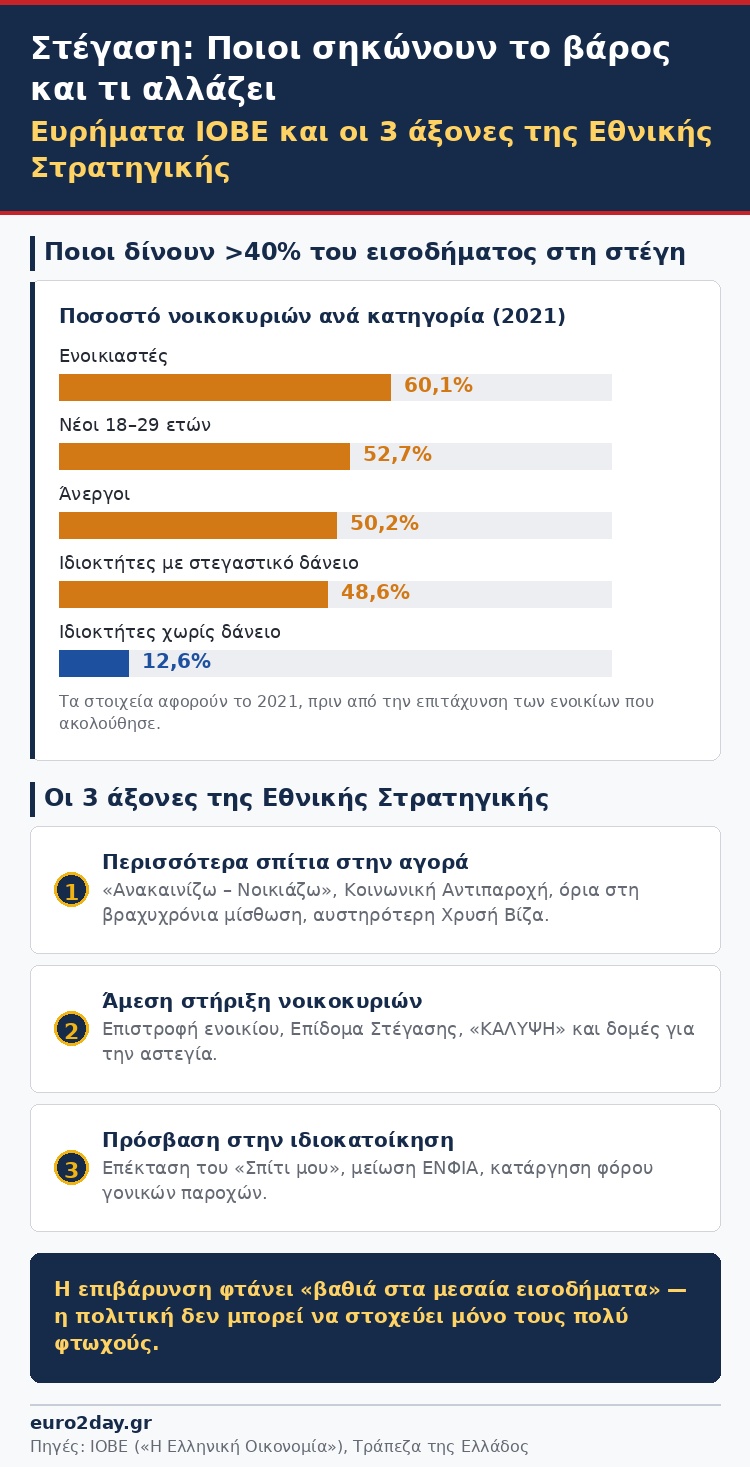
The study finds that the burden is worsening, is no longer confined to low-income households and is more pronounced in urban centres. Housing tenure is the main factor. In 2021, 60.1% of tenants and 48.6% of homeowners with a mortgage spent more than 40% of their disposable income on housing. The figure for homeowners without a mortgage was 12.6%. These figures predate the subsequent acceleration in rents.
The labour market is the second key factor: 50.2% of unemployed people exceeded the same threshold. Young people came next, with the share reaching 52.7% among those aged 18–29, followed by small households and, in particular, single-parent families.
IOBE notes that Greece has a high homeownership rate and a “virtually non-existent social housing stock”. In such a market, housing affordability depends not only on income but also on a household’s tenure, employment, demographic characteristics and place of residence. Effective policy therefore cannot rely on income criteria alone.
The three pillars of the National Strategy
The National Housing Policy Strategy was drawn up by the Ministry of Social Cohesion and Family Affairs, with advisory support from IOBE and EY. It is organised around three pillars: increasing available supply, supporting households facing housing difficulties and facilitating access to homeownership. It also incorporates measures that have already been announced or are under way.
The first pillar is to increase supply. Vacant homes are a central focus. The “Renovate – Rent” programme subsidises their renovation on condition that they are made available for long-term rental. Together with a three-year exemption from income tax on rental income, the aim is to make long-term letting more attractive than short-term rentals or leaving properties unused.
To create new supply, the Social Land-for-Property Scheme uses underused public property to build homes, some of which will form part of the social housing stock. Pilot schemes have already begun in Athens and Thessaloniki. New student residences through public-private partnerships and the simplification of building permit procedures, which is expected to reduce construction time and costs, are also part of the same effort. Restrictions on short-term rentals in central areas of Athens and tighter Golden Visa criteria, which now rule out short-term letting of the properties, are intended to return homes to the permanent housing market.
The second pillar is immediate support. Increasing supply takes time, so low-income tenants receive help through measures such as the Annual Rent Rebate. Support for very low-income households is more targeted and longer-term, through the Housing Allowance and the “KALYPSI” programme, which covers rental costs and home repairs for three years. For people experiencing homelessness, shelters provide immediate protection. Programmes such as “Housing and Work” link housing with employment and psychosocial support, with the aim of helping beneficiaries achieve lasting reintegration.
The third pillar is homeownership. The main obstacle is usually access to finance. The Strategy therefore expands programmes such as “My Home”, offering tax incentives to banks that lend to eligible households at lower interest rates. This is the same tool that IOBE warns in the same report could be partly reflected in higher prices.
The Strategy also seeks to reduce the cost of maintaining a home through energy-efficiency programmes such as “Exoikonomo”. On taxation, ENFIA property tax is being phased out for primary residences in small settlements and cut overall for individuals. Tax on parental gifts between first-degree relatives is being abolished to facilitate transfers within families, which have historically been a key route to housing in Greece.
The implementation challenge
IOBE concludes that housing policy cannot target only very low-income households, as the burden extends “deep into middle-income households”. It describes the National Strategy, whose design it helped shape, as an “important step” towards addressing the issue.
Systematic monitoring will be crucial. The full range of measures will be tracked through a unified digital infrastructure, enabling them to be evaluated and adjusted in a timely manner. The goal, as IOBE puts it, is a healthy housing market that supports economic activity while also meeting households’ needs.