2027 will be a landmark year for the Independent Authority for Public Revenue (AADE), with a series of flagship digital initiatives already under way due to be completed over the coming year. They aim to transform tax administration into a more effective, data-driven organisation, with positive results in the ongoing fight against tax evasion.
The reforms now being implemented are set out in the Draft Budgetary Plan (DBP) 2027, submitted yesterday by the Ministry of National Economy and Finance to the European Commission, following the submission of the draft budget to parliament on the first Monday in October.
Among the most notable reforms are the Property Ownership and Management Register (MIDA), the full integration of digital audit and interconnection tools (POS, myDATA), and the use of data analytics to narrow the “gap” in VAT, helping to underpin projected revenue through the curbing of tax evasion.
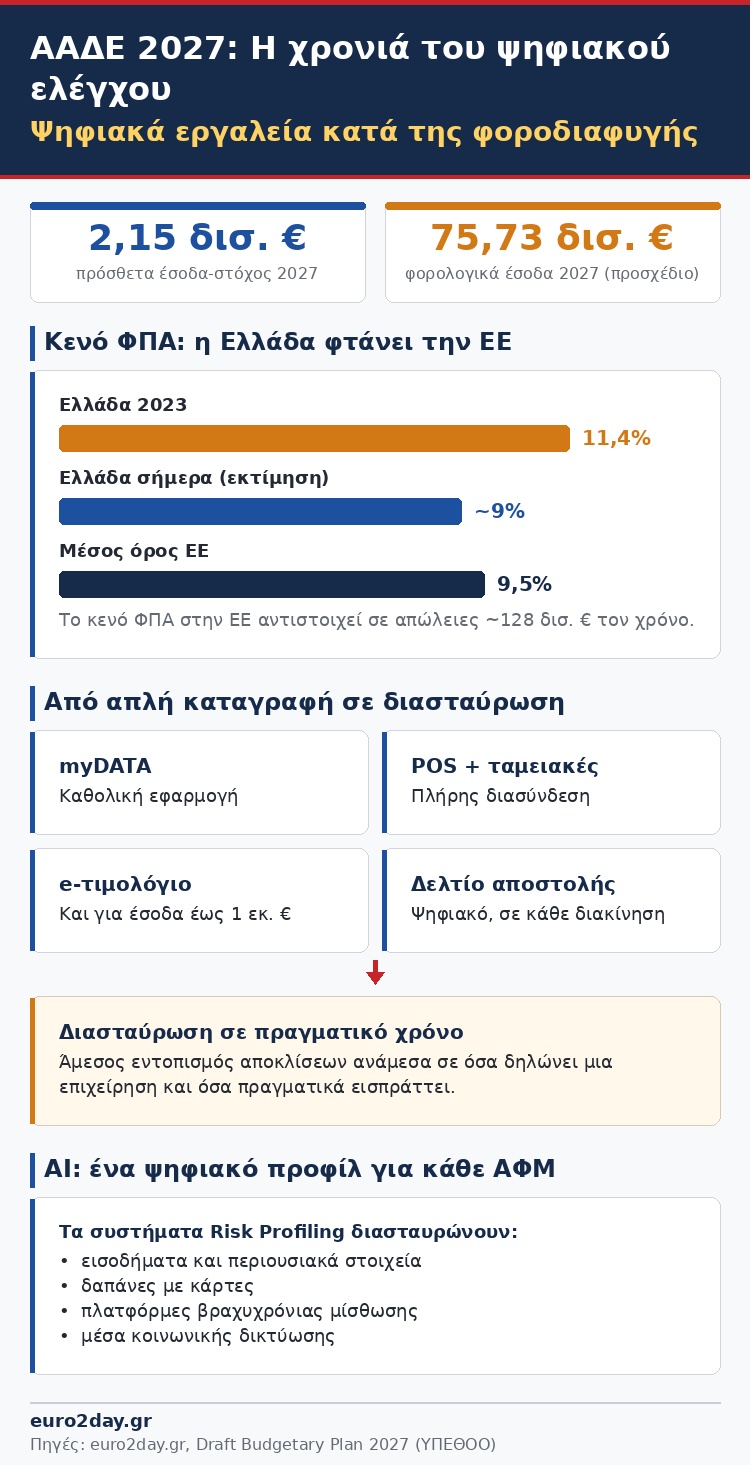
The Ministry of National Economy and Finance presents the digital and structural transformation of tax administration not merely as a technological upgrade, but as the key “weapon” for permanently broadening the tax base and securing an additional €2.15bn in revenue next year.
The draft budget is projected to generate tax revenue of €75.73bn next year, around €2.15bn more than this year. The increase is attributed both to economic growth and to the impact of the AADE’s digital measures (POS interconnection, myDATA, MIDA) in the fight against tax evasion.
The AADE’s plan is for systems that until recently were at a pilot or transitional stage to reach full operational maturity in 2027.
Specifically, it will seek to turn them from simple record-keeping tools into real-time data cross-checking mechanisms: the universal rollout of the myDATA platform, the interconnection of POS terminals with cash registers, e-invoicing and the digital delivery note.
A key aim of this package of measures remains a sharp reduction in the VAT “gap”.
The AADE aims to bring Greece’s performance into line with the European average by using digital traceability to quickly identify discrepancies between businesses’ declared revenue and their actual receipts.
Convergence
It is worth noting that the average VAT “gap” in the EU stands at 9.5% of total expected revenue. This represents losses of around €128bn a year for EU member states’ public coffers due to tax evasion, bankruptcies and administrative errors.
Greece’s VAT “gap”, estimated at 11.4% in 2023, is now thought to have fallen into single digits, to around 9%, bringing it into line with the European average.
The road map
According to the road map set out in the DBP, the AADE will complete the following in 2027:
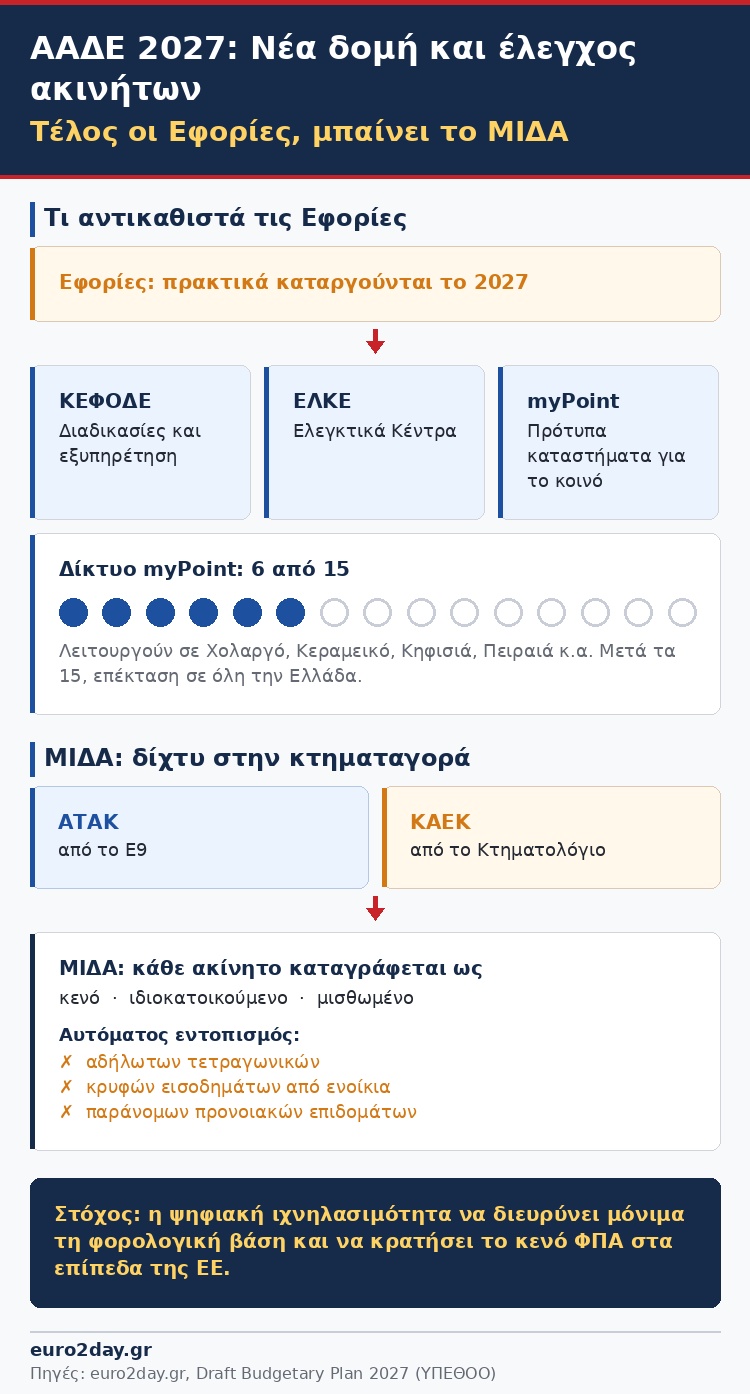
The full transformation of tax offices, which are effectively being abolished. They are being replaced by the continued development of KEFODE (Tax Procedures and Customer Service Centres) and ELKE (Audit Centres) for administrative and audit functions, as well as myPoint branches, the new, modern model for in-person taxpayer services. To date, six myPoint model branches have opened, establishing the AADE’s new, unified identity for in-person and digital services. The branches opened gradually, beginning in areas such as Holargos, Kerameikos, Kifisia and Piraeus, as the first phase of the new model. The AADE plans to expand the network promptly, with the aim of reaching a total of 15 myPoint branches before rolling out the model fully across Greece.
- The most innovative part of the plan involves the use of Artificial Intelligence (AI) and Big Data. The AADE is developing advanced risk-profiling systems. These will create a single digital profile for every tax identification number, cross-checking income, card spending, assets and even data from short-term rental platforms or social media.
One of the most important structural reforms set out in the DBP is the launch of MIDA (the Property Ownership and Management Register). The system will bring property data together by “marrying” the Property Identity Number (ATAK) from the E9 tax declaration with the KAEK cadastral code from the National Cadastre.
MIDA will fully digitise the property market, recording whether a property is vacant, owner-occupied or rented out, either long-term or through platforms such as Airbnb. The AADE will use it to automate cross-checks to detect undeclared floor space, hidden rental income and the unlawful receipt of welfare benefits, creating an effective oversight net across the property market.
- The Digital Client Register, already in use in certain sectors, is set to be extended to the events industry. Recording customers or transactions before or during the provision of a service creates a digital trail that can be cross-checked against issued transaction documents and cash-register data.
- The functions of “ELENCHOS Live”, the app inspectors use on portable devices, are also set to be expanded. During on-site inspections, the app provides access to information about the entity being inspected and supports the completion and recording of audit actions.
- The e-invoicing requirement is being extended to businesses with gross revenue of up to €1m.