A few days ago the US 10-year Treasury yield closed near 5.25%. Greece’s 10-year government bond was trading near 4.5%.
That figure matters for the Athens Stock Exchange too, because the discount rate applied to every listed company’s cash flows starts with the risk-free bond yield (the 10-year yield is generally used internationally) and adds a risk premium. When the base rate rises, everything built on it rises.
We wanted to see how differently six sectors of our market feel the impact. For each sector, we created a representative company with rounded figures and kept the rest of the assumptions constant. We made a working assumption to show how rising yields affect companies’ valuations and, in turn, the fair value of a share.
The risk-free rate rises from 3.50% to 5.25%, an increase of 1.75 percentage points, or 175 basis points. The equity risk premium remains at 5%, the tax rate at 22%, and the cost of borrowing is one percentage point above the 10-year yield. The figures are indicative for each sector and do not relate to any specific listed company.
The cost of equity (Ke) is the risk-free rate plus the stock’s beta multiplied by the equity risk premium. The weighted average cost of capital (WACC) is the average of Ke and the after-tax cost of debt, weighted by the proportions of equity and debt in the company’s financing. The value of a business growing at a constant rate g is next year’s free cash flow divided by the difference between WACC and g.
Banks
Banks are usually valued using the price-to-tangible book value ratio, calculated as (ROTE − g) / (Ke − g). We assume β = 1.1, g = 2% and a return on tangible equity (ROTE) of 14%. With a risk-free rate of 3.50%, Ke is 9.00% and the ratio is 12 / 7 = 1.71.
Higher interest rates bring more interest income, lifting the return to 15.5%. But Ke also rises, to 10.75%. The ratio becomes 13.5 / 8.75 = 1.54 and value falls by 10.0%. For value to remain unchanged, the return would have to reach 17.0%. The sector that benefits from higher interest rates can therefore still lose value if its gains do not keep pace with the cost of capital.
Electricity networks
Regulated networks have stable, predictable cash flows and a low beta. We assume β = 0.6, debt equal to 55% of value, cash flow of €100m for the next year and g = 2%. Ke rises from 6.50% to 8.25%, while the after-tax cost of debt rises from 3.51% to 4.875%. WACC increases from 4.86% to 6.39%.
The value of the business falls from €3,502m to €2,276m, a decline of 35.0%. The difference between WACC and g, which is the denominator, widens from 2.86% to 4.39%, or 54%. The sector’s defensive nature offers no protection here, because almost all its value lies in the distant future. A regulatory revision to the allowed return would soften the decline, but such revisions come with a lag.
Transport
The airline has a high beta (1.2), little debt (10% of value) and €300m in cash. Cash flow for the next year is €100m, growing by 4% a year for five years and by 2% thereafter. WACC rises from 8.90% to 10.61% and the value of the business falls from €1,549m to €1,238m, a decline of 20.1%.
The cash balance, however, remains at €300m and is not discounted. The value of the shares falls from €1,849m to €1,538m, or 16.8%. The net cash position acts as a buffer. Our calculations do not include fuel costs or demand, which in this sector often matter more than interest rates.
Construction and concessions
A group with a construction business and a portfolio of concessions and energy assets has two different profiles under one roof. The construction business generates cash flow of €70m, with β = 1.2, no debt and g = 2%. Ke rises from 9.50% to 11.25% and value falls from €933m to €757m, a decline of 18.9%.
The concessions generate €120m a year for 20 years, with β = 0.8 and debt equal to 60% of value. WACC rises from 5.11% to 6.63% and value falls from €1,482m to €1,309m, a decline of 11.7%. The loss is smaller because the cash flows have a finite life and there is no terminal value far in the future.
Overall, the value of the business falls from €2,415m to €2,066m, or 14.5%. With net debt of €700m, the shares lose 20.4%, falling from €1,715m to €1,366m.
Software
The software company generates cash flow of €20m, growing by 12% a year for five years and by 3% thereafter. Its beta is 1.4 and it has no debt, so WACC equals Ke and rises from 10.50% to 12.25%. Here too, value falls, from €355m to €285m, or 19.7%.
The cash flows in the first five years lose just 4.6%. The terminal value falls by 25.0%, accounting for 74% of value before the increase and 69% afterwards. The sector that sells growth is the first to pay for its future.
Property
The property investment company receives net operating income of €60m and has €400m in loans, whose interest rate floats at one percentage point above the 10-year yield. The capitalisation rate is two percentage points above the 10-year yield and rises from 5.50% to 7.25%. The value of the properties falls from €1,091m to €828m, or 24.1%.
Debt remains unchanged and equity falls from €691m to €428m, a decline of 38.1%. Interest payments rise from €18m to €25m, interest cover falls from 3.3 to 2.4 times and debt as a share of assets increases from 37% to 48%. We assumed a fixed two-percentage-point premium in the capitalisation rate. If it widens, the fall will be greater.
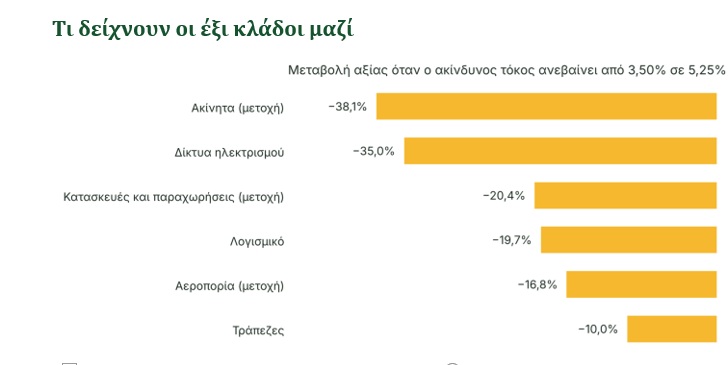
| Sector | Metric (€m) | Before | After | Change |
|---|
| Banks | P/TBV | 1.71 | 1.54 | −10.0% |
| Electricity networks | Enterprise value | 3,502 | 2,276 | −35.0% |
| Transport | Equity value | 1,849 | 1,538 | −16.8% |
| Construction and concessions | Equity value | 1,715 | 1,366 | −20.4% |
| Software | Enterprise value | 355 | 285 | −19.7% |
| Property | Equity value | 691 | 428 | −38.1% |
The duration of cash flows matters more than whether a sector is labelled “defensive” or “cyclical”. Networks, with their long, steady cash flows, lost more than transport and software. Where cash flows have an end date, as with concessions, the loss was smaller.
Borrowing magnifies the decline for shareholders. The same assumptions that produced a 24.1% fall in property values resulted in a 38.1% fall in equity, while debt in the construction business turned a 14.5% decline into 20.4%. Banks stand out because their revenues rise along with interest rates, and the outcome depends on whether returns keep pace with Ke.
To identify which companies are hardest hit, three questions are enough:
- How far into the future are the cash flows?
- How much debt is there, and when is its interest rate reset?
- Can the company pass higher costs on through prices or revenues?
Valuations built on interest rates of 3% leave little room for error when the 10-year yield is above 5%.