‘One misfortune is followed by countless others,’ as the ancient Greeks said — a saying that aptly captures the predicament Europe finds itself in because of the war in Ukraine and its rupture with Moscow.
The leaders of continental Europe made three strategic mistakes. The first was that they did not try to intervene decisively to prevent the shift from diplomacy to hostilities and Russia’s invasion.
The truth is that only the then German chancellor, Scholz, reportedly made a feeble attempt to persuade Zelensky to return Ukraine to neutrality, as the Wall Street Journal revealed a few months later.
Zelensky, however, refused, apparently with the backing of the US leadership at the time and other European powers.
The second mistake came during the 2022 peace negotiations in Istanbul, when there was a serious prospect of finding a compromise that today looks highly favourable to Ukraine.
The intervention of Boris Johnson also appears to have been decisive. According to the head of Ukraine’s negotiating team, David Arakhamia, the then British prime minister urged Kyiv not to sign an agreement and to continue the war.
The third — and perhaps biggest — mistake came when Europeans decided to shoulder almost the entire cost of the war, after Donald Trump, as the new US president, distanced himself.
History will examine how Europe’s leaders allowed themselves to be drawn by the US into a war whose burden, in a tragic irony, they were subsequently called on to shoulder almost alone.
What matters now, given the turmoil around the world, Europe’s economic decline, and the high debts and deficits in many EU member states, are the huge economic consequences of these mistakes.
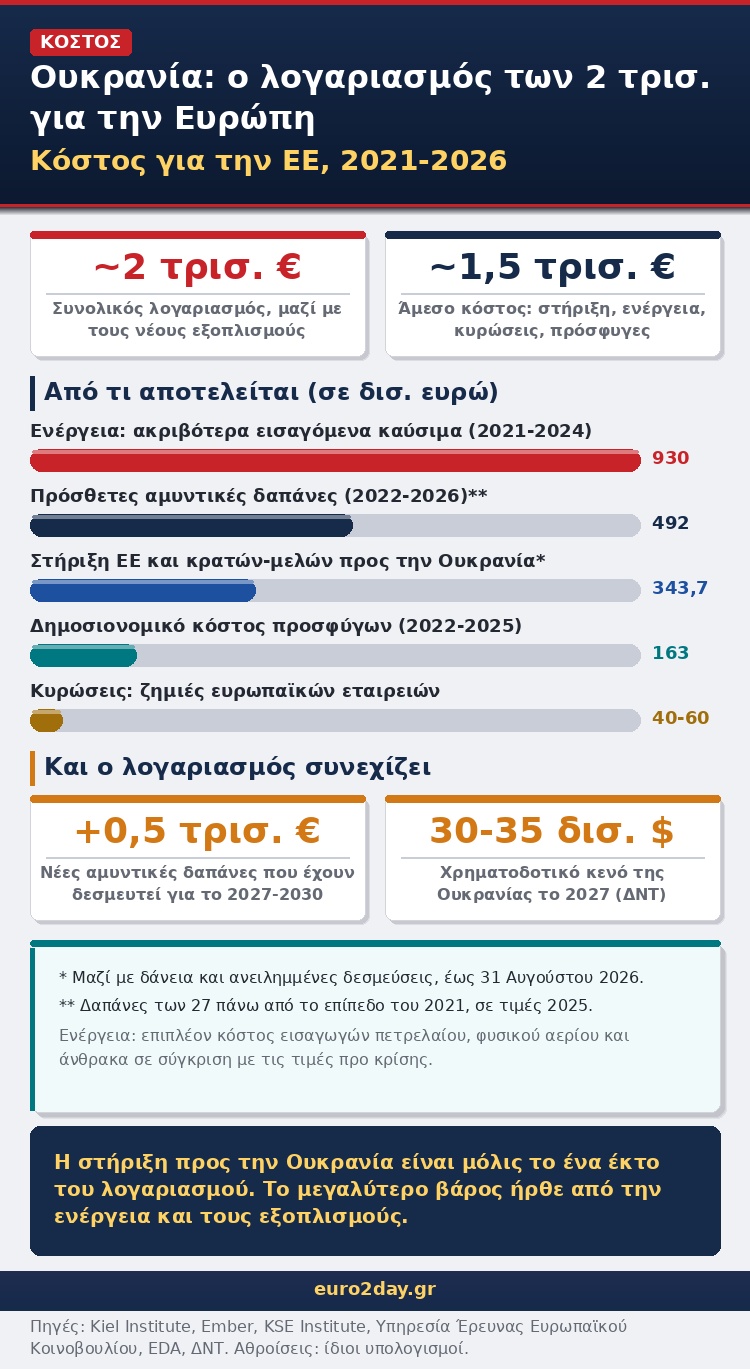
For the bill, as we will show, already stands at about €2 trillion! This is a sum that weighs on government budgets, households and businesses, hampers growth and threatens to upend the established political order.
A few days ago, Germany’s current chancellor, Friedrich Merz, said that abandoning support for Ukraine would have ‘huge repercussions for Europe’s political order’.
Perhaps he fails to see it (despite his plummeting approval ratings and the disastrous election and polling results in his country), but continuing ‘unconditional’ support for Ukraine will have precisely the same effect!
Ukraine: The bill beyond aid
Few people know that total support for Ukraine from the EU and its member states, including commitments already made, amounts to €343.7 billion, according to data from the Kiel Institute as of 31 August 2026.
But this figure pales in comparison with the wider bill from the energy crisis, other sanctions on Russia, and support for Ukraine and its refugees. A conservative projection of the available data through mid-October 2026 puts the total burden on the EU at more than €1.5 trillion!
The rise in the price of imported fossil fuels — oil, natural gas and coal — cost the EU an additional €930 billion in 2021–2024 alone, compared with what the same volumes would have cost at pre-crisis prices, according to a study by Ember Energy.
Other sanctions and economic decoupling from Russia are conservatively estimated to have caused companies losses of between €40 billion and €60 billion, based on an analysis of data from the KSE Institute.
In addition, the fiscal cost associated with refugees from Ukraine amounted to about €163 billion in 2022–2025, again according to the Kiel Institute, as cited by the European Parliamentary Research Service.
The scale of the figures, particularly the rise in energy costs, makes clear that the indirect damage is also enormous. It is reflected in the loss of competitiveness of European industry, deindustrialisation (centred on Germany), inflation and a higher cost of living.
This, in turn, is fuelling growing dissatisfaction among a large share of European citizens with their financial situation, whether or not they understand the scale of the damage and the mistakes made over Ukraine.
The second front: defence spending
There is also a huge indirect cost, on top of those outlined above, that is relatively easy to measure: the surge in defence spending, driven primarily by the ‘Russian threat’, which is invoked more forcefully each year amid the confrontation over Ukraine.
According to data from the European Defence Agency (EDA), defence spending by the EU’s 27 member states is set to rise from €259 billion in 2021 to €454 billion in 2026, an increase of 75% in real terms.
Adding up the amount spent each year above the 2021 level, the additional defence spending in 2022–2026 comes to about €492 billion in 2025 prices.
This additional spending helps explain why the wider bill is now in the region of €2 trillion. And a further half a trillion euros — roughly as much again — is the additional defence spending that EU member states, together with the EU’s central budget, have committed to over 2027–2030!
The question is whether this spending is really necessary in the face of Putin’s Russia.
Based on 2026 data and estimates, the following table shows conventional (non-nuclear) defence spending by the EU-27, NATO member states excluding the US and Turkey, and a group of 13 countries that includes Germany, France, the UK and Canada, among others.
The comparison is made both at market exchange rates and in purchasing power parity (PPP) terms.
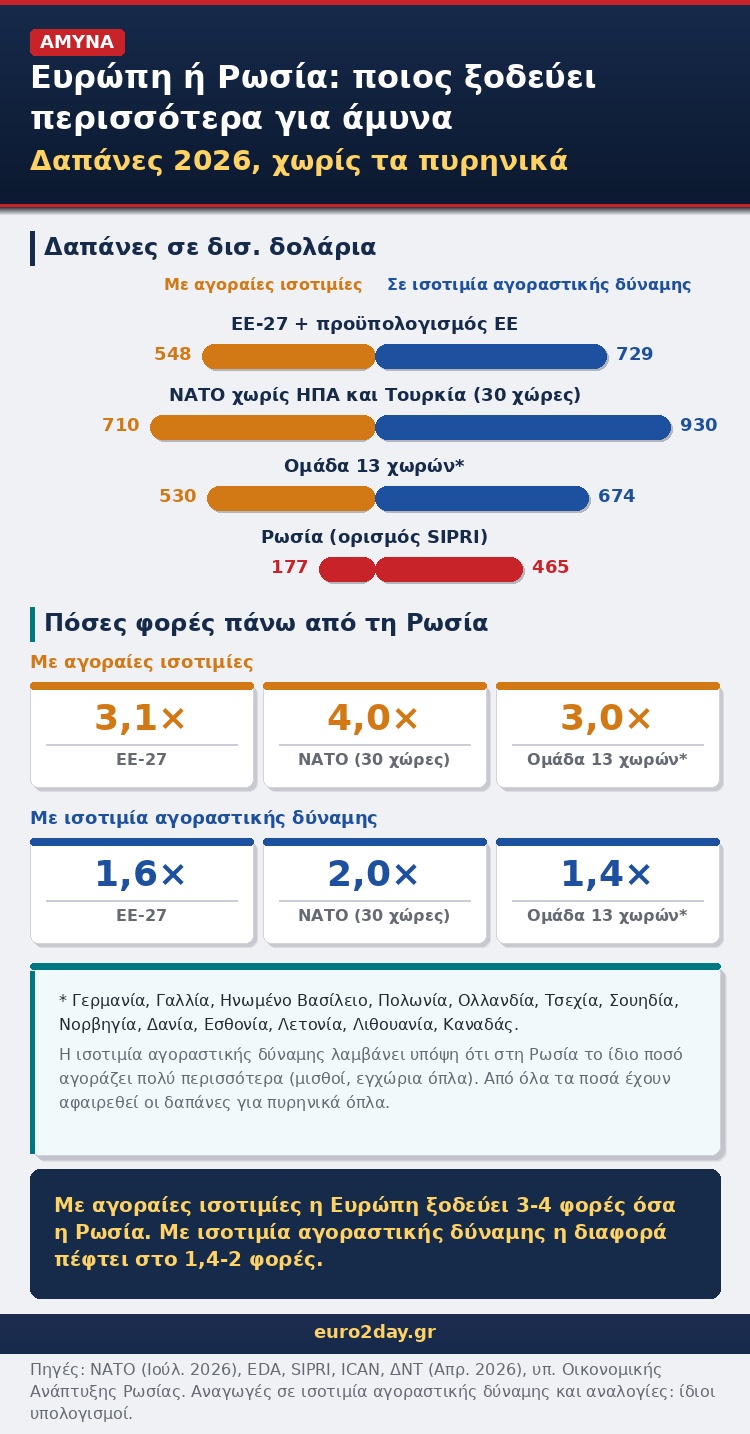
The figures show that, based on 2026 data, the EU already spends about 60% more than Russia in purchasing power parity terms. The figure rises to 100% — or twice as much — for NATO as a whole, excluding Trump’s US and Erdogan’s Turkey.
Even the group of 13 countries listed above, which are Ukraine’s most hawkish supporters, spends about 40% more than Russia on conventional defence in purchasing power parity terms, despite Russia already being engaged in a high-intensity war.
This raises a crucial question that has yet to receive a meaningful answer: why should EU countries spend an additional half a trillion euros over the next four years, instead of making more rational use of existing spending?
Especially when, judging by the combat readiness of most European armies, this spending is probably not being put to proper use!
The political cost of persisting with a mistake
With debts and deficits high and borrowing costs far above past levels, most European governments feel compelled to spend staggering sums because of the war in Ukraine, without taking account of either the fiscal or political consequences.
Unless something changes, this spending will continue in the years ahead. Already, Zelensky has formally requested a further €70 billion for 2027 alone, while defence spending, as we have seen, will also continue to rise.
Unless the further fallout from the serious crisis in the Middle East, as well as developments in Ukraine itself, forces Europe’s leaders to change course. That would mean realistically accepting a compromise diplomatic settlement, as well as a new security architecture in Europe that includes Russia.
The only certainty for now is that if dogmatic ‘insistence on the wrong course’ continues, the economic, political and geopolitical consequences will be even harder to bear.