According to the International Monetary Fund’s World Economic Outlook report (October 2026, “Resilience Under Strain, Urgent Choices”), the global economy is at a critical juncture. Managing public debt, adopting AI responsibly and swiftly, and ensuring energy security are the main pillars for securing sustainable growth and reducing inequality.
Against this backdrop, Greece is forecast to grow faster than the eurozone in 2026 and 2027, according to the report. The positive differential, however, has not translated into a convergence in living standards. In 2025, GDP per capita in purchasing power standards (PPS) stood at 68% of the EU average, compared with 104% in the eurozone.
The reasons are well known: higher inflation, a large current account deficit, negative household saving and one of the highest public debt burdens in the world. Unemployment is falling and the government budget is in surplus, but nominal incomes are not enough to demonstrate a lasting improvement in purchasing power.
The picture at a glance
Table 1 brings together the key indicators. Growth and unemployment are moving in the right direction. Inflation and the current account balance are not.
| Table 1. Key macroeconomic indicators: Greece and the eurozone |
|---|
| Indicator | Greece | Eurozone | Interpretation |
|---|
| Real GDP, 2025 | 2.1% | 1.2% | Faster growth in Greece |
| Real GDP, 2026 | 1.8% | 1.1% | The gap narrows |
| Real GDP, 2027 | 1.8% | 1.2% | The lead narrows |
| Inflation, 2025 | 2.9% | 2.1% | Prices rise faster in Greece |
| Inflation, 2026 | 4.2% | 3.1% | Severe pressure on purchasing power |
| Inflation, 2027 | 3.6% | 2.8% | Inflation eases, but prices do not fall |
| Unemployment, 2025 | 8.9% | 6.3% | Higher than in the eurozone |
| Unemployment, 2026 | 8.0% | 6.3% | Further decline |
| Unemployment, 2027 | 7.6% | 6.3% | The gap narrows |
| Current account balance, 2026 | −6.6% of GDP | +1.2% of GDP | A serious external imbalance |
| Source: IMF, World Economic Outlook, October 2026. |
Growth with question marks
The IMF forecasts real GDP growth in Greece of 1.8% in both 2026 and 2027, compared with 1.1% and 1.2% in the eurozone. Greece outperforms Germany, France and Italy, but falls short of Spain, Portugal, Bulgaria, Croatia, Slovenia, Lithuania, Estonia, Malta and Cyprus in every year of the period.
The growth figure is positive; the composition of growth is the problem. It is driven by consumption, tourism and investment financed by European funds, factors that do not in themselves demonstrate an increase in productivity. And the Recovery Fund’s expiry at the end of 2026 raises a simple question: who will sustain the pace of investment when European funding flows stop? Productivity remains the big unresolved issue.
Incomes rise, savings run down
According to supplementary data from ELSTAT, nominal household disposable income rose by 5.3% in 2025 to €167bn, while consumption increased by 5.5%. In the first quarter of 2026, income growth slowed to 3.2% and the saving rate fell to −3.3%, from −1.8% a year earlier.
| Table 2. Household income, consumption and saving |
|---|
| Indicator (ELSTAT) | Period | Figure |
|---|
| Nominal disposable income | 2025 | +5.3%
(€167bn) |
| Nominal disposable income | Q1 2026 | +3.2% year on year |
| Household saving rate | Q1 2026 | −3.3%
(compared with −1.8%) |
| Household consumption | 2025 | +5.5% |
| Source: ELSTAT |
With inflation at 2.9% in 2025, the 5.3% increase in nominal income implies a real rise of around 2%. This is a rough estimate: it uses headline inflation rather than the relevant income deflator, and there is not yet an official figure for real disposable income.
The picture is worse for 2026. If nominal growth stays close to 3% and inflation reaches 4.2%, real income will contract. A negative saving rate simply means that households as a whole are spending more than they earn.
The gap that is not closing
The most revealing comparison concerns living standards:
- In 2025, Greece’s GDP per capita in purchasing power standards (PPS) stood at 68% of the EU average, down from 69% in 2024. The eurozone figure was 104%, or 36 percentage points higher.
- Greece shares the lowest level in the EU with Bulgaria, behind Latvia (71), Slovakia (75) and Hungary (76).
- In 2006, Greece stood at 96% of the European average. The gap widened during the crisis and has not been made up. In 2025, the figure fell by one percentage point, even though the Greek economy is estimated to have grown by 2.1%, compared with 1.5% for the EU.
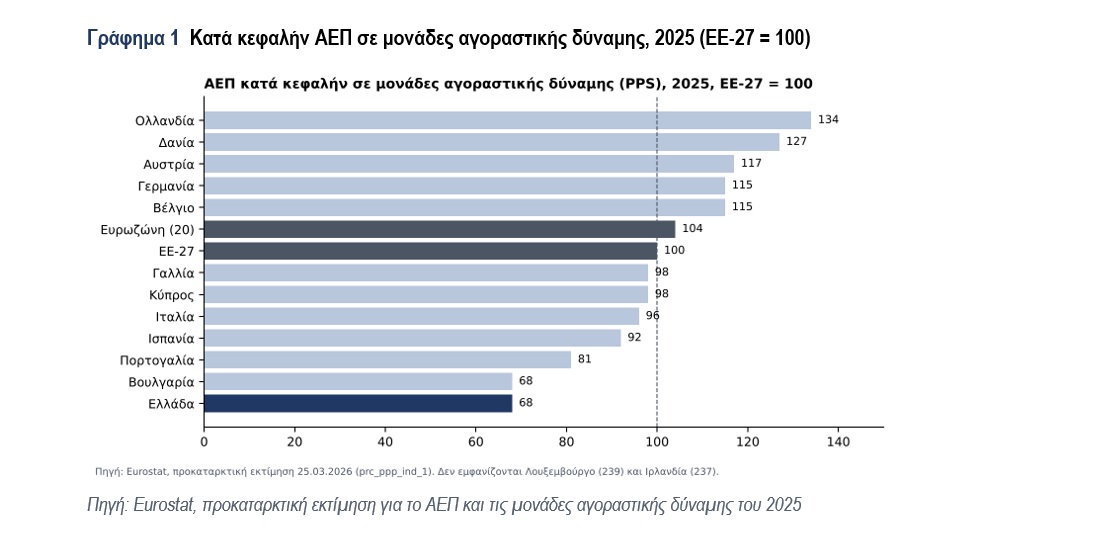
How long would it take Greece to reach the European average? With a 0.7 percentage-point annual growth advantage over the EU, about 55 years to rise from 68% to 100%. With a one-point advantage, about 39 years. The calculation (years = ln(100/68) ÷ ln(1 + growth differential)) is an order-of-magnitude exercise, not a forecast: it ignores changes in population and prices. It does, however, show how far away the target is.
Inflation is not neutral
The IMF forecasts inflation in Greece of 2.9% in 2025, 4.2% in 2026 and 3.6% in 2027. The corresponding figures for the eurozone are 2.1%, 3.1% and 2.8%. In both forecast years, prices in Greece rise faster.
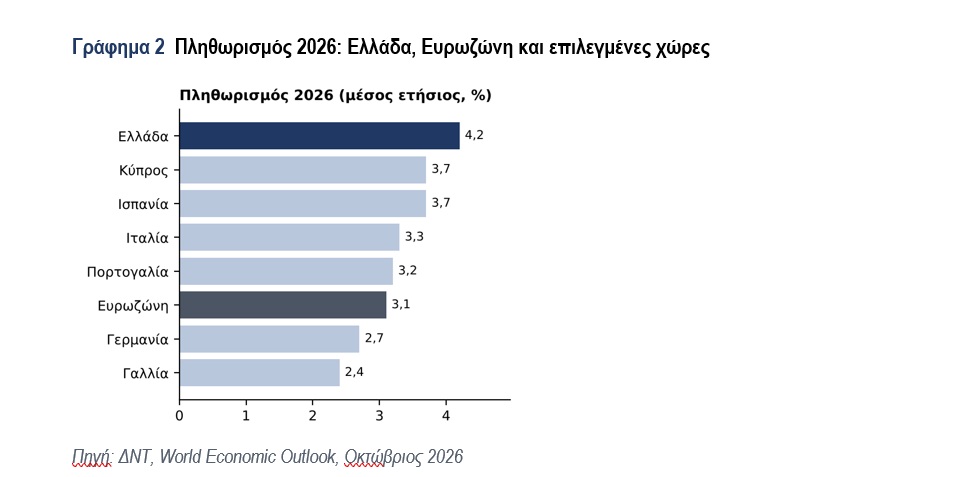
The pressure is coming mainly from abroad. Global inflation is forecast to rise from 4.1% to 4.7% in 2026, driven chiefly by energy and food. Oil is expected to become 41.3% more expensive in 2026 and 8.7% cheaper in 2027.
TTF natural gas prices are estimated to be about 36% higher than forecast in April. Food prices are expected to rise by 5% and fertiliser prices by 10%. Eurozone core inflation is not expected to return to 2% until mid-2028. As for rents, the IMF notes that during cost-of-living crises, the burden is also linked to higher interest rates and falls most heavily on renters and lower-income households.
There is a common misconception here. Disinflation does not mean that prices are falling; it means they are rising more slowly. With inflation at 3.6% in 2027, following 4.2% in 2026, the overall price level will be about 8% higher in 2027 than in 2025, based on the IMF’s annual average rates. The expected fall in oil prices will reduce energy costs, but will not undo the earlier increase.
To preserve real income, wages and pensions must rise at least as fast as prices. The burden is not shared fairly: in a typical advanced economy, lower-income households spend 70% of their budget on essentials, compared with 50% for higher-income households, according to IMF estimates.
We should also note the looming threat of stagflation (see related article: “The ECB’s dilemmas in a stagflation scenario triggered by the Persian Gulf”, Euro2day.gr, 24 March 2026)
Public finances, interest rates and the external deficit
Greece recorded a budget surplus of 1.7% of GDP in 2025 and public debt of 146.1% of GDP. Its debt remains the highest in the EU, but is declining. The main challenge is to maintain fiscal credibility without sacrificing public investment and growth prospects.
Financing conditions remain sensitive. The IMF forecasts rising yields on eurozone government bonds and warns that monetary policy may need to remain tight if the energy shock persists. Interest rates are set by the ECB for the eurozone as a whole; Greece has no scope to influence them.
The most serious external weakness is the current account deficit, forecast at 6.6% of GDP in 2026, while the eurozone is expected to post a surplus of 1.2%. A deficit of this scale means a need for external financing and greater sensitivity to changes in energy costs, interest rates and international demand.
Strengths - Weaknesses / Opportunities - Risks
| Table 3. Summary assessment (SWOT) |
|---|
✓ Strengths - Growth above the eurozone
- Falling unemployment
- Budget surplus
- Declining public debt
| ⚠ Weaknesses - GDP per capita in PPS at just 68% of the EU average
- Higher inflation
- Current account deficit of 6.6% of GDP in 2026
- Negative saving and high public debt
|
↗ Opportunities - Investment and a deeper EU single market
- Energy diversification and interconnections
- Reforms to promote competition and productivity
- Upgrading skills and digital infrastructure
| ! Risks - A new energy shock and prolonged conflict
- Tighter monetary policy and more expensive borrowing
- International financial turbulence
- Investment dependence on European funds
|
The bottom line
Greece has positive momentum in growth, employment and fiscal performance. Its lead over the eurozone, however, remains small and is not enough to close the deep income gap. Inflation, the external deficit and high debt limit the economy’s resilience.
Over the next three to five years, sustainable convergence will require investment and growth to translate into higher productivity, better-paid jobs and a stronger export base. The country also needs greater energy security, targeted social policy and fiscal discipline that protects productive investment.
The final judgement is straightforward. Greece is on course for convergence in growth rates, but not yet for meaningful convergence in living standards. If it maintained a one-percentage-point annual growth advantage over the EU average, it would take about 39 years to move from 68% to 100%. The challenge is to turn today’s growth into lasting productivity and a genuine improvement in purchasing power.
* Business Finance Consultant.
Brief biography: Mr Segredakis was born in Heraklion, Crete. He graduated from the Department of Economics at the University of Patras and holds an MSc in Finance. Since 1998, Mr Segredakis has served as a senior finance executive at large-cap companies listed on the Athens Exchange, as well as head of economic analysis departments at companies in the financial sector. He holds analyst certification from the Hellenic Capital Market Commission and was named Best Greek Analyst in the Athens Exchange’s annual competition in 2007. Several of his studies have been published in reputable Greek and international journals, as well as in financial magazines and the daily press, and he has presented a number of his studies at conferences and seminars.