Boosting family savings and protecting state revenue from tax evasion and undeclared money are priorities for the government’s economic team, as underscored by three key provisions included in the bill from the Ministry of National Economy and Finance, setting out measures announced at the Thessaloniki International Fair.
The bill — posted for consultation at opengov.gr/minfin — introduces institutional measures to address the falling birth rate through an “investment nest egg” for the next generation. It also extends for another year tax deductions for electronic receipts in sectors prone to tax evasion and makes the rules on tax-free tips more favourable, while keeping them strictly defined.
The investment nest egg
The Individual Investment Account for Minors (A.E.L.A.) is being formally established. The measure applies to babies up to 2 years old (for children born in 2025–2026), with implementation starting in 2027.
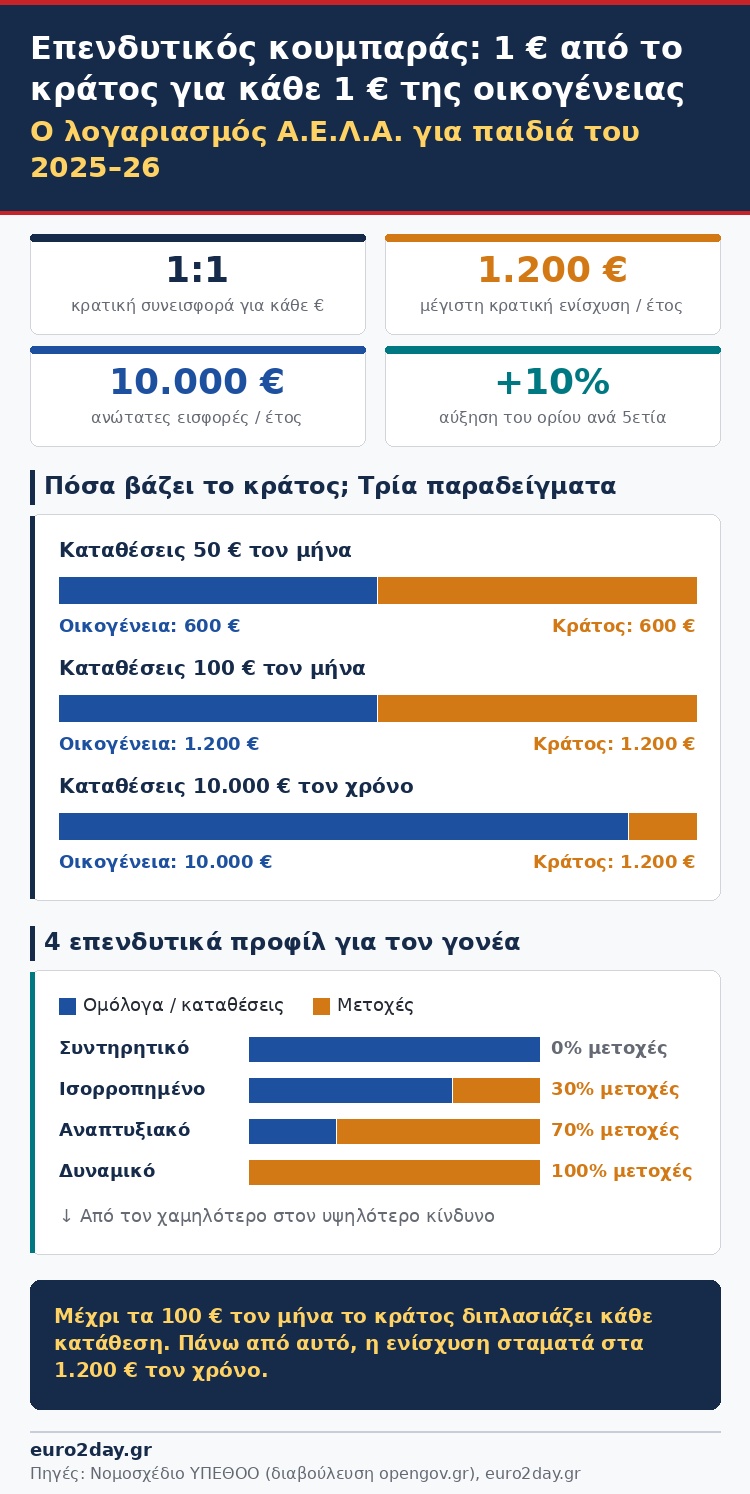
For every euro deposited by a family, the state will make an equal contribution, up to 1,200 euros a year. This limit will rise by 10% every five years. The funds will be invested exclusively in financial products (shares, bonds and mutual funds), and the capital will remain “locked up” until the beneficiary reaches adulthood, at 18.
Specifically, the relevant articles (29-46) provide that:
- For every child born in Greece, or who becomes eligible for an account under the specified conditions, the person with parental responsibility or custody may open one A.E.L.A. account.
- The process of setting up an A.E.L.A. is initiated when the person with parental responsibility or custody applies to a provider, provided the child has not yet reached the age of two at the time of application.
- Those with parental responsibility or custody may freely choose whether to have an A.E.L.A. managed by one of the providers or to manage the account themselves.
- The Greek state will contribute to each beneficiary’s A.E.L.A. an amount equal to 100% of eligible contributions paid into the account, up to a maximum of 1,200 euros per calendar year. The maximum amount will rise by 10% every five years.
- Total contributions to each A.E.L.A. may not exceed 10,000 euros per calendar year.
- The state contribution will generally be paid monthly on contributions of up to 100 euros a month. As higher amounts may be paid in some months and lower amounts in others, an annual reconciliation will be carried out covering all contributions paid by 31 December of the relevant calendar year.
Not just parents
Deposits into the account may be made not only by parents but by any individual, including grandparents and other relatives. The state will contribute an amount equal to 100% of eligible contributions, initially up to a maximum of 1,200 euros a year.
For example, if 50 euros is paid into an account each month, the state will add another 50 euros. Private contributions would therefore total 600 euros a year, with a further 600 euros in state support. If contributions reach 100 euros a month, the annual state contribution will be 1,200 euros. Even if private contributions reach 10,000 euros a year, state support will not exceed the prescribed maximum.
Parents will be able to choose how the money is managed from among four investment profiles, depending on the level of risk they wish to take:
- Conservative: 100% in fixed-income investments and 0% in shares.
- Balanced: 70% in fixed-income investments and 30% in shares.
- Growth: 30% in fixed-income investments and 70% in shares.
- Dynamic: 0% in fixed-income investments and 100% in shares.
Fixed-income investments are defined as holdings in bonds, bond mutual funds and deposits. The percentages for the four investment profiles apply to the invested portion of the account, excluding cash. Cash holdings will generally be limited to 5% of the portfolio’s total value, with provision for temporary exceptions.
Investments may be made in mutual funds, exchange-traded funds (ETFs), shares and bonds traded on regulated markets in the European Union or the European Economic Area.
By contrast, high-risk investments are excluded, including crypto-assets, leveraged products and certain derivatives and complex financial products.
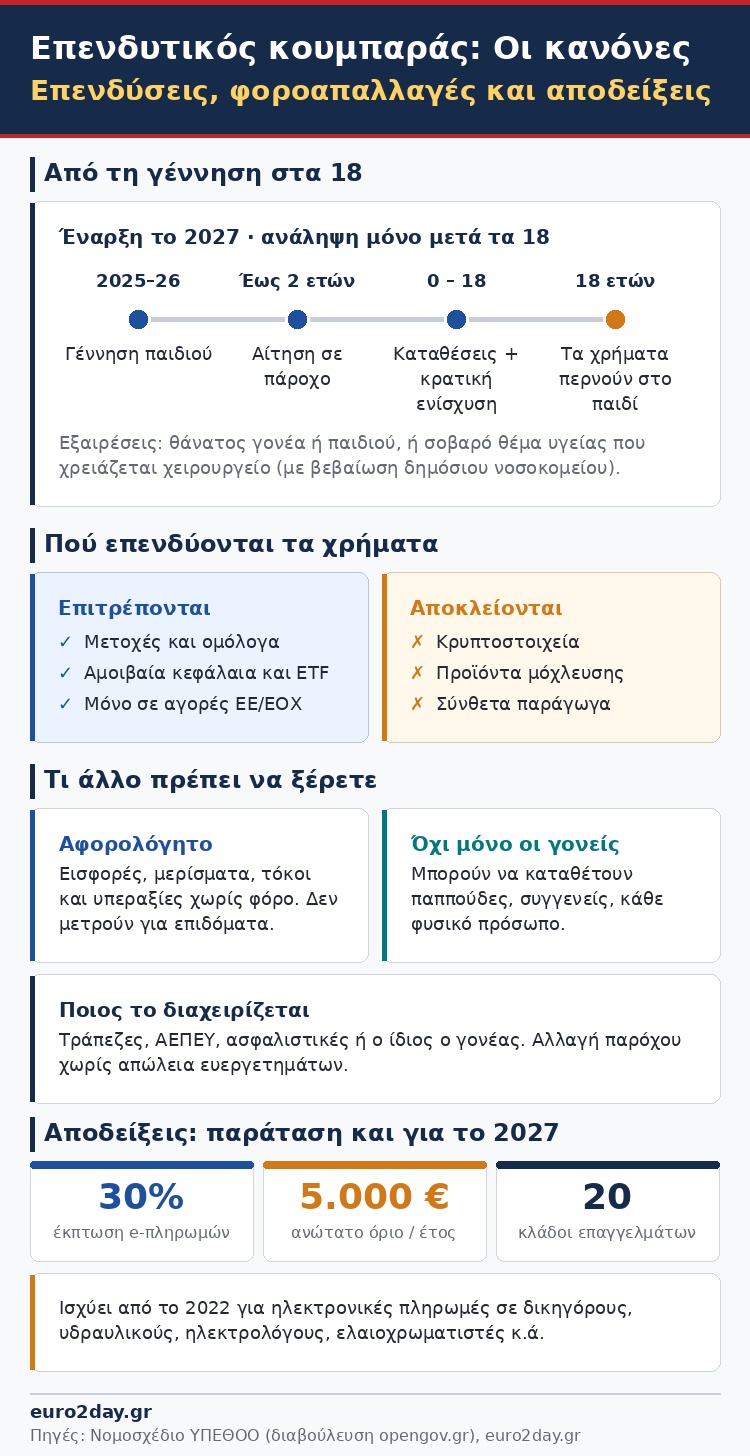
Providers of A.E.L.A. services or products may include credit institutions, investment firms and insurance companies. A beneficiary may transfer an A.E.L.A. from one provider to another without losing the tax benefits or other rights associated with the account.
A.E.L.A. funds — namely, contributions, the state contribution and investment returns — may not be withdrawn before the beneficiary reaches 18. Exceptions apply in the event of the death of a parent or child, as well as in cases where the A.E.L.A. beneficiary has serious health problems requiring surgery, as certified by a public hospital. Once the beneficiary reaches 18, the A.E.L.A. becomes their personal asset.
A.E.L.A. contributions are tax-free, do not count as taxable income for the minor beneficiary and are not taken into account when assessing income or other eligibility criteria for social benefits. Income from dividends, interest and capital gains on the transfer of securities held in an A.E.L.A. is exempt from tax.
Extension of incentives for receipts
Under Article 4 of the bill, tax incentives for electronic transactions in certain professions with high levels of tax evasion — such as plumbers, electricians and painters — will also remain in force in 2027.
The measure, which has been in force since 2022, provides that an amount equal to 30% of expenses paid electronically for services in 20 occupational categories is deducted from taxable income, up to an annual limit of 5,000 euros. The list includes, among others, lawyers, plumbers and electricians.