Italy’s move to subsidise the cost of natural gas for power generation is shaking up the electricity market and reinforcing the impression of a Europe where each country is going its own way to tackle the energy crisis.
The Meloni government announced on Friday that it had received the European Commission’s green light to introduce a scheme similar to the “Iberian model”: subsidising gas purchased by the country’s power producers above a set price, in a bid to contain wholesale electricity costs and, in turn, bills for households and businesses.
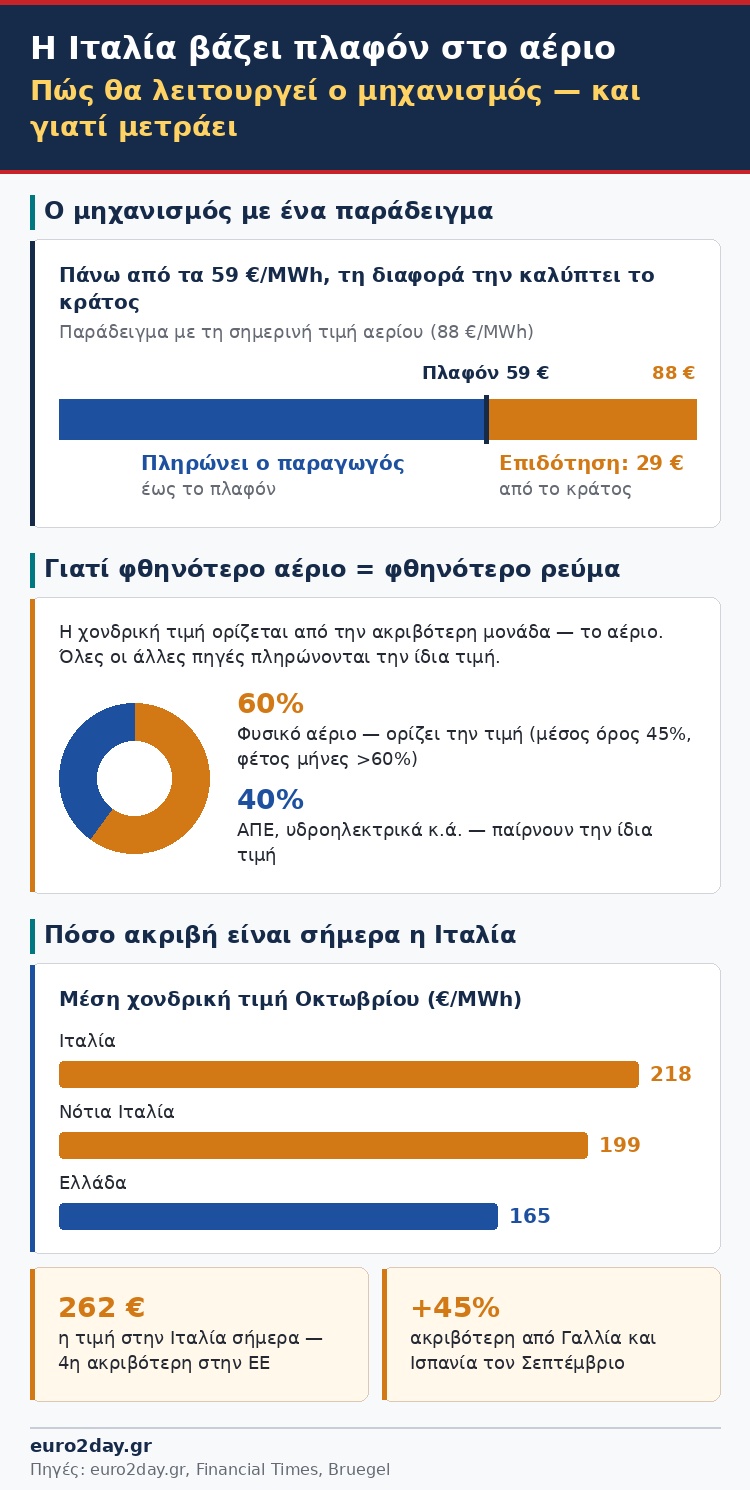
Although the details have not been made public, the Italian scheme, as revealed by the FT, sets a cap on natural gas at €59 per megawatt hour, above which a mechanism will compensate energy companies for the difference between that level and the current price they pay for the fuel.
For example, if the measure were in force today and power producers were buying natural gas at €88 per megawatt hour, its current price, they would receive a subsidy of €29 per megawatt hour to lower their costs, bring down the wholesale price and, in turn, the retail tariffs they offer.
In effect, by using the EU’s METSAF (Middle East Crisis Temporary State Aid Framework) state aid instrument, Italy — which has one of the most expensive electricity markets in Europe because of its heavy reliance on natural gas — hopes to sharply reduce its costs, secure cheaper electricity and become an exporter.
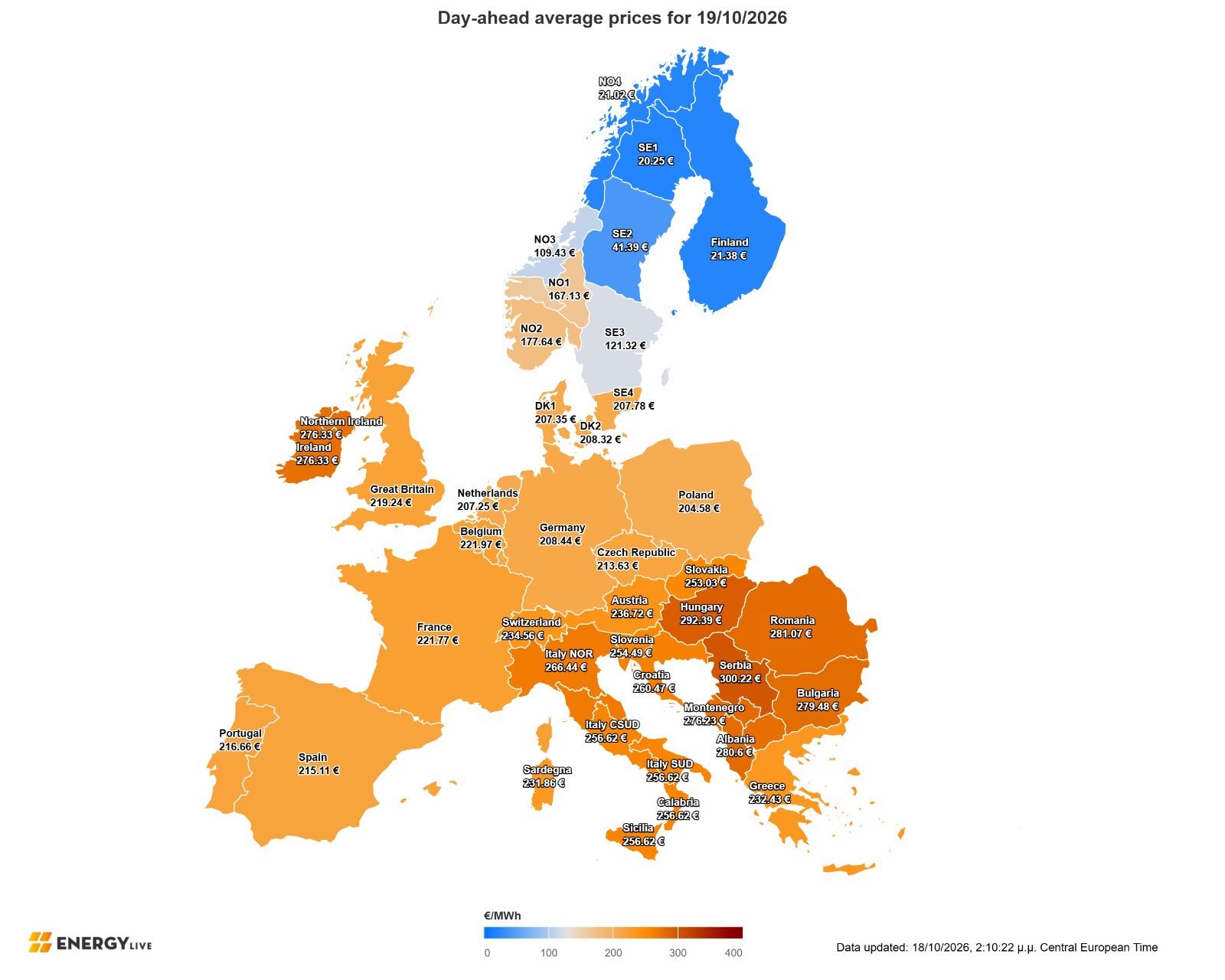
In September, prices in the country were 45% higher than in France and Spain, which rely mainly on nuclear power and renewables. Today, Italy has the fourth most expensive electricity in the EU, as the map below shows.
Why it matters to Greece
There are two reasons why this matters to Greece. The first is political: whatever the outcome, Italy’s move confirms the trend of a host of the EU’s 27 member states pursuing their own solutions, outside the usual frameworks, without waiting for Europe-wide action. The recent summit of the 27, and all that was — and was not — decided on the energy crisis, bear this out.
The second is practical. By subsidising natural gas costs for power generation, Italy’s very expensive electricity market — at €262 per megawatt hour today and an average of €218 in October — could become cheaper than many of its neighbours, including Greece.
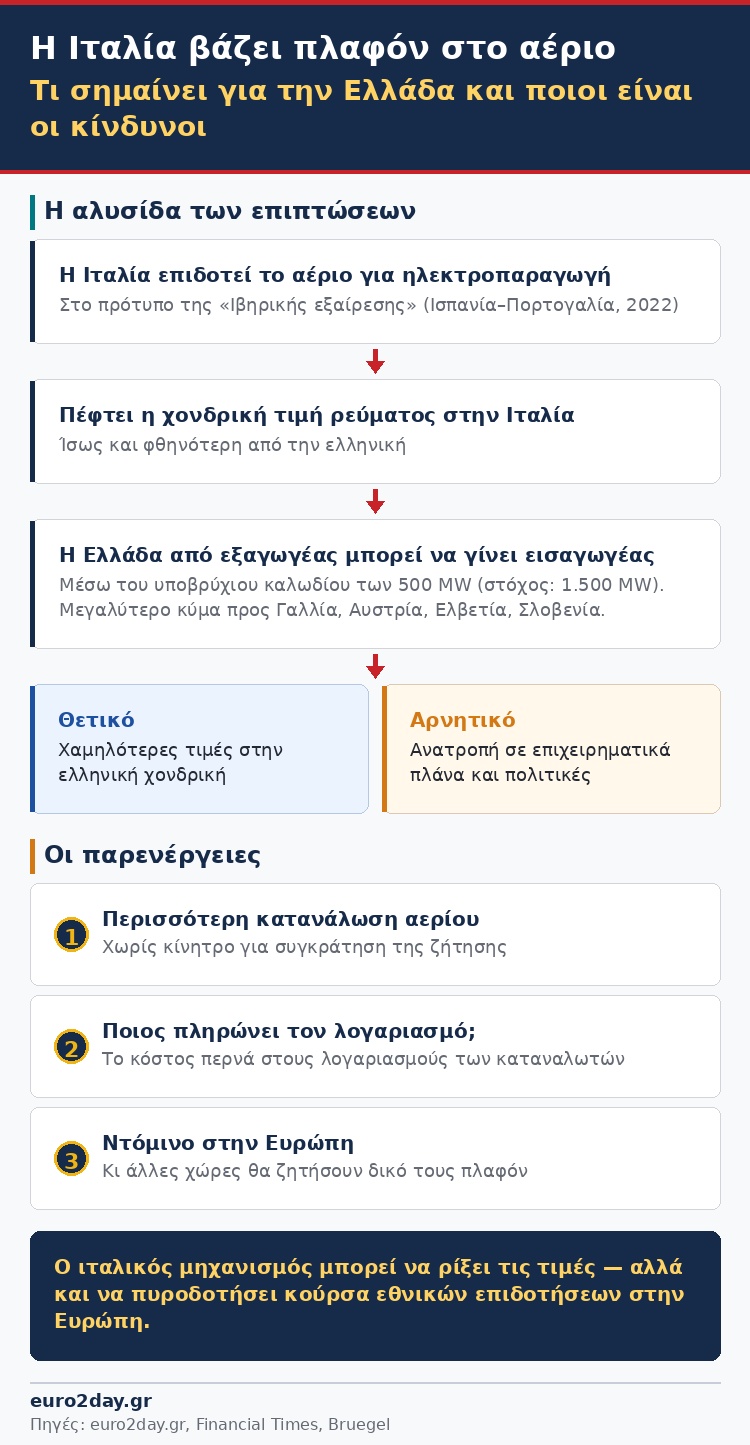
This will not happen overnight, as the gap between the two markets is very large: the average price in southern Italy was €199 in October, compared with €165 in Greece. Even so, under this scenario, instead of exporting electricity to Italy, as has traditionally happened through the submarine cable linking the two countries, with a capacity of 500 MW (and a target of 1,500 MW), Greece could start importing it.
That could bring lower prices to Greece’s wholesale market, but it would also upend some business plans and wider policies drawn up on entirely different assumptions.
This scenario would not affect Greece alone, but every country interconnected with Italy, all of which, notably, have lower prices. From France, Austria and Switzerland to Slovenia, Italy’s neighbours could suddenly find themselves importing abundant, cheap, subsidised Italian electricity.
And because Italy’s interconnections with its northern neighbours have far greater capacity than the smaller Greek link, the flows of electricity into western and central Europe would reshuffle the deck and provoke reactions, turning neighbouring markets upside down.
How the Italian mechanism will work
Although reports say the subsidy for gas used in power generation will ultimately be funded through additional charges on consumers’ bills, the Italian scheme appears to be based on the premise that the resulting costs for households and businesses will be far smaller than the benefits they receive.
That is because natural gas accounts for 45% of Italy’s power mix, although its share exceeded 60% in some months this year.
Under EU rules, however, the wholesale price of electricity is set by the most expensive unit used to meet demand — in this case, natural gas. All other technologies supplying the market at that particular hour are therefore paid the same high wholesale price.
In broad terms, the Italian scheme is based on the idea that subsidising gas will also bring down the wholesale price for the remaining 40% (assuming gas accounts for 60%) generated by renewables, hydropower and other technologies, with a knock-on effect on costs across the neighbouring country’s market.
The adverse effects
Market executives with knowledge of the discussions at EU level, who spoke to Euro2day.gr, have listed a series of adverse effects and warned that the agreement between Rome and the European Commission may not deliver the expected result — lower electricity prices.
The measure paves the way for Italy, which is highly dependent on natural gas, to consume even more of the fuel. Once gas is subsidised, market participants will have little reason to pay attention to the price they buy it at. The gas market is currently governed by what is known as “price sensitivity”, whereby a price rise can lead to a sharp drop in consumption.
This raises the question of who will cover the costs if, for example, gas prices continue to rise and the gap above the €59-per-megawatt-hour threshold widens further.
“Given Italy’s heavy reliance on natural gas for power generation, the system will ultimately become unsustainable in terms of cost, while bringing a series of side effects — from increased demand for natural gas to exports of subsidised electricity to neighbouring countries,” said Simone Tagliapietra, an energy expert at the Bruegel think tank.
Another issue is the reaction other countries may have to exports of cheap, subsidised electricity paid for with Italian taxpayers’ money.
Experts believe this could open the floodgates, with a host of European countries asking Brussels for permission to cap the price of natural gas used for power generation. In practice, the model favours countries with greater fiscal capacity, which can secure lower electricity prices, but puts others at a disadvantage.
The Iberian exception
The mechanism agreed with Brussels is based on the so-called “Iberian exception”, agreed with Spain and Portugal in 2022. It involved a temporary cap on the price of natural gas used exclusively to generate electricity.
As the FT reports, it is no coincidence that the mechanism for Italy was championed by former Spanish energy minister Teresa Ribera, now a European Commission vice-president responsible for state aid and competition policy.
Last February, the Meloni government had already sought permission to subsidise gas-fired power plants to cover CO2 costs, but the European Commission did not approve the proposal at the time.