When yields rise, anyone who already owns bonds suffers a capital loss: prices move inversely to yields, and the longer the maturity, the greater the fall. Against the backdrop discussed in our previous article (Fed 3.75-4.00%, ECB 2.50%, US 10-year above 5%), this is no theoretical issue: it affects individuals, businesses and, above all, banks.
Conditions have worsened since early October. The US 10-year yield reached 5.36% and the 30-year 5.73%, their highest levels since 2002, driven by energy inflation and fiscal concerns. Brent closed at $109.86 on 16 October, its highest close since mid-May.
September inflation (CPI of 3.7% for the headline index and 2.6% for core, both above forecasts) increased the chances of another Fed rate rise: markets are pricing in a probability of more than 70%, for December, while the October 27-28 meeting is expected to see rates held.
The Greek 10-year yield is trading at 4.30-4.50%, with a spread of about 90-95 basis points over the Bund.
Why prices fall
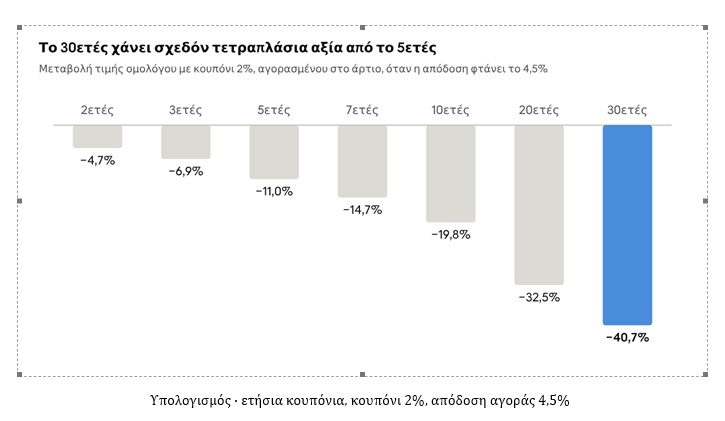
A bond pays a fixed coupon. When the market demands a higher yield, an older bond has to sell for less so that its new buyer earns the current yield. The table shows a bond bought at par (100) when its yield matched its coupon, with the market at 4.5%, close to the Greek 10-year yield of 4.4%.
| Bond | Coupon | Price at a 4.5% yield | Change |
|---|
| 5-year | 2% | 89.0 | -11.0% |
| 10-year | 3% | 88.1 | -11.9% |
| 10-year | 2% | 80.2 | -19.8% |
| 30-year | 1% | 43.0 | -57.0% |
The loss remains «on paper» as long as the bond is not sold; if held to maturity, the holder receives 100% of the principal. But anyone who needs liquidity sooner or is forced to sell realises the loss.
Individuals: The risk of the «safe» portfolio
Individuals are often the least protected because they believe bonds cannot lose money. A long-term bond in a period of rising yields is not «safe».
- Forced sale. If they need cash, the loss becomes real when the market is weaker.
- Mutual funds. A «bond fund» may hold long-term bonds that have lost value without the investor realising it.
- Leverage. If bonds have been bought with borrowed money (on margin), a fall in prices can trigger forced sales.
- More expensive loans. The same rise in interest rates increases repayments on variable-rate mortgages.
Investors who bought bonds in 2020-2021 often refuse to sell so as «not to make the loss real». They simply defer the loss and miss the opportunity to invest in bonds with higher coupons.
Businesses: Refinancing, bond holdings and pensions
For businesses, the risks stem from maturing debt, bonds held in their cash reserves and pension schemes.
- Debt refinancing. Companies that issued bonds with coupons of 2-3% in 2020-2021 will have to refinance at much higher rates; interest expenses will rise and earnings will cover less of them. Companies with high debt or weak cash flows are more vulnerable.
- Cash reserves invested in bonds. If a company sells before maturity to meet operating needs, it realises losses. The risk is twofold: as SVB showed in 2023, cash reserves may be held at a bank under severe strain.
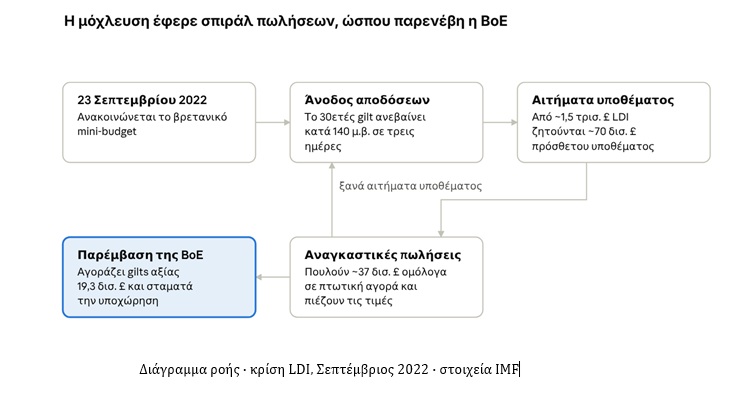
- Pension schemes. The clearest example is the UK’s 2022 LDI crisis, when funds sold bonds into a falling market.
Banks: Losses that stay hidden until liquidity is needed
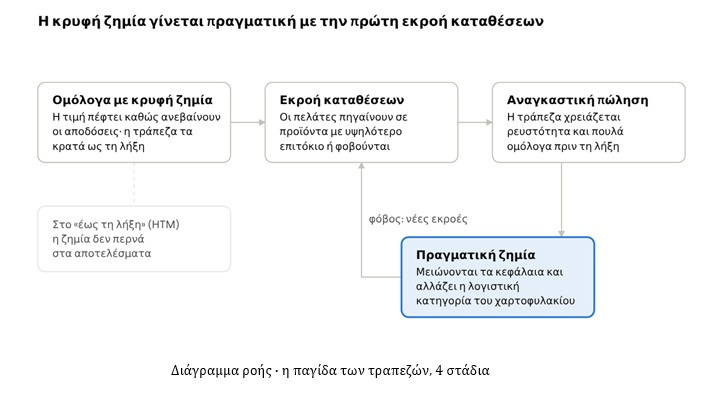
Bond losses alone do not threaten a bank. The problem begins when it is forced to realise them, which usually happens when unrealised losses coincide with deposit outflows.
How the trap works. «Held-to-maturity» bonds are recorded at amortised cost, so their price falls do not flow through to profit or loss or equity; «available-for-sale» bonds are measured at market value through other comprehensive income. But if a bank sells before maturity, the loss is realised and may affect the classification of the rest of its portfolio: when it needs to sell, it does so at the worst possible time.
The scale. In 2023, FDIC chairman Martin Gruenberg estimated unrealised losses at US banks at about $620bn, following a rise of about 4.5 percentage points in Fed interest rates (Fortune). According to the FDIC, they stood at $326.7bn at the end of June 2026 (5.5% of amortised cost), excluding the rise in yields in October.
The double squeeze. Deposit rates rise with a lag and depositors move into higher-yielding products; the bank loses cheap funding and asset value at the same time.
The IMF’s warning. In its October 2026 Global Financial Stability Report, the IMF identifies the vicious cycle of forced selling as a key risk: sales push yields higher, triggering margin calls, while leverage accelerates the process. In a severe-stress scenario, banks accounting for about 22% of global banking assets would have insufficient capital, up from 18%; this is a simulation, not an indication of insolvency.
In Greece. During the 2012 PSI, Greek banks, which held about €48.8bn in nominal Greek bond holdings, lost €37.7bn and the system needed more than €40bn in new capital (ESM). This is not a comparable scenario (the cause was a sovereign debt default, not rising interest rates), but it shows how quickly bond exposure can become a balance-sheet problem.
First-half 2026 figures. Most of the securities held by the major banks are carried at amortised cost: €23.7bn out of €29.1bn at Eurobank, €16.8bn out of €21.2bn at Piraeus and €17.6bn out of €19.3bn at Alpha Bank (91%).
The latent loss on this portion grew rapidly: €254m at Eurobank, up from €59m at the end of 2025, and €409m at Piraeus, up from €315m. DBRS estimates that Greek banks’ holdings of government bonds are close to 300% of CET1 capital, and that 71% have a duration of more than five years (46% in the EU).
What history teaches: The same pattern over three decades
The pattern repeats: a sharp rise in interest rates, long-term bonds that lose value, leverage or a duration mismatch, and an unexpected need for liquidity.
| Case | Period | What happened | Outcome |
|---|
| US Savings & Loans | 1980s | Long-term fixed-rate mortgages lost value, while deposits had to offer ever-higher returns | The Resolution Trust Corporation closed 747 banks with assets of more than $407bn, at a cost to taxpayers of up to $124bn (Federal Reserve History) |
| UK pension funds (LDI) | September 2022 | After the 23/9 mini-budget, the 30-year gilt yield rose by 140 basis points in three days; leverage triggered forced selling | About £70bn in additional collateral was called for, about £37bn of bonds were sold and the Bank of England bought £19.3bn of gilts (IMF) |
| Silicon Valley Bank | March 2023 | Bonds accounted for 55% of assets (78% in HTM) and 94% of deposits were uninsured | Sale of $21bn in bonds at a loss of $1.8bn (8/3), withdrawals of more than $40bn (9/3), bank closed (10/3) (Federal Reserve) |
Three conclusions emerge from these cases. First, it was usually not rising interest rates themselves that caused a collapse, but forced selling following leverage or deposit outflows. Second, central banks intervened within weeks, something that cannot always be taken for granted.
Third, losses emerge at small funds, municipalities and banks with «silent» portfolios.
How many funds have collapsed?
There is no reliable count of how many funds have gone bankrupt because of rising interest rates, nor are there reliable statistics. However:
- Background noise. Hedge funds close all the time, regardless of interest rates: 156 funds closed in the second quarter of 2022 (Investing.com/Reuters). Sources do not break the figures down by cause.
- Named cases. In 1994, Askin Capital Management collapsed with losses of about $0.6bn on mortgage-related products, and Orange County went bankrupt with losses of $1.6-1.7bn from leveraged investments. In 1998, Long-Term Capital Management lost about $4.6bn on leveraged bond positions.
- 2022. No closure of an Irish fund was reported during the UK’s LDI crisis, but the survival of a significant minority of funds was threatened: a quarter of funds lost more than 80%, and the sector raised £41bn in new capital (Central Bank of Ireland).
In conclusion...
Rising yields threaten those combining long duration, leverage or inadequate liquidity, not those able to absorb the loss until maturity.
- Individuals: the loss is «on paper» until they need cash; the risk is failing to understand the duration of their portfolio.
- Businesses: refinancing at higher cost and liquidity that is inaccessible when needed.
- Banks: the «held-to-maturity» classification does not eliminate the loss; it hides it. With a large portfolio, few insured deposits and fragile confidence, the problem can quickly become systemic, as in 2023.
- Greece and the eurozone: Greece is now better positioned than France and Italy, but the Greek banking system knows better than any other how costly a bond crisis can be.
In the coming months, with the Fed meeting on October 27-28 as the first key event, it will be worth watching for the first historical warning signs: sharp moves in yields, leverage outside the banking sector and outflows of uninsured deposits.