Signals from four fronts point to a perfect energy storm that is intensifying by the day, with the government concerned as winter approaches, fiscal room for manoeuvre narrows and a European response remains the key outstanding issue.
From low nuclear and hydropower output in our neighbourhood to expensive natural gas and high CO2 prices, everything points to a deepening price crisis. For now, the situation remains under control thanks to weather conditions that are still favourable.
The Greek energy exchange, meanwhile, increasingly resembles a “roller coaster”, with wholesale prices swinging by more than 100% over the past month in line with renewable energy output: as soon as it falls, prices surge, and vice versa.
Today, for example, with light winds, renewables account for just 43% of the energy mix and natural gas for 39%. Wholesale prices are hitting a yearly record, reaching €247.82/MWh and €406.48/MWh at the evening peak.
From €102/MWh at the end of September to €247/MWh today, prices have risen by more than 140%.
Scenes reminiscent of the previous energy crisis are returning across our wider neighbourhood, which is once again in the “red”. Average wholesale prices today stand at €300 in Bulgaria, €307 in Romania, €317 in Serbia and €326 in Hungary.
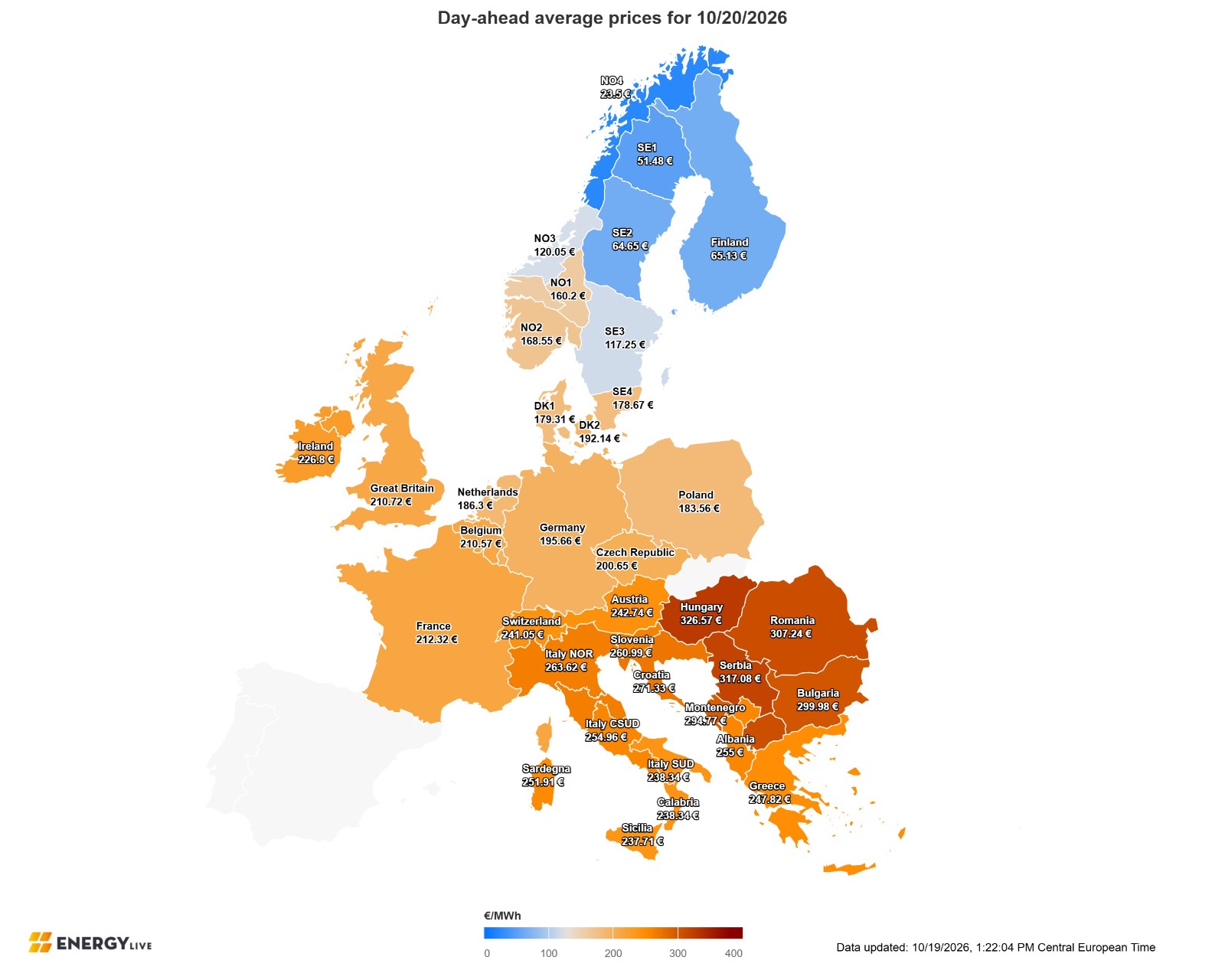
Central and Western Europe may be faring somewhat better, but prices there are also holding at crisis levels. They stand at €195 today in traditionally low-cost Spain (up 182% on Monday), €195 in Germany, €200 in the Czech Republic and €212.32/MWh in France, where problems with nuclear output are pushing prices higher in neighbouring countries too.
In Greece, prices at these levels have not been seen on a broad scale since January 2023, when the previous energy crisis was still in full swing and across-the-board subsidies set the tone in the electricity market each month.
Asked what the government would do if the situation persisted, official sources say “winter will be quite difficult”. In effect, that points to the budget’s inability to begin providing support for both fuel, where there is no sign of prices easing, and electricity.
Oil rose above $110 a barrel again yesterday, while gas is holding steadily above €88/MWh.
In practice, as the Prime Minister’s arguments also indicate, Athens will continue to press at European level for the national escape clause to be repurposed. This would allow it to spend some of the next funding allocations directly on support for households and businesses, without the amounts counting towards the spending ceiling (fiscal flexibility).
But as developments revive memories of the previous energy crisis, government calculations of how much would need to be distributed for fuel and electricity, in the worst-case scenario of the current situation extending into 2027, amount to an exercise with an unknown outcome.
This is particularly true now that four critical cost factors are also driving electricity prices, and are more pronounced in our neighbourhood than in the rest of Europe.
1. Low nuclear output
Although reduced summer output from major nuclear plants in Central and south-eastern Europe, due to falling water levels in the Danube, was expected to be temporary, those expectations have ultimately proved wrong.
The problem appears to be more systemic: disruption is continuing, and production shortfalls in Romania and Hungary are being covered by Greece and Bulgaria.
In the second half of October, the Cernavoda plant in Romania and Kozloduy in Bulgaria are out of service for scheduled maintenance, with Kozloduy operating at 50%. The reactors at Hungary’s Paks plant are also running at 30-35% because of persistently low water levels in the Danube.
Nuclear output in south-eastern Europe has fallen by 15% since the start of the year.
2. Low hydropower output
The summer drought was not followed by heavy autumn rainfall, and hydropower reserves across south-eastern Europe remain very low. Hydropower output in the region has fallen by 31% since the start of the year.
This is why Montel analysts estimated a month ago that the combination of low water levels and volatility in natural gas prices could drive electricity prices in the region up by as much as 66% year on year in the fourth quarter. In practice, that means wholesale prices above €200/MWh, which have been a regular feature lately.
3. Expensive natural gas
Natural gas is consistently hovering around €90/MWh, meaning that on days when renewable output is low, wholesale prices in Greece climb above €200/MWh.
What is happening today is a snapshot of the wholesale market’s ups and downs over the past month.
When renewable output falls short, prices can rise by as much as 53% from one day to the next (for example, from 11 to 12 October). Conversely, they can plunge by up to 26% (from 10 to 11 October) when green generation is close to 70% or reaches 80%.
4. High CO2 prices
CO2 allowance prices are hovering around €86 a tonne, adding €30/MWh to the cost of running a gas-fired plant. At the start of the war in the Persian Gulf, the same price stood at €70 a tonne. Allowance prices are rising because Europe is “burning” more natural gas while the supply of CO2 allowances is limited.