More workers do not necessarily mean more output, just as more hours worked do not guarantee higher incomes. Greece’s productivity problem largely reflects weaknesses in the country’s production model: insufficient investment, a limited industrial footprint, small businesses and obstacles that hamper the spread of technology and innovation across the economy.
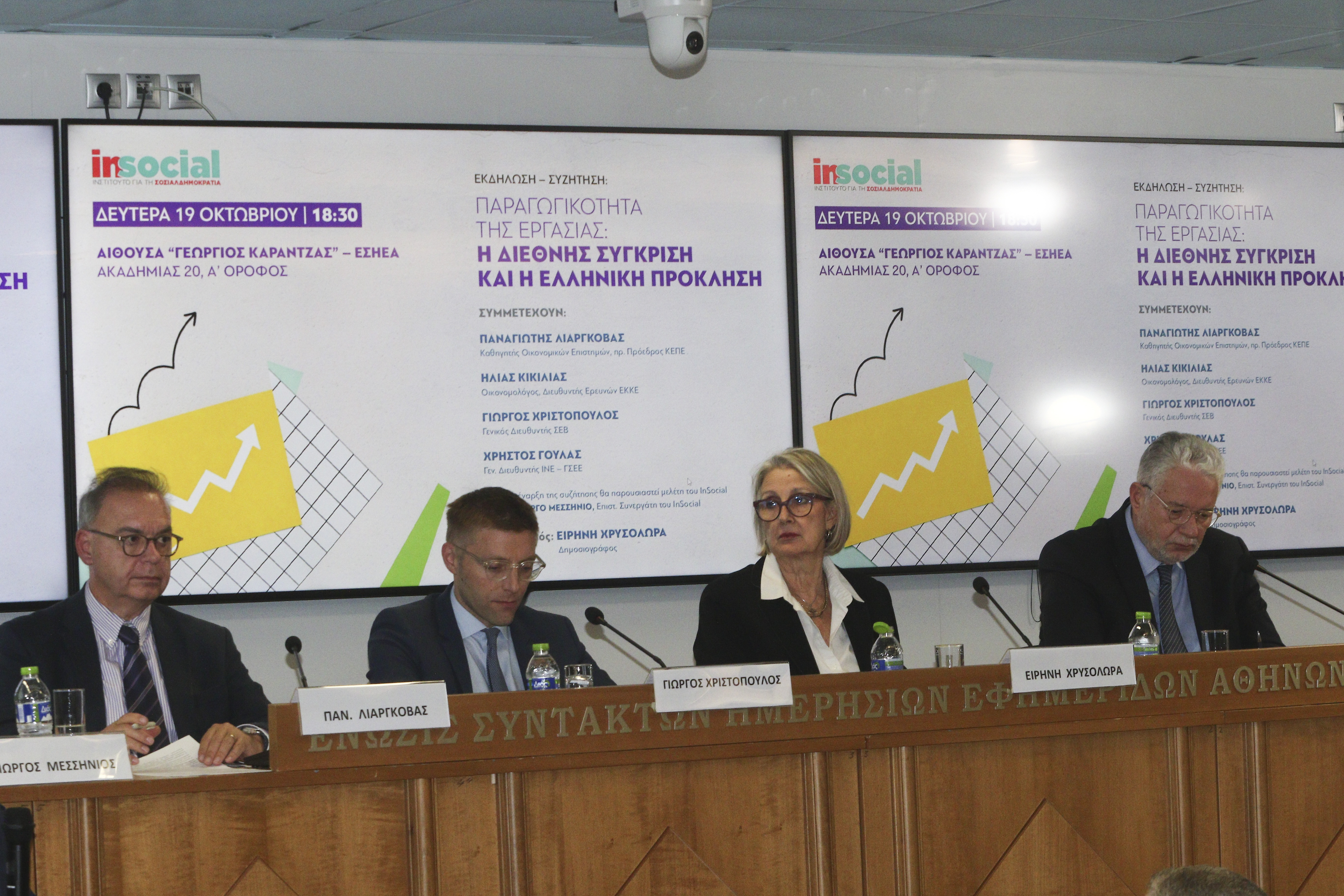
This picture was set out in a study by George Messinios, a research associate at InSocial, presented at an institute event entitled “Labour productivity: The international comparison and the challenge for Greece”.
According to the findings, Greece remains last in average productivity per worker among the five countries examined, despite a gradual improvement since 2020. The study’s conclusion, echoed in the discussion that followed, is that productivity is not merely an economic indicator but a prerequisite for sustainable growth in incomes and competitiveness.
The challenge for Greece, moreover, is to turn investment into productive capital, strengthen manufacturing and remove the obstacles that keep businesses small and the economy low in the European rankings.
In detail, the strongest finding concerns the link between investment and productivity. The study records a correlation coefficient of 0.95 between productivity and the I/C investment intensity index, indicating an exceptionally strong positive relationship. The finding highlights the investment shortfall as a key factor behind Greece’s underperformance.
In the same vein, InSocial head and professor Nikos Christodoulakis linked the decline in productivity after 2008 to the collapse in investment, stressing the need for large-scale reinvestment.
He also criticised the use of funds from the Recovery Fund, estimating that better management could have covered 50% of the investment gap.
The sectoral picture reveals another contradiction. Manufacturing has higher productivity than the Greek economy as a whole, yet its share of gross value added is the lowest among the countries compared. In 2024, it accounted for 10.4% of total value added, compared with 16.9% in Italy, 13.5% in Portugal and 11.9% in Spain.
The picture is similar in employment. In 2025, the number of people working in manufacturing in Greece reached 426,600, representing 8.2% of all employed people. The corresponding share was 14.6% in Italy, 13.6% in Portugal and 10.1% in Spain. The figures underline that upgrading productive capacity depends not only on the performance of individual sectors but also on their weight in the economy.
By contrast, tourism, which accounted for 7.3% of value added and 14.4% of employment in Greece in 2024, had productivity below the national average. Its performance also lagged behind Portugal’s, despite the similarities between the two economies in this sector.
According to Panagiotis Liargovas, the shortfall is linked to limited investment, the small size of businesses, weak links between research and production, and the quality of institutions. The professor of economics and former chairman of KEPE also noted that productivity gains should translate into higher wages.
Ilias Kikilias, an economist and research director at EKKE, put the clientelist and bureaucratic allocation of resources at the centre of the discussion, while SEV director general George Christopoulos highlighted shortcomings in rail infrastructure, high energy costs, licensing delays and a shortage of technical staff.
*See the study’s charts and tables in the “Supporting Material” column on the right.