ND remains in first place in GPO’s October poll for iefimerida.gr, with ELAS and PASOK vying for second place.
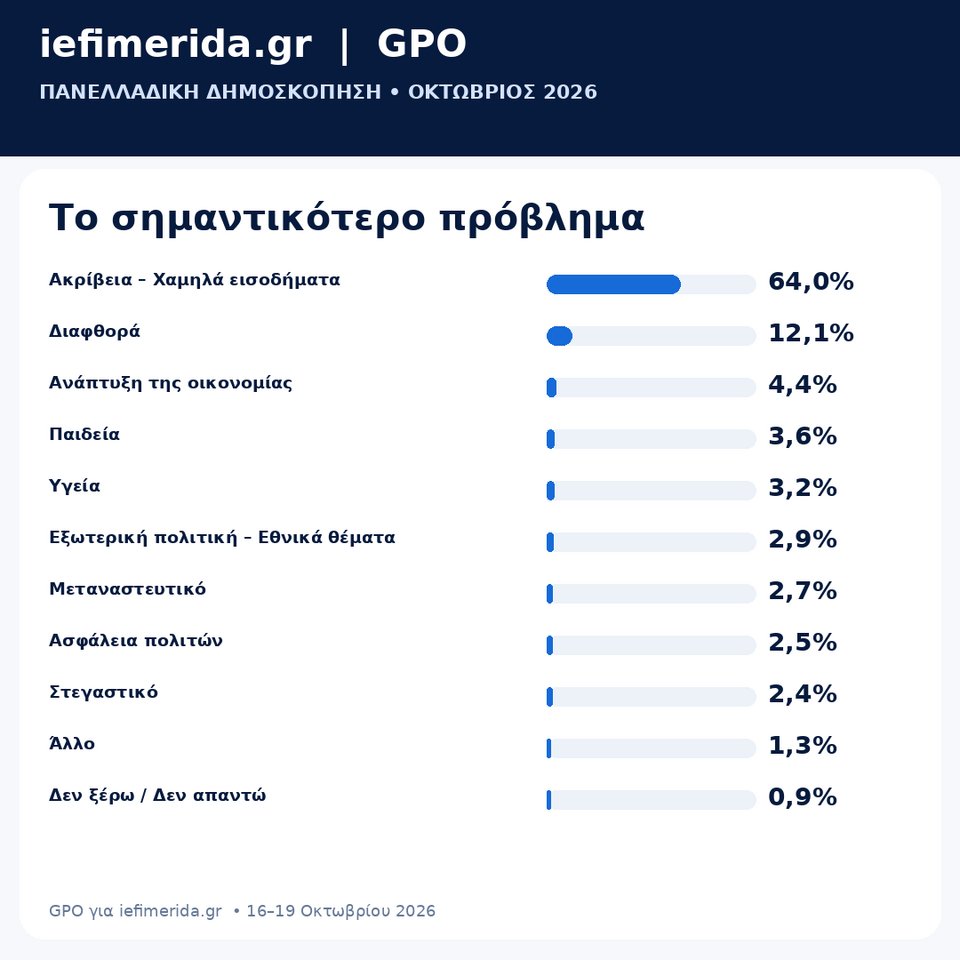
The poll shows that the biggest problem facing citizens remains the cost of living.
52.7% want a single-party government after the election
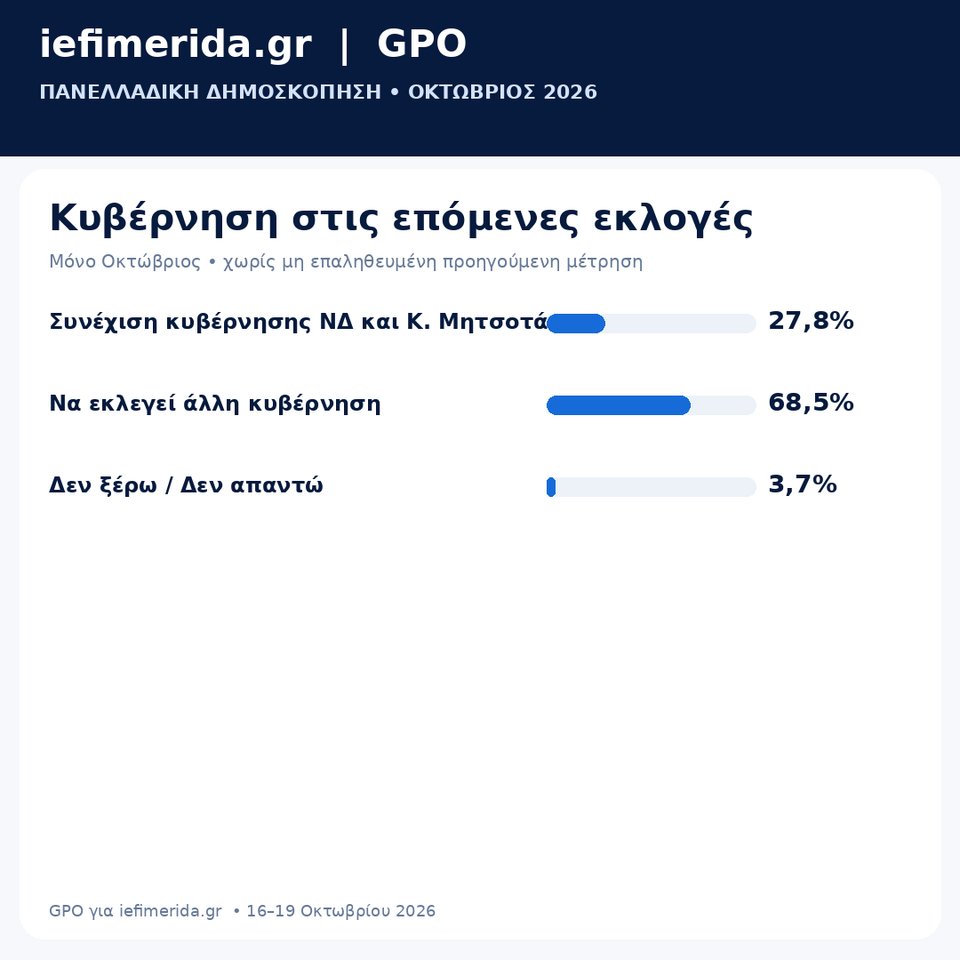
As for the period after the election, 27.8% say they would like ND to remain in government and Kyriakos Mitsotakis to stay on as prime minister. Despite a clear preference for a change of direction among 68.5%, voters have not settled on an equally clear model of government.
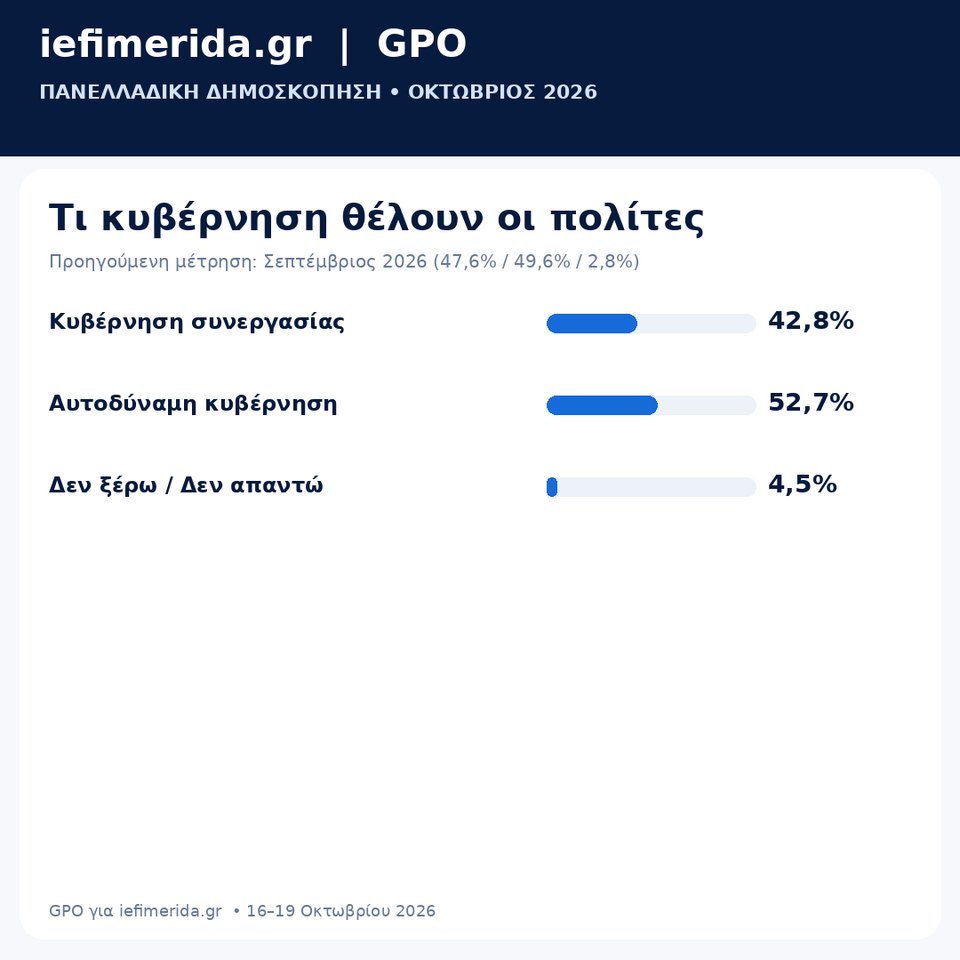
Some 42.8% of the electorate would like a coalition government, while an increased share of 52.7% compared with September, seeing the impasse, recognises the need for a single-party government, even if repeated elections are needed to achieve it.
ND continues to be seen as the strongest force on growth
Overall, the findings describe a political landscape in which ND continues to be seen as the strongest force on growth and, to a lesser extent, the cost of living, although its performance remains low in absolute terms. ELAS is more strongly associated with protecting workers and the middle class, but has not dispelled the widespread sense that no genuinely realistic plan is on offer. The result is an open, demanding and sceptical electoral landscape in which any party seeking majority support will need to combine economic credibility, a clear governing programme and, perhaps, a willingness to reach beyond narrow party lines.
Kyriakos Mitsotakis the most suitable for prime minister
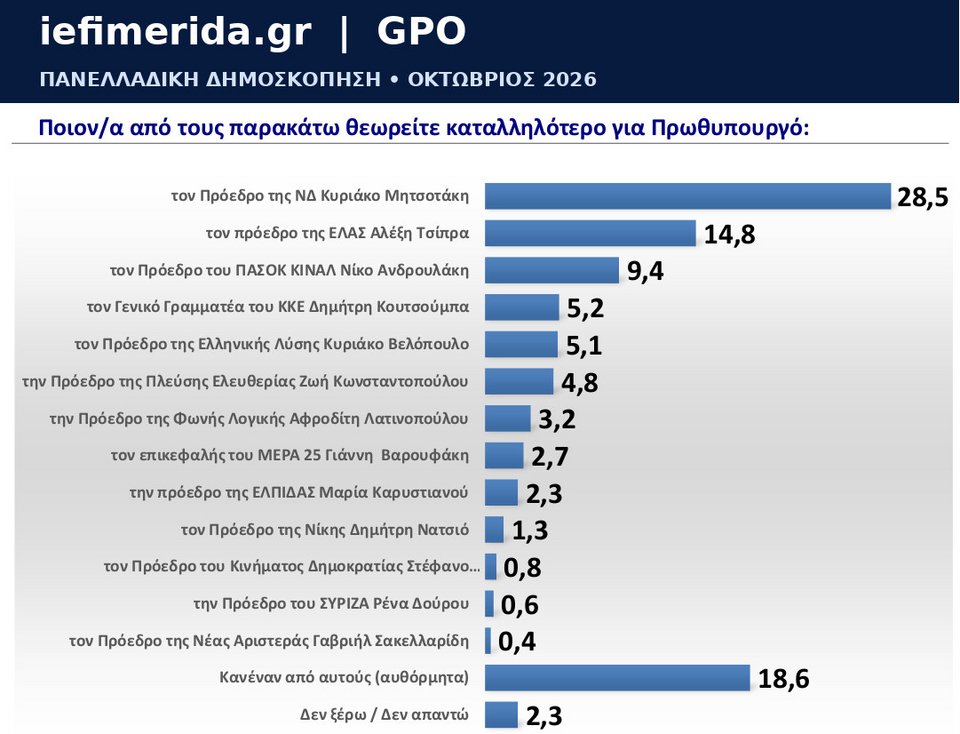
In the overall assessment of political leaders, and specifically on the measure of suitability for prime minister, Kyriakos Mitsotakis retains first place with 28.5%, comfortably ahead of A. Tsipras, who is second on 14.8%, and third-placed N. Androulakis on 9.4%.
Samaras’s party offers an outlet for discontent
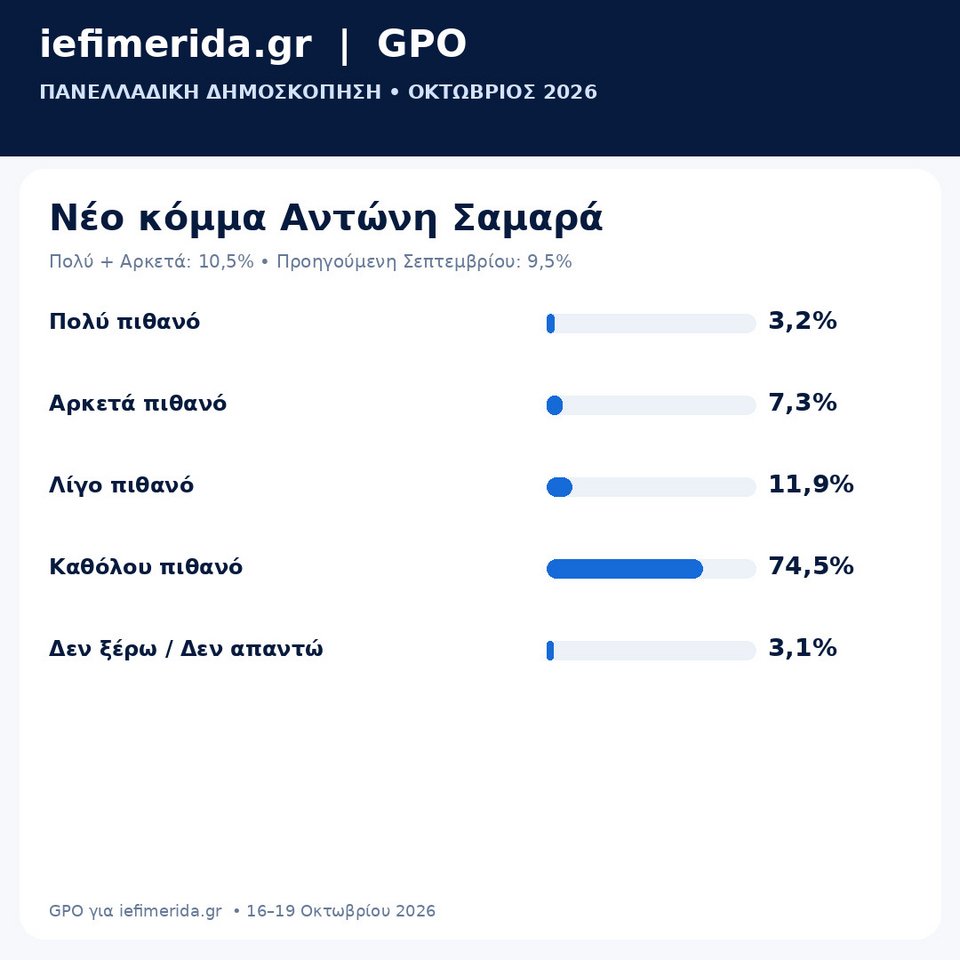
The likelihood of voting for a new party led by Mr Samaras registers a strong possibility of 3.2%, with the total potential pool standing at 10.5%. For now, this suggests the party is acting more as an outlet for discontent than as a mass draw in a fragmented opposition landscape.
Voting intention in the GPO/iefimerida poll
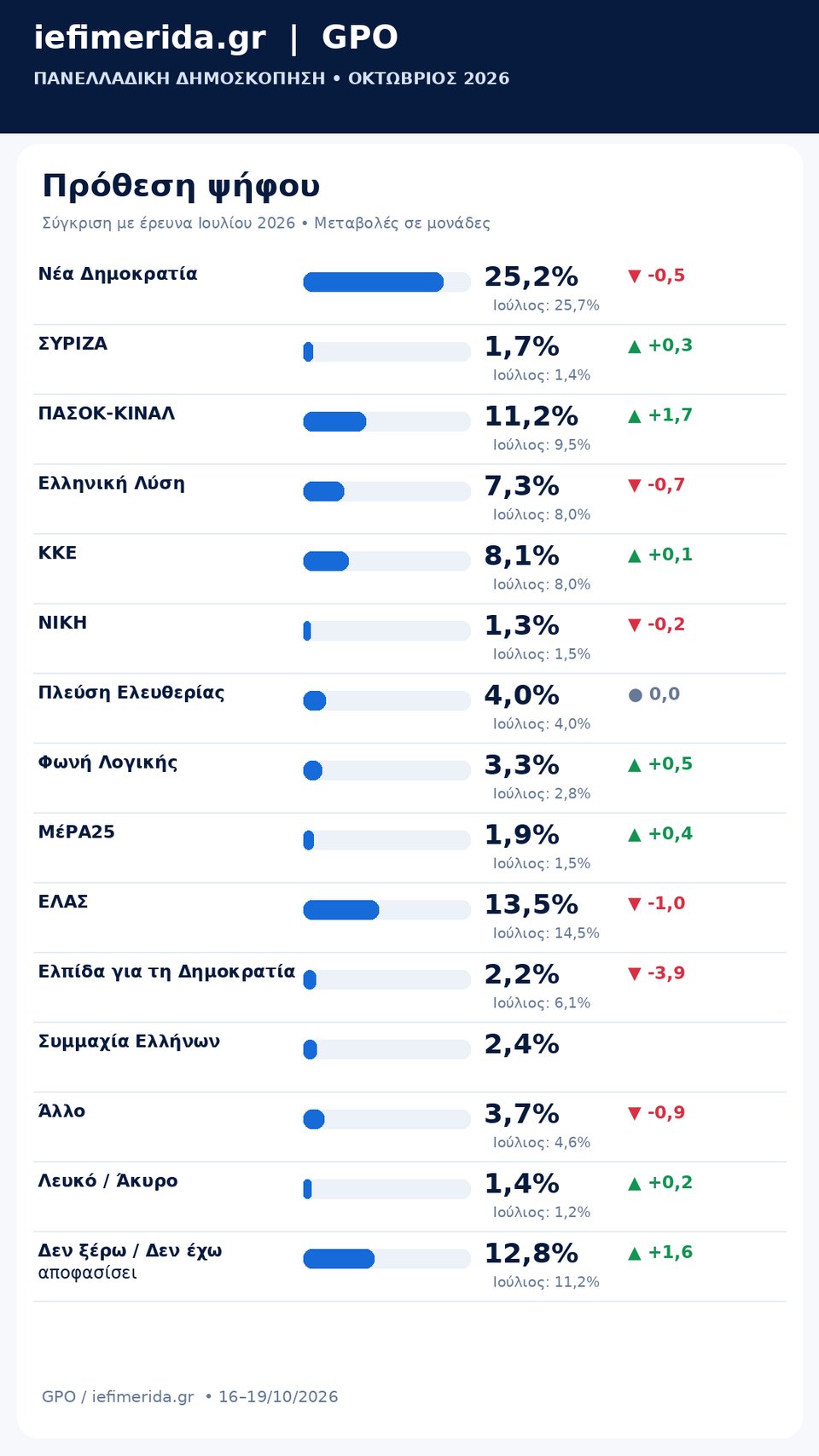
In voting intention, ND records a very small decline, standing at 25.2%, down from 25.8% in September. ELAS and PASOK are unchanged at 13.5% and 11.2%, respectively, putting the gap between them in the race for second place at 2.3 percentage points. KKE has gained ground and is in fourth place on 8.1%, followed by Greek Solution on 7.3%, Course of Freedom on 4% and Voice of Reason on 3.3%. Maria Karystianou’s Hope for Democracy attracts just 2.2%, while the Alliance of Greeks, the party reportedly backed by Ilias Kasidiaris, registers 2.4%.
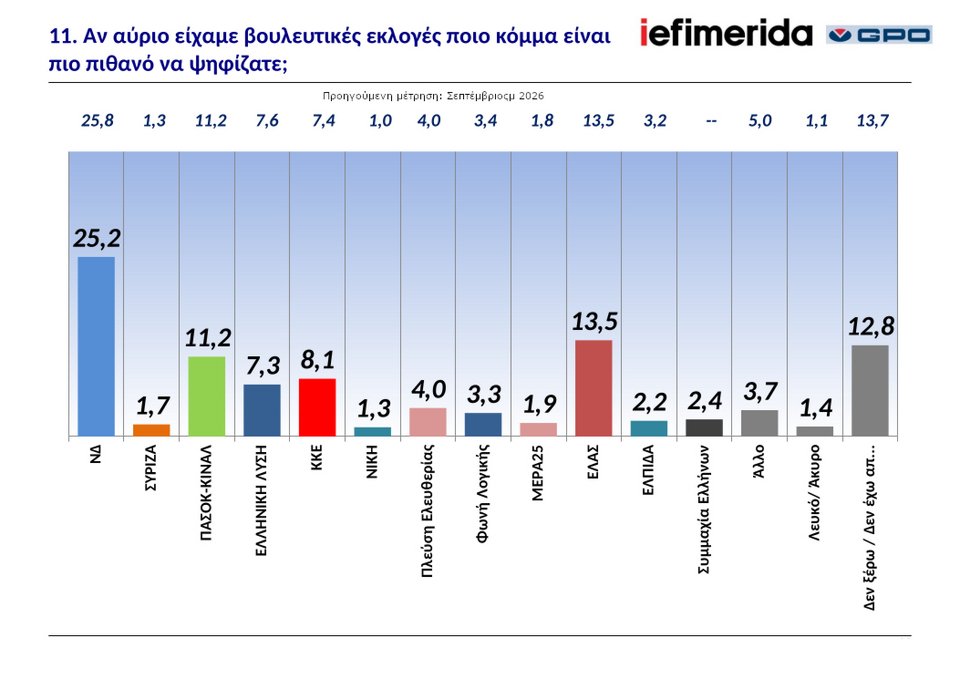
Estimated vote share in the GPO/iefimerida poll
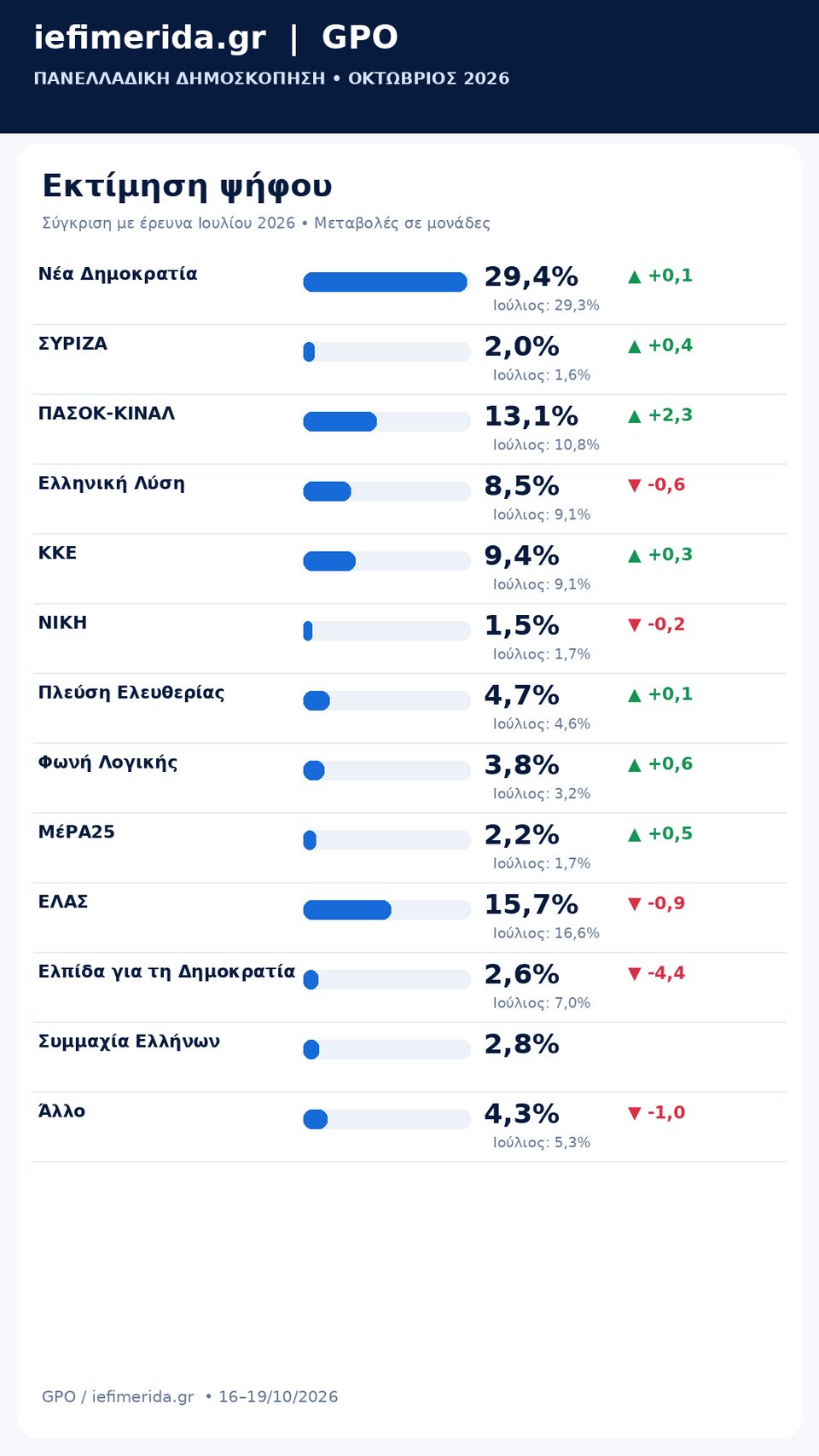
In the estimated vote share, ND registers 29.4%. ELAS stands at 15.7% and PASOK at 13.1%; KKE is in fourth place on 9.4%, followed by Greek Solution on 8.5%, Course of Freedom on 4.7% and Voice of Reason on 3.8%. Hope for Democracy attracts 2.6%, which would not be enough to enter parliament, while the Alliance of Greeks stands at 2.8%.
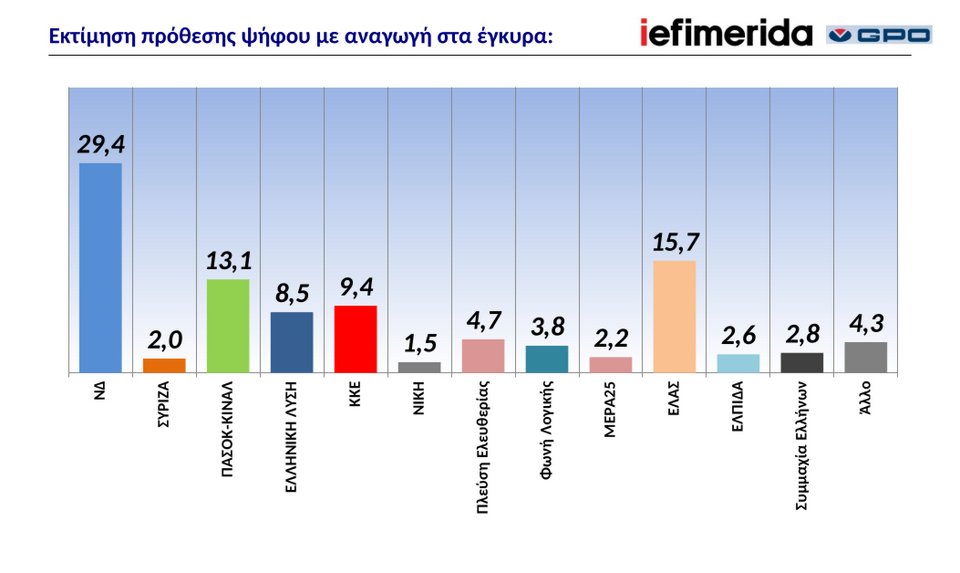
GPO/iefimerida poll results compared, July-October
The tables below compare the parties’ shares in voting intention and estimated vote share in GPO polls for iefimerida (July 2026-October 2026).
The cost of living is citizens’ biggest concern
The cost of living, cited by 64%, and the financial strain it causes are the dominant experience for most citizens, shaping the overall context in which they assess both their day-to-day lives and the public agenda.
Just 5.9% say they live comfortably and can save, while 26.7% live comfortably but cannot save. By contrast, 41.5% say they struggle to make ends meet, 18.6% find it very difficult to cover all their needs, and a further 5.9% cannot afford even the basics. This means that almost two-thirds are experiencing anything from near-poverty to severe financial strain, explaining why purchasing power carries such great political and social weight.
The cost of living overwhelmingly dominates as the country’s biggest problem, far outstripping every alternative priority. With the exception of corruption, all other issues register single-digit percentages, though this does not mean they are unimportant. The picture does, however, show that before any other discussion of reform or institutions, citizens assess the current situation primarily through the immediate cost of living and the level of their disposable income.
Struggling to make ends meet
The scale of financial pressure becomes even clearer when looking at households’ specific needs. For food and supermarket shopping, 53.2% say they struggle a lot or quite a lot, while the equivalent figure for paying energy bills reaches 55.8%, confirming that the most basic and inflexible expenses are putting the greatest pressure on households. This leaves them little room to adjust, because these are categories of spending that cannot easily be cut without an immediate impact on quality of life.
Spending on transport and heating is particularly burdensome: fuel and heating oil record the highest figures, with 66.1% finding it very or quite difficult to cover this expense.
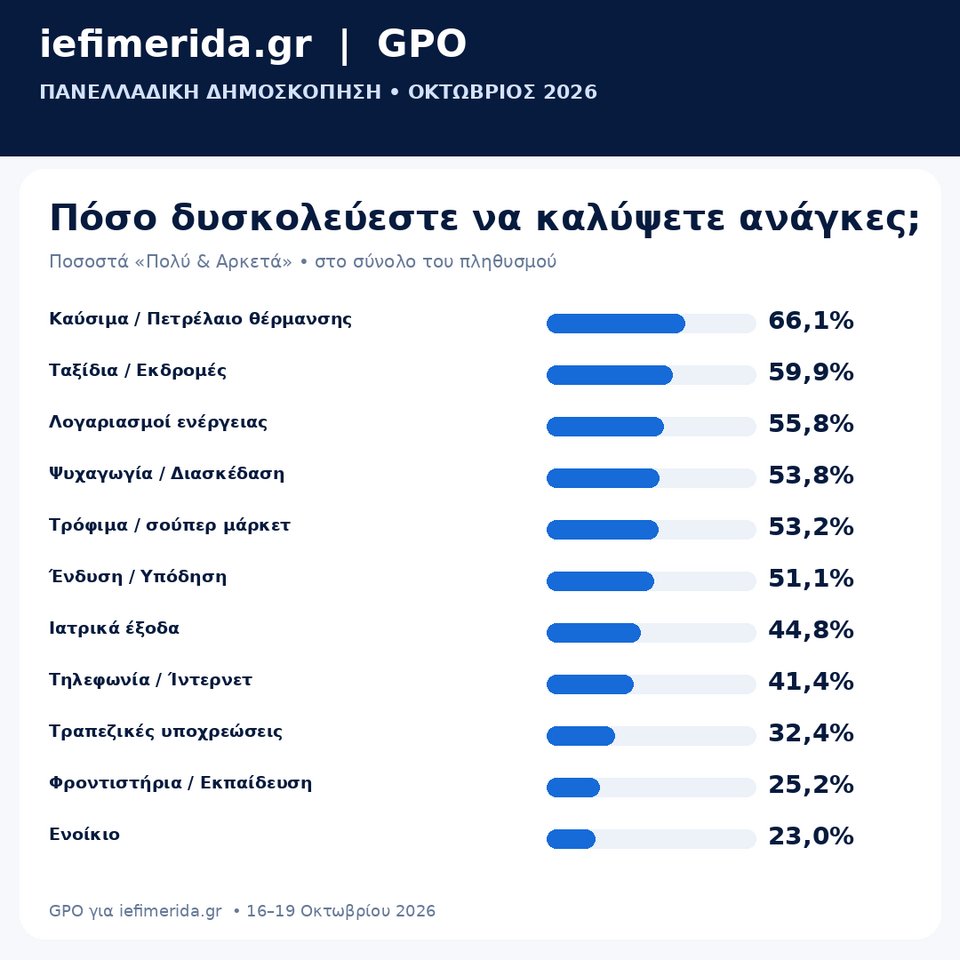
Essentially, this shows that the pressure is not limited to household consumption but also affects the cost of access to work and services, as well as people’s ability to get around more generally, placing a particular burden on the day-to-day running of the household.
Citizens do not offer a one-dimensional explanation for the cost of living. The largest share, 45.2%, believe it is due equally to international conditions and government policy. Another 34.2% attribute it mainly to government policy, while 20% see it as primarily imported as a result of international conditions. This breakdown has clear strategic significance: citizens recognise external factors but do not absolve domestic policymakers of responsibility, raising expectations for tangible and immediate action.
It is therefore clear that tackling the cost of living is not simply one economic issue among many but the main criterion through which citizens interpret and assess the political system and make their choices; that system’s economic credibility appears, at the very least, inadequate.
ND retains an edge amid economic distrust
On the main economic issues examined in relation to ND, PASOK and ELAS, the most common response was that none of these parties has a realistic plan, creating the impression that no convincing economic proposal is on offer. It should be noted, however, that amid this climate of economic distrust, ND continues to hold a relative lead, though not enough for it to be seen as dominant. This confirms that the governing party continues to have the strongest standing in areas where citizens tend to look for administrative competence, but its advantage remains a minority view and does not overcome the widespread belief that no proposal is fully convincing.
The picture changes when economic issues are more closely linked to social protection and redistribution. ELAS then records figures close to ND’s, suggesting opposition parties have more scope to gain ground on social protection than on macroeconomic issues.