Thousands of tax cases that become time-barred on 31 December 2026 are being targeted by the Independent Authority for Public Revenue.
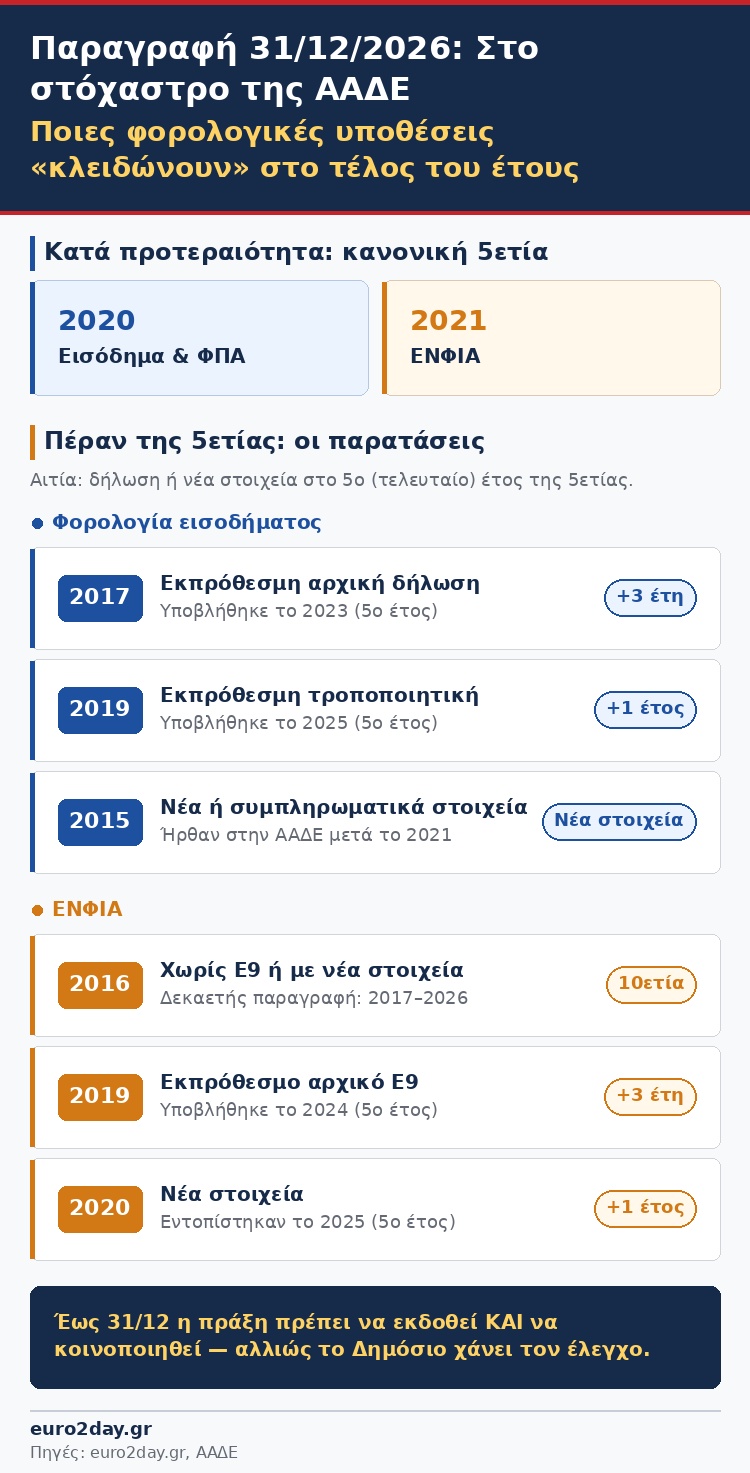
Income tax and VAT cases relating to 2020, as well as cases involving the Unified Property Ownership Tax (ENFIA) for 2021, will be prioritised for audit. The five-year limitation period for these cases covers the state’s right to carry out a tax audit and issue a provisional or final tax assessment and impose penalties.
By the end of this year, the competent tax services must not only issue but also notify each audited taxpayer of the provisional or final tax adjustment assessment.
However, it is not only income tax and VAT cases for 2020 or ENFIA cases for 2021 that become time-barred in about two months. Many other cases are also affected, for which the limitation period is extended beyond five years.
Extensions and special categories
More specifically, these include income tax cases relating to the 2017 tax year 2017, for which initial late returns were filed during 2023. For these cases, the initial five-year limitation period, which would normally have expired on 31-12-2023 (five years after the end of 2018, the year in which the original return was due), was extended by a further three years, until 31-12-2026, because the original returns were filed in the final year (the fifth year) of the standard five-year limitation period.
They also include cases relating to the 2019 tax year for which late amended returns were filed during 2025. For these cases, the initial five-year limitation period, which would normally have expired on 31-12-2025 (five years after the end of 2020, the year in which the original return was due), was extended by one year, until 31-12-2026, because the amended returns were filed in the final year of the standard five-year limitation period.
They also include cases relating to the 2015 tax year in which, after the standard five-year limitation period had expired — that is, after 31 December 2021 — the competent tax authorities received new or supplementary information showing that taxable income was higher than declared and that the returns filed were inaccurate.
Supplementary information and ENFIA
These also include cases relating to the 2015 tax year in which an initial tax audit was carried out within the standard five-year limitation period, that is, by 31-12-2021, but the competent tax authorities received new or supplementary information after that date.
As regards ENFIA, cases for the 2016 tax year become time-barred. These are cases in which no E9 property declaration was filed, or in which the AADE received new (supplementary) information after the initial five-year limitation period. A 10-year limitation period applies to these cases, starting immediately after the end of the year in which the return was due (on 1-1-2017) and ending on 31-12-2026.
Cases for 2019 also become time-barred where initial E9 declarations were filed late during 2024 — the final year of the standard five-year limitation period — triggering a three-year extension of the state’s right to audit that tax year. Cases involving ENFIA for 2020 also become time-barred where new information came to light in the final year of the initial five-year limitation period (that is, during 2025), extending the right to audit by a further year.
Estimated tax assessments
The AADE’s management has instructed tax audit services to examine other cases at risk of becoming time-barred at the end of the year, including those involving individuals and legal entities that failed to file income tax returns for the 2020 tax year.
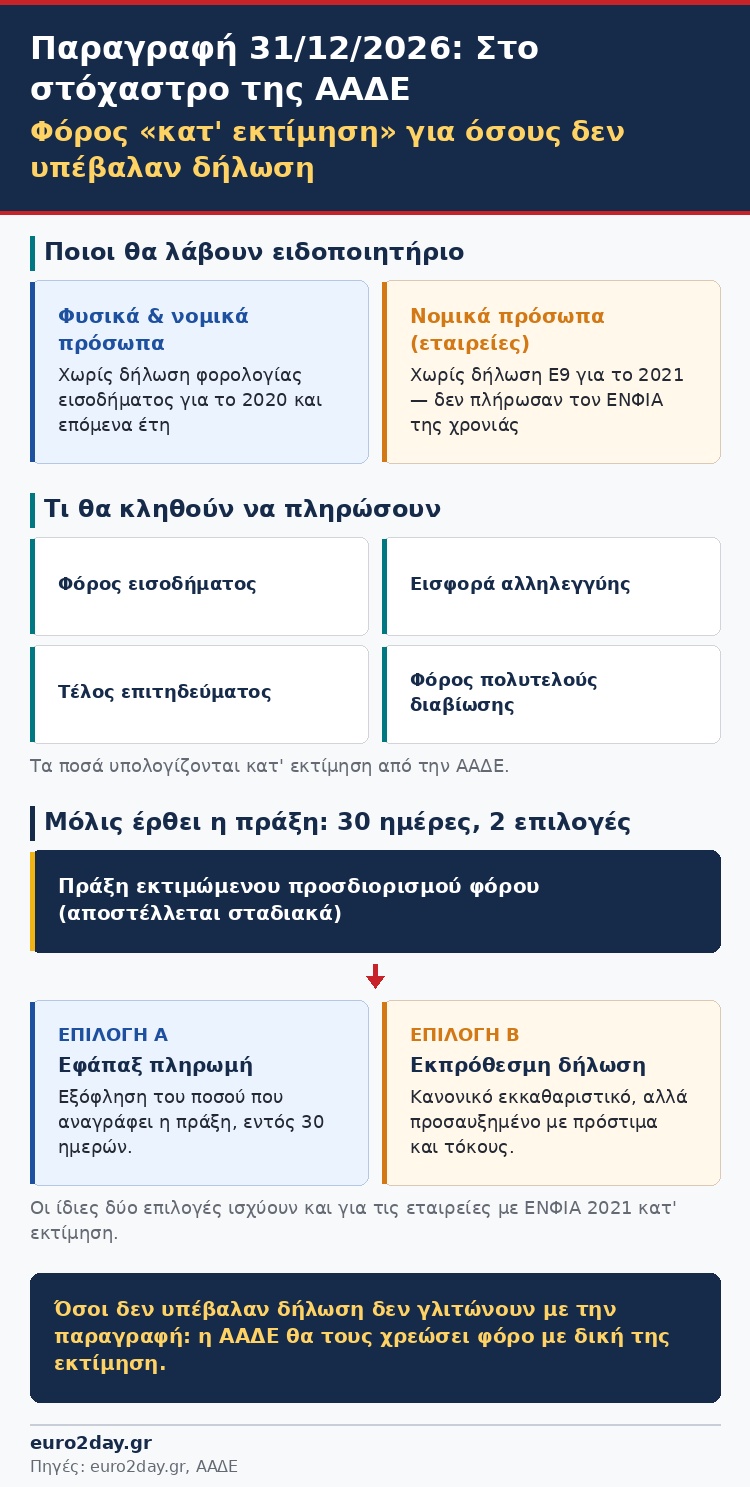
The AADE will send individuals and legal entities that did not file income tax returns for the 2020 tax year and subsequent years estimated tax assessments, calling on them to pay amounts for income tax, the special solidarity contribution, the business levy and the luxury living tax, calculated on an estimated basis by the competent tax services.
Payment notices for estimated tax will be sent to these taxpayers in stages.
Taxpayers who receive estimated tax assessments will have the following two options:
- either pay the full amount in a single instalment within 30 days of being notified of the estimated tax assessments,
- or file late returns within 30 days of being notified of the assessments, for income tax for 2020. On the basis of these returns, standard income tax assessments for the 2020 tax year will be issued, with the amounts charged to them increased by the applicable penalties and interest for late payment.
E9 assessments
The Tax Administration will also send estimated tax assessments to legal entities that did not file property details declarations (E9) for 2021 and avoided paying ENFIA for legal entities that year.
Companies will be asked to pay estimated amounts of ENFIA for 2021, calculated by the competent tax services, and to settle the bill using the same options outlined above for income tax.