From 2027, the offsetting of the personal difference will end for good, allowing an additional 670,000 pensioners to receive increases.
Specifically, from 1 January 2027, the way annual increases are granted to main pensions will change for those with a positive personal difference, bringing an end to their years-long “freeze”.
Under the provisions of legislation passed in 2025, the offsetting of the personal difference against annual increases will be permanently discontinued.
This provision has come to be known as the “abolition of the personal difference”. The measure was first introduced when older pensions were recalculated under the framework of Law 4387/2016, also known as the Katrougalos law.
The aim of the measure at the time was to protect existing pensioners from nominal cuts when the amount they were receiving proved higher than that calculated using the new replacement rates. In the years that followed, however, the mechanism acted as a brake. Whenever a general increase was granted to pensions, the amount of that increase was gradually “absorbed” by the personal difference.
As a result, hundreds of thousands of pensioners saw no real increase, or only a minimal one, in the amount they received, despite the nominal adjustments.
In 2026, a partial offset of 50% of the increase was applied for those with a positive personal difference, while ensuring that no group was deprived entirely of support.
From 1 January 2027, the offset will be abolished for good. The annual increase will be applied in full to the net amount of the main pension (national and contributory), while any remaining personal difference will stay frozen at its existing level, neither decreasing nor increasing.
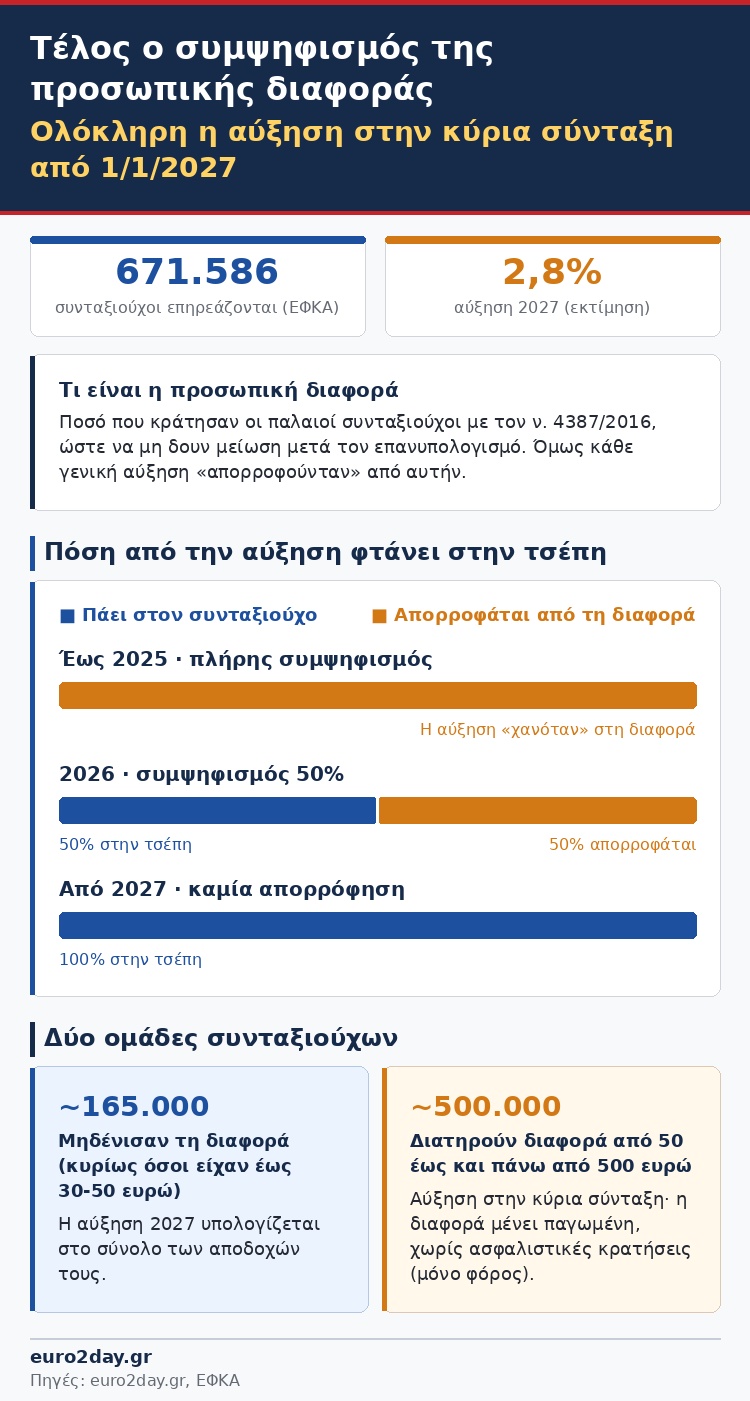
According to official figures from EFKA, around 671,586 pensioners in total will be affected by the new system. They fall into two distinct groups:
- Pensioners whose personal difference has been almost eliminated. This group comprises around 165,000 people who, thanks to increases in previous years — particularly the 2.4% increase in 2026 — have managed to eliminate their personal difference completely. It mainly includes those who initially had smaller differences (for example, from €0 to €30 or €50). For these 165,000 people, the personal difference has been fully incorporated into their calculated pension. As a result, the 2027 increase will be calculated not just on the basic amount, but on their total pension income.
- Nearly half a million pensioners who retain a larger personal difference balance, ranging from €50 to more than €500. They will receive the 2027 increase as usual, which the budget puts at around 2.8%, on the national and contributory parts of their pension. The personal difference, meanwhile, will remain fixed and separate. An important point for this second group is that no social insurance contributions are levied on this separate personal difference amount (such as healthcare contributions or the Solidarity Contribution for Pensioners), only the applicable income tax, together with the rest of the pension. This means that even those with a large personal difference will see a net gain that would otherwise have taken many years to reach them.
Examples
To make clear exactly how the measure will work in practice, it is worth looking at illustrative examples based on actual EFKA data:
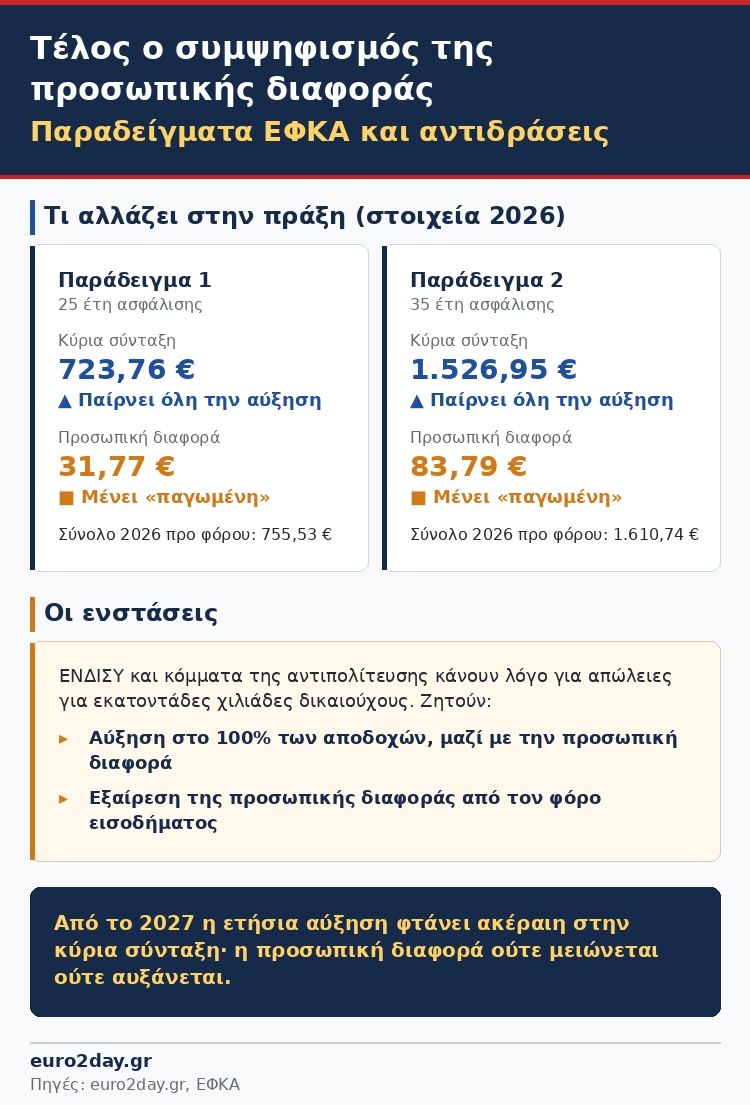
Example 1: A pensioner with 25 years of insurance who received a main pension of €723.76 in 2026 and had a personal difference balance of €31.77 (a total of €755.53 before tax) is entitled to an increase in the main pension in 2027. The calculated pension amount will rise, while the personal difference will remain unchanged at €31.77, increasing total monthly income.
Example 2: A pensioner with 35 years of insurance and a pension of €1,526.95 in 2026, alongside a personal difference of €83.79 (a total of €1,610.74 before tax), will receive a substantial increase in the main pension. The personal difference will remain “frozen” at €83.79.
The measure has prompted strong reactions from trade union organisations, including the United Network of Pensioners (ENDISY), as well as opposition parties. Pensioners’ representatives argue that excluding the personal difference from the increases means losses for hundreds of thousands of beneficiaries, who do not receive the increase on 100% of their total pension income.
They are also forcefully raising the issue of taxation, calling for the personal difference to be excluded from the calculation of income tax as well, to prevent tax bands from reducing their monthly income.