Market operators who continue unabated with the “game” of tax evasion, costing state coffers hundreds of millions of euros, appear to be one step ahead of the Independent Authority for Public Revenue’s (AADE) digital “arsenal”.
The revelation of another major tax-evasion case confirms that, while the tax authority has significantly advanced its modern digital tools, including through the use of Artificial Intelligence, tax evasion is still “alive and well” thanks to the ingenuity of the networks, which have the expertise needed to evade the tax authority’s “digital eye”.
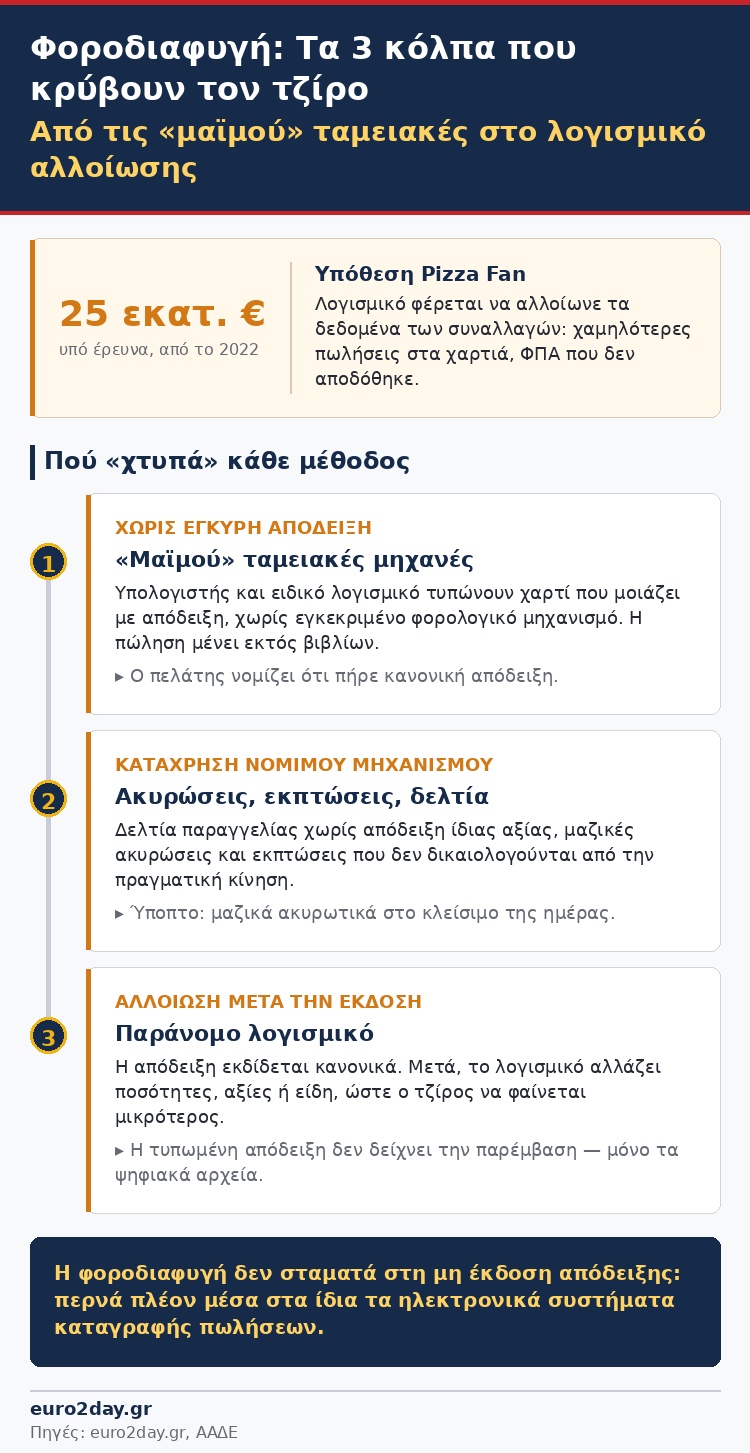
Tax inspection findings show that the networks use three main methods to conceal sales and report lower revenue than they actually earn.
These involve using “fake” cash registers, abusing legitimate fiscal devices and installing illegal software that alters transaction data.
The last method is in the spotlight following the case involving Pizza Fan, which is under investigation for tax evasion totalling €25 million since 2022. The company allegedly used software to alter transaction data and conceal some of its actual turnover, resulting in lower reported sales and unpaid VAT.
The case highlights the challenges facing the inspection authorities when tax evasion goes beyond failing to issue receipts and extends to the electronic systems used to record sales.
The first method involves using computers and specialist software to produce and print documents that look like legitimate receipts but have not been issued by an approved fiscal device (these are “fake” cash registers). The customer receives a piece of paper that looks legitimate, without necessarily knowing that it is not a valid tax document.
The transaction is not recorded in the business’s accounting records as required, leaving the corresponding revenue out of its tax return. The state therefore loses income tax and VAT revenue, while the customer is misled into thinking they have received a proper receipt.
Fraud tactics
The second trick involves the abusive use of legitimate fiscal devices. A business may issue order slips without following them with a receipt for the corresponding amount, or record mass cancellations and discounts that are not justified by its actual commercial activity.
Particular attention is warranted when a large number of cancellation slips are recorded at the end of the day, or when the value of discounts is unusually high. These actions do not in themselves prove tax evasion, but they are indicators that require further investigation.
To identify possible violations, inspectors examine the digital records held by fiscal devices, analysing the frequency, value and timing of receipts, cancellations and discounts. Cross-checking the data can reveal discrepancies and help identify revenue that may not have been declared.
The third method is particularly complex, as a receipt may be issued normally while the data is altered at a later stage. Illegal software can interfere with transaction data, changing quantities, values or the types of products recorded in order to make turnover appear lower than it really is.
In such cases, the printed receipt does not necessarily reveal the extent of the interference. Inspectors need to examine digital files and data from fiscal devices to determine whether any changes have been made and reconstruct the true picture of sales.
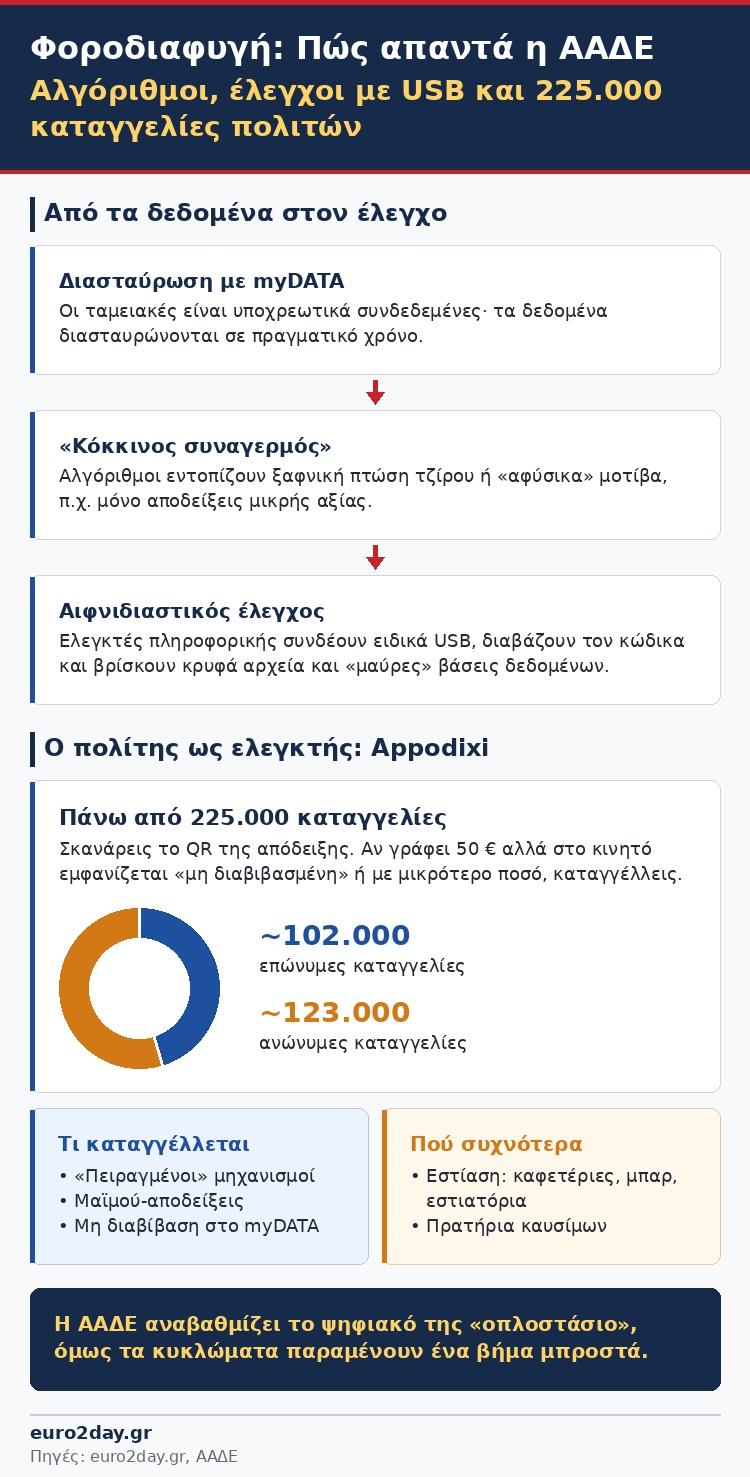
For its part, the AADE is seeking to curb tax evasion through the new digital tools in its arsenal and data cross-checks, using digital records from fiscal devices and comparing the available information with data submitted to the myDATA platform in search of discrepancies that may reveal concealed taxable revenue.
The Authority’s inspectors no longer rely on random on-site checks alone, but also use sophisticated algorithms, real-time data cross-checks and specialist software. Illegal systems and tampered cash registers are now easier to detect thanks to the requirement that they be connected to the AADE’s myDATA platform, but operators continue to find ways to hide their income from the tax authorities.
Inspections and algorithms
The AADE has also developed a central system that now uses algorithms to “scan” businesses’ behaviour. If a large chain with dozens of outlets records a sudden or sustained fall in turnover, or if the receipts it issues display “unnatural” patterns (for example, if only low-value receipts are issued), the system raises the alarm and on-site inspections follow where necessary.
When there are serious indications of tax evasion, the AADE’s specialist IT inspectors carry out unannounced inspections. They use special USB sticks containing inspection software, which they connect to the business’s computers and fiscal devices.
The tool reads the programmes’ source code and can detect hidden files or secondary, “black” databases, as well as software designed to alter data and erase traces of sales before the information is sent to the tax authorities.
It is worth noting that a number of tax-evasion cases have been uncovered thanks to the Appodixi app. By scanning a receipt’s QR code using the AADE’s official app, members of the public can check whether the receipt is valid and has been transmitted correctly.
If, for example, a receipt in a customer’s hand shows €50 but appears on their mobile phone as “not transmitted” or for a lower amount, they can immediately file a complaint, prompting the inspection authority to act.
According to the AADE’s latest official figures, complaints submitted by members of the public through the Appodixi digital app have exceeded 225,000 in total. About 102,000 were made by identified complainants, while the remaining 123,000 were anonymous.
The vast majority of reports submitted by members of the public concern receipts from tampered fiscal devices, fake receipts and failures to transmit data to myDATA. The sectors with the highest number of complaints are food service (cafés, bars and restaurants) and petrol stations.