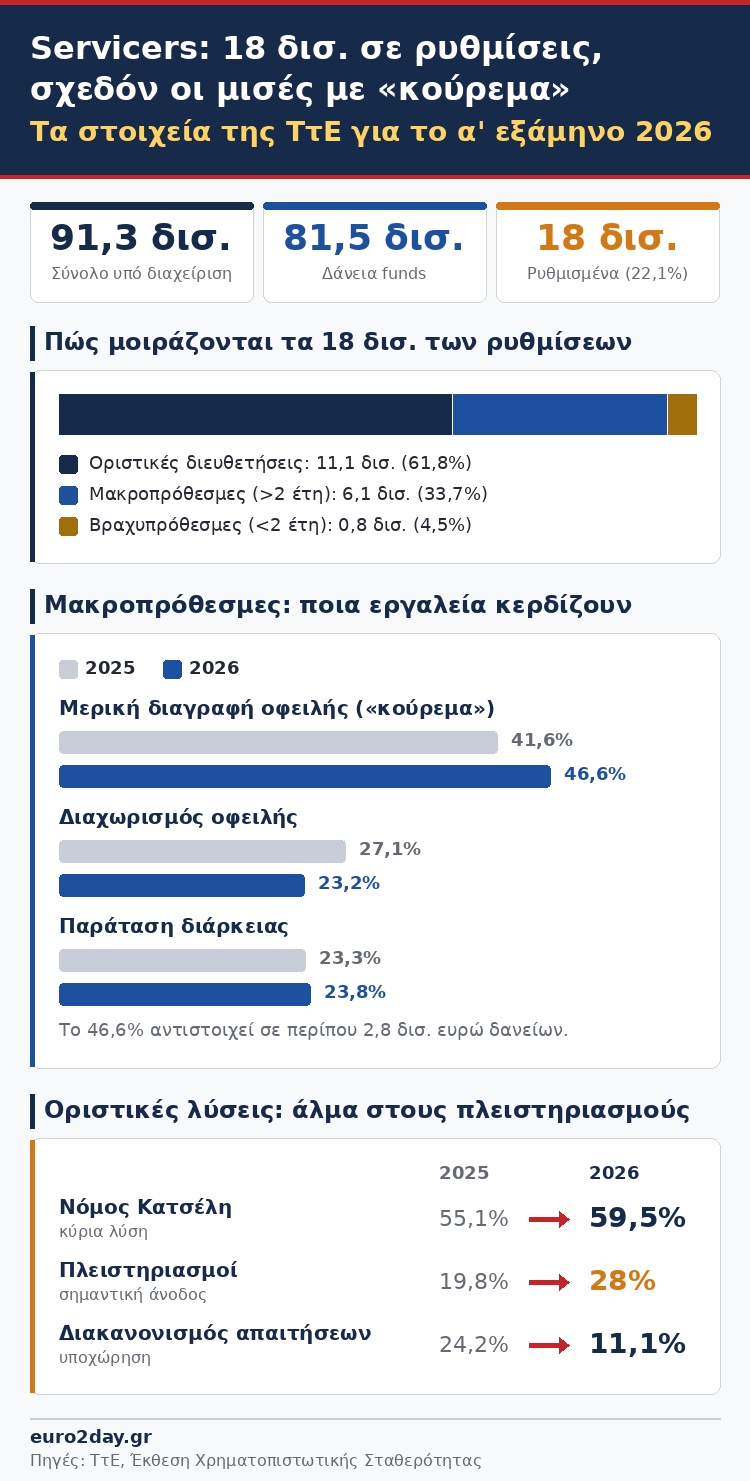
Servicers have restructured loans worth €18bn, out of a total of €81.5bn in loans transferred to funds (credit servicers).
Almost half of the long-term restructurings have involved a “haircut”, while auctions have also risen significantly. The Bank of Greece analysis in its Financial Stability Review also shows that instalments on loans restructured under the Katseli law are still being recalculated, following a Supreme Court ruling.
Management of Greece’s accumulated private debt by credit servicers (servicers) has entered a more mature phase, with data for the first half of 2026 showing a clear shift towards definitive settlements and restructurings rather than temporary solutions.
Of the total €91.3bn portfolio managed by the sector’s 17 licensed firms, the largest share — €81.5bn, or 89.2% — comprises exposures assigned to them on behalf of credit purchasers (funds). This is little changed from the €81.6bn they managed for these entities in June 2025.
The share of exposures managed on behalf of credit and financial institutions fell to 10.8% in 2026, from 13.2% in 2025.
A closer look at the €18bn and the “haircuts”
The scale of loans restructured reflects the core of servicers’ strategy on behalf of credit purchasers. In June 2026, restructurings amounted to 22.1% of the funds’ total portfolio, reaching €18bn. Although this was slightly down from the 23.4% recorded in June 2025, the composition of the solutions points to a more assertive approach to definitive resolution.
The most notable development is in long-term restructurings (lasting more than two years), which totalled €6.1bn, or 33.7% of all restructurings, compared with €7.1bn, or 37.2%, in 2025.
Within this category, partial debt write-offs are the predominant approach. Specifically, 46.6% of these long-term restructurings in 2026 — involving loans worth about €2.8bn — included partial debt forgiveness.
The corresponding share was 41.6% in 2025, indicating that servicers are now more likely to regard writing off part of the principal as the most realistic tool. The long-term solutions in 2026 also included maturity extensions (23.8%) and debt splits (23.2%), compared with 23.3% and 27.1%, respectively, in 2025.
Definitive settlements and rising auctions
The trend towards a definitive clean-up of portfolios is reflected in the category of definitive settlements. In June 2026, these solutions totalled €11.1bn, accounting for 61.8% of all restructured exposures.
Restructurings under legal protection — those under the Katseli law — remain the main component of definitive settlements, accounting for 59.5% in 2026, compared with 55.1% in 2025.
However, the use of auctions increased, accounting for 28% of definitive settlements in 2026, up from 19.8% in 2025. Settlements of claims moved in the opposite direction, falling to 11.1% from 24.2% the previous year.
Temporary solutions decline
By contrast, short-term restructurings (lasting less than two years) continued to shrink. In 2026, they fell to €0.8bn, or 4.5% of restructurings, from €0.9bn, or 4.7%, in 2025. Almost half of this category — 46.1% in 2026 and 50.1% in 2025 — involved the simple capitalisation of overdue debt.
Total recoveries in the first half of 2026 stood at €1.8bn, exactly the same as in the first half of 2025. Their composition changed, however: repayments totalled €1bn, compared with €1.1bn in 2025; realisations of collateral fell to €0.4bn from €0.5bn; and write-offs of exposures doubled to €0.4bn from €0.2bn in 2025.
Portfolio composition and quality
Across the total portfolio managed on behalf of credit purchasers, business lending remained the largest category, accounting for 49.2% in June 2026, up from 48.8% in 2025. It was followed by residential mortgages at 30.9%, compared with 31.2%, and consumer lending at 19.9%, compared with 20.0%.
The quality of these exposures remains low. Non-performing exposures (NPEs) accounted for 89.5% in 2026, a marginal improvement on 89.6% in 2025. Of these NPEs, the vast majority — 78.7% in 2026 and 77.4% in 2025 — had already been formally terminated. Loans more than 90 days past due edged down to 15.9% from 17.7%, while unlikely-to-pay loans rose to 5.4% from 4.9%.
The Supreme Court ruling and the recalculation of instalments
An additional factor affecting the operations of credit servicers in 2026 was ruling No. 6/2026 by the Full Court of the Supreme Court, which set out how interest should be calculated for court-ordered restructurings under Law 3869/2010.
The Bank of Greece notes that, after Articles 126 and 127 of Law 5313/2026 clarified the ruling, servicers began the demanding process of recalculating thousands of debts. Instalment schedules could be adjusted only after credit institutions paid the relevant interest to the servicers.
Tighter supervisory framework
In 2026, servicers’ business model came under even tighter supervision. Building on Executive Committee Act 244/4 of July 2025, which introduced corporate governance rules and minimum supervisory capital requirements, the Ministry of National Economy announced a new framework for debtor protection in September 2026.
The framework introduces strict deadlines, clear limits, independent management audits of securitisations backed by a state guarantee, and a requirement to submit strategic plans to the Bank of Greece annually.
Oligopolistic features of the sector
Finally, it is worth noting, as the Bank of Greece repeatedly points out, that the credit-servicing market retains pronounced oligopolistic features. The three largest firms control 83.6% of the total value of exposures under management in 2026, while 11 of the 17 firms have a combined market share of just 2.9%, up from 2.8%.
The financial position of credit servicers weakened, with their total assets falling to €1.1bn in June 2026 from €1.2bn in 2025, their equity shrinking to €588m from €697m, and their net profit for the half-year declining to €49m from €51.8m in the same period of 2025.