The rally in natural gas, now flirting with €100, heralds a surge in wholesale electricity prices to levels last seen during the 2022 crisis and means tariffs will rise for another month — the fifth in a row — in November.
In reality, the situation is even worse: the domino effect shows no sign of stopping, oil has now stabilised at $114-$116, and none of the factors driving electricity costs — water, CO2 or gas, for example — is improving. They are all getting worse.
There is no sign of any easing, with gas topping €97 yesterday, dragging up the price of CO2, which in turn adds further costs for power plants, as well as for Greek electricity futures, which closed at €213 for December, up 94% on last year.
And all this before the months of peak demand have even begun. Caught in the grip of this “polycrisis”, winter is approaching with nuclear generation down 15% since the start of the year, hydropower output down 31%, natural gas 210% more expensive and CO2 costs up 14%, while the government continues to avoid raising the prospect of subsidies.
The daily domino effect
Worse still, analysts are now considering not only the prospect of a prolonged closure of the Strait of Hormuz, but some are forecasting that it could last until September 2027, as Brendan A'Hearn, a natural gas market specialist at ICIS, wrote in a post yesterday.
That is the picture six days before the green tariffs for November are announced, with the market heading for two-tier increases: smaller rises from the big suppliers, which will absorb some of the 20% monthly increase in wholesale prices, and larger ones from smaller suppliers.
And even if the average increase for November is in the single digits, as many suppliers, large and small, absorb some of the cost to remain competitive, the predicament for those on green tariffs will deepen.
The self-reinforcing spiral of price rises is steadily swelling bills. The average price in this category for November is expected to be significantly higher than October’s average of 23.5 cents per kilowatt-hour, which in turn is 30% above July’s 17.7 cents.
Looking at the electricity rates paid by the more than 80% of customers on green tariffs — roughly the market share of the three largest suppliers — charges have also risen by 19% over the same period, from 14.9 to 17.7 cents.
More than €200 on half of October’s days
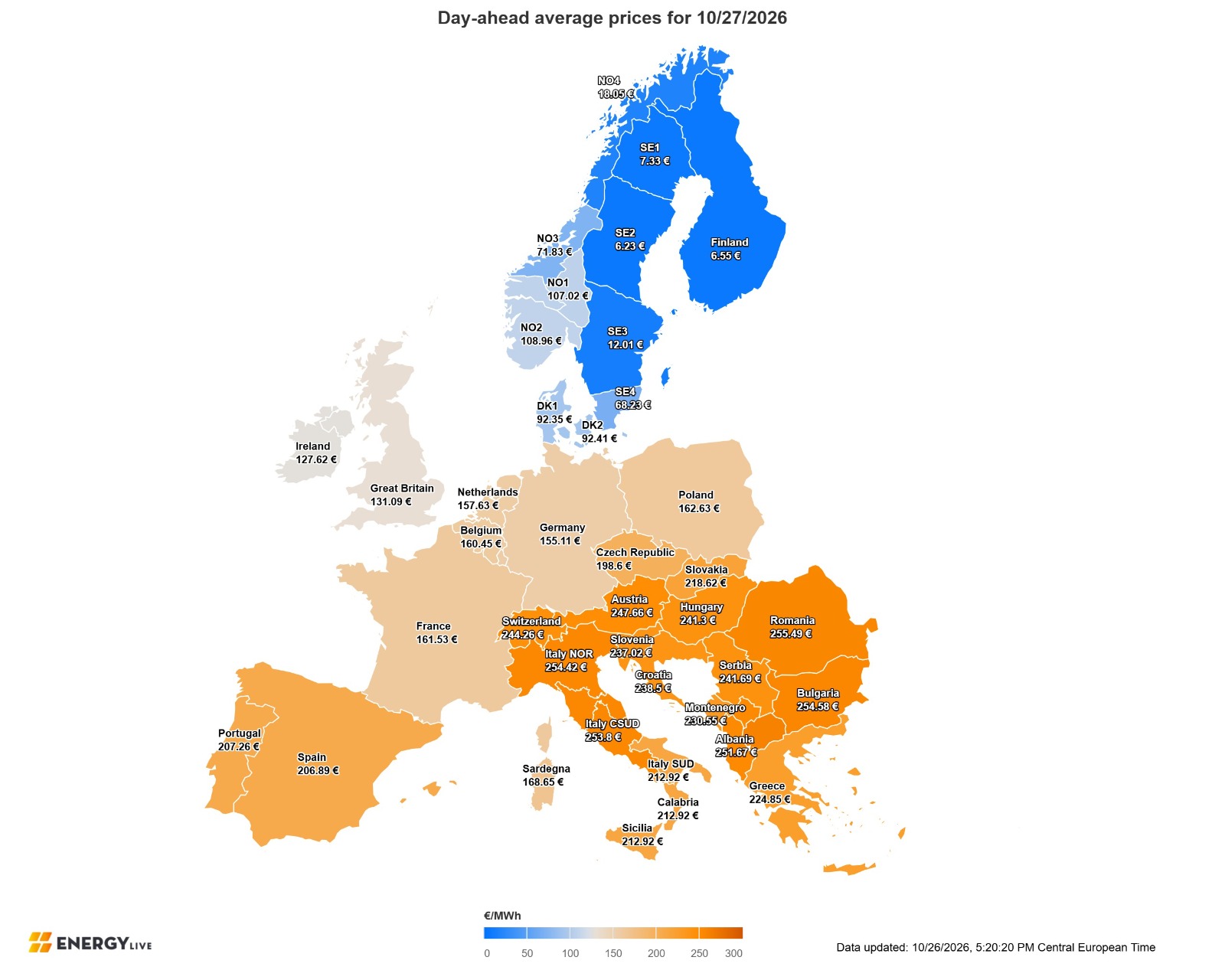
This is where things stand on the eve of winter: more consumers are switching to blue tariffs, wholesale prices are hitting one year-to-date high after another and have been “stuck” above €200/MWh for a week, while the government seeks funds but is (for now) not considering a blanket electricity subsidy.
Anyone hoping for immediate EU intervention need only look at the agenda for Thursday’s Energy Council in Luxembourg, where Greece will be represented by Environment and Energy Minister Stavros Papastavrou.
Network charges are a key item; another is the… future of Europe after 2030. Somewhere in between, the 27 ministers will assess countries’ energy security ahead of this winter and the pressure from prices, with half the continent once again in the red today.
No subsidies for now
The government’s central position, reiterated days ago by Deputy Environment and Energy Minister Nikos Tsafos, is that subsidies are not on the table except for small and medium-sized businesses, as the market offers tools to protect consumers, such as blue tariffs.
However, the by far cheapest product in this category, PPC’s online blue tariff (11.5 cents/kWh with a €3.5 fixed charge), will no longer be available after the end of October. The promotional discount, which the government had also presented as a buffer against wholesale price rises, will apply only to contracts activated by 31 October.
In any case, the products available on the market (14-16 cents/kWh, with monthly fixed charges of €7-€14), together with a comparison of the other colour-coded tariff categories for October using the RAAEY statistical analysis tool, show that blue tariffs remain the most competitive option. This is true both for customers with high electricity use and for those with low or medium consumption.
For monthly consumption of 200 kWh, which is considered close to the national average, the average green tariff currently offers the lowest bill, at €50.69 a month, compared with €54.17 for the average yellow tariff and €54.58 for the blue tariff. The differences are negligible and do not deter those seeking the security of a fixed price from locking in a blue tariff.
For monthly consumption of 300 kWh, the fixed blue tariff offers the lowest bill, at €67.05, compared with €76.83 for the average green tariff and €78.04 for the average yellow tariff. The gap between the cheapest and most expensive is €11 a month.
At higher consumption — for example, 400 kWh a month — a customer on the average blue tariff will pay €82.07, compared with €101.44 on the average green tariff and €101.91 on the average yellow tariff. The difference reaches €20 a month and widens as consumption rises.