Victor Haghani, founder and CIO of Elm Wealth and a former founding partner of LTCM, recently told CNBC’s “ETF Edge” that investors are not significantly more sophisticated than they were three decades ago.
We remain human, exposed to biases and, above all, to extrapolation bias: we believe that what has happened recently will continue. In Haghani’s view, a retail investor chasing alpha (editor’s note: returns above the market, adjusted for risk) is trading against professionals such as Citadel or Jane Street, and is better served by broad exposure through index funds.
Valerie Grimba of RBC Capital Markets takes the opposite starting point: more choice is a good thing. Thematic ETFs holding 10 to 15 stocks and derivative-based income products have a place in a portfolio, provided investors understand what they are buying and the trade-offs involved.
We believe the two views converge: the key factor is not the product, but the person making the decision. We examine how dominant emotion is and what the data show.
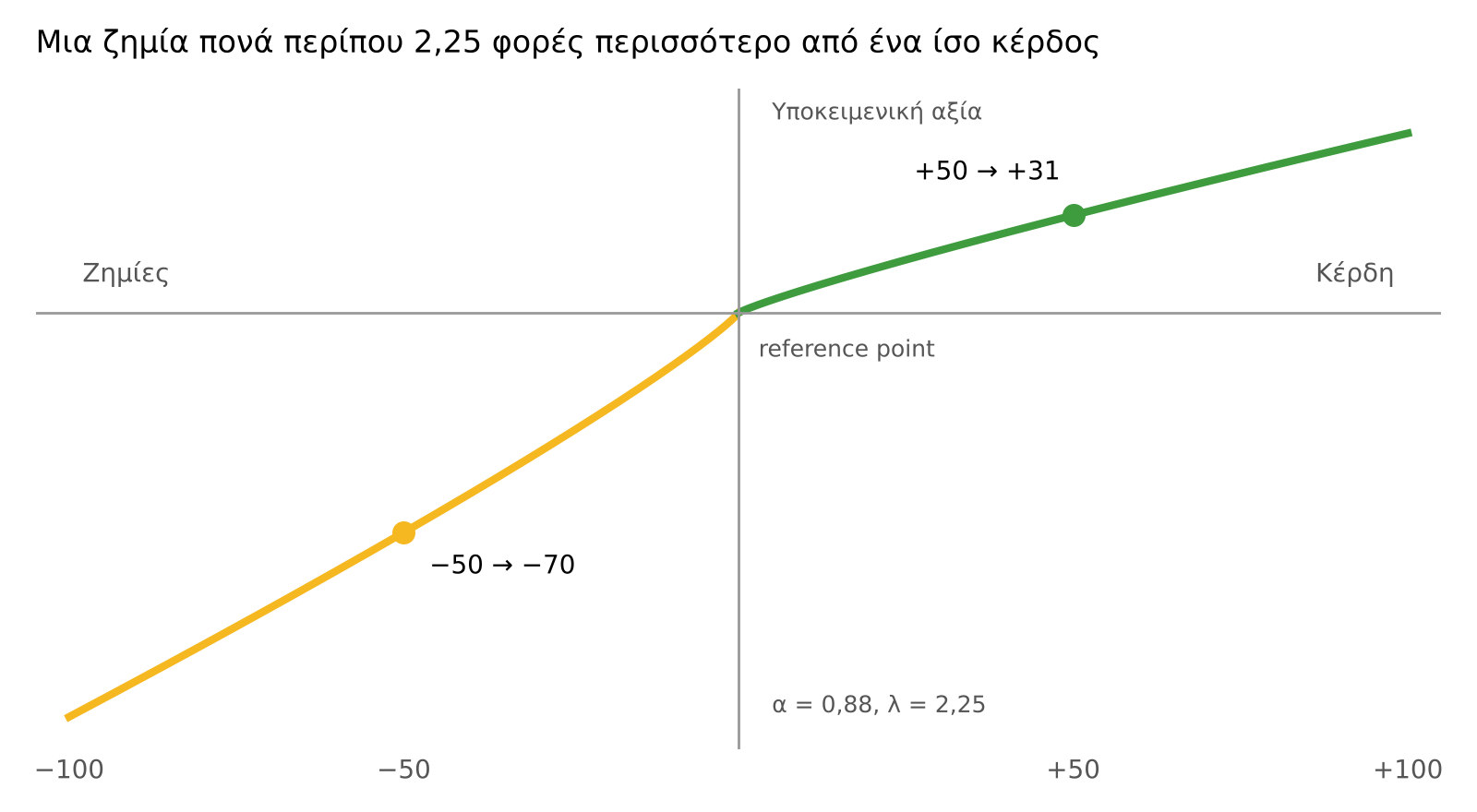
Classical theory assumed a Homo economicus who maximises expected utility. Kahneman and Tversky showed in their Prospect Theory (1979) that we assess gains and losses relative to a reference point, not in terms of our final wealth. The key finding is loss aversion: a loss hurts us about 2 to 2.5 times more than an equivalent gain pleases us (the widely cited 1992 estimate is about 2.25).
The psychology of risk
The curve has a second feature, diminishing sensitivity. When we make gains, we become risk-averse and sell early; when we incur losses, we become risk-seeking and hold on to the losing position in the hope that it will “turn around”.
The result is a recurring asymmetry in our behaviour: we cut our gains short and let our losses grow.
Research in neurofinance shows that this is not just a figure of speech. Studies of physiological responses among professional traders (Lo and Repin) and brain imaging during financial decision-making (Kuhnen and Knutson) link risk decisions to areas involved in emotional processing. Emotion is not noise layered over reason; it is part of the decision-making process.
The data: the behaviour gap in numbers
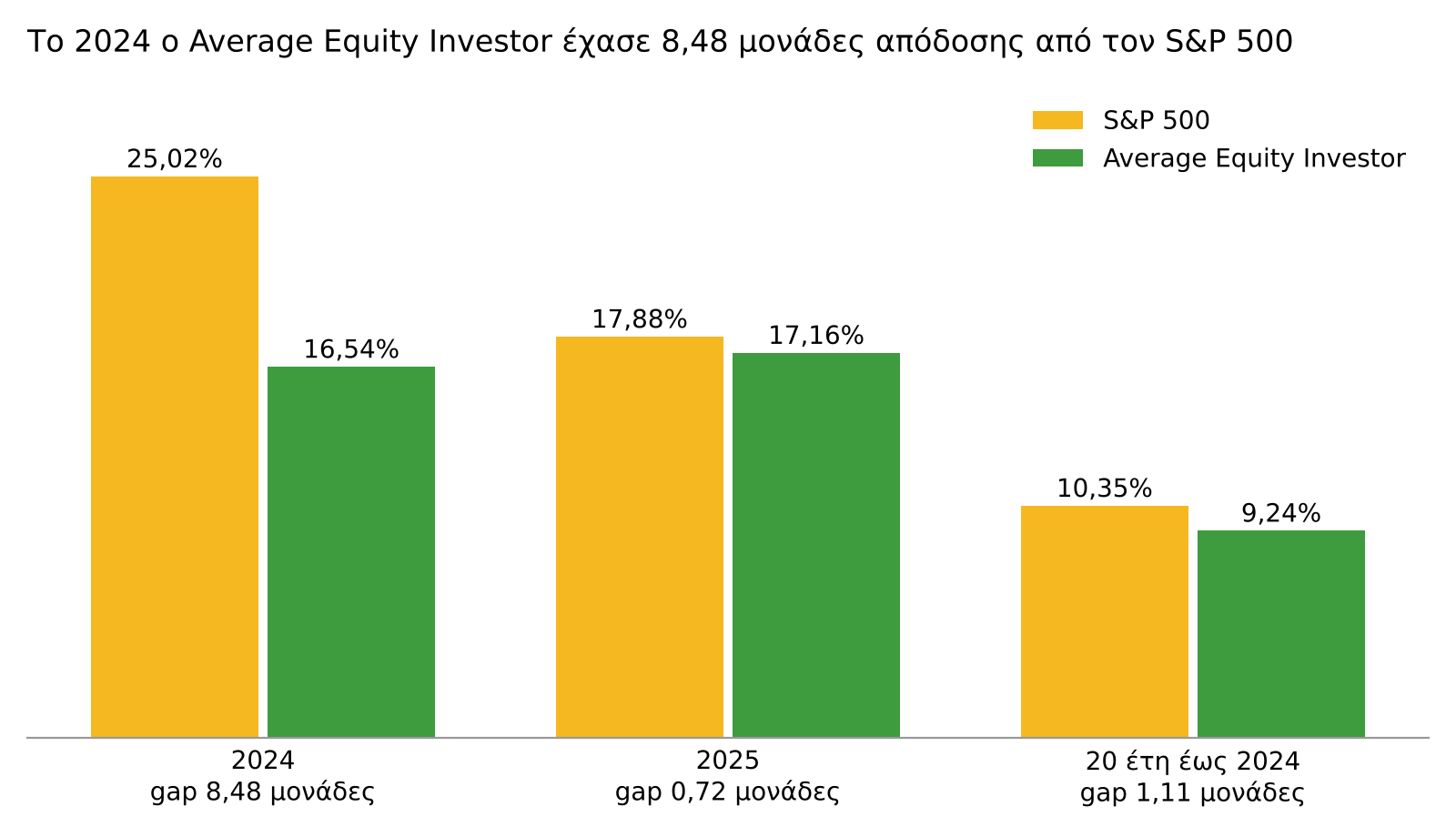
DALBAR has measured the difference between the returns of the average equity investor and the S&P 500 since 1985. In 2024, the average equity investor gained 16.54%, compared with 25.02% for the index — a shortfall of 848 basis points — as equity funds saw outflows in every quarter, with the largest just before the rally.
In 2025, the gap narrowed to 72 basis points (17.16% versus 17.88%), the third-smallest since 1985. But outflows reached 6.91% of assets, with a record monthly redemption rate of 2.30% in July 2025. DALBAR’s methodology is debated, but independent research by Morningstar points to similar findings.
Morningstar’s findings
Morningstar’s Mind the Gap 2026 study, based on the dollar-weighted returns of nearly 23,000 mutual funds and ETFs, found a gap of 1.2 percentage points a year over the 10 years to December 2025. That is equivalent to about 12% of the funds’ total returns and reflects the timing and size of investors’ purchases and sales.
Morningstar notes that the gap does not necessarily point to impulsive decisions, since even regular contributions or rebalancing can widen it.
The findings by fund type are telling, however: ETF investors have a 1.6% gap, compared with 1.2% for open-end fund investors; investors in active funds have a 1.6% gap, compared with 1.1% for investors in index funds; while the gap for crypto ETFs reaches about 14% a year.
When activity looks like skill
The classic study by Barber and Odean, “Trading Is Hazardous to Your Wealth” (Journal of Finance, 2000), analysed 66,465 households at discount brokerages between 1991 and 1996. After adjusting for their preference for small-value stocks, the households underperformed the market by about 3.7% a year, with average annual turnover of 75%.
The 20% of most active traders underperformed by 10.3% a year. The authors attribute this to trading costs and frequency, driven by overconfidence in the quality of private information.
The pattern is not confined to the US. Complete transaction data from Taiwan show that retail investors incurred an annual performance penalty of 3.8 percentage points, with gains transferred to institutional investors. When 1,600 investors switched to online trading, their trading increased by about a third and speculative trades almost doubled.
Greater access and more information did not lead to better decisions; they led to more unchecked activity. This is also Haghani’s point about the other side of the trade.
Herding and FOMO
The disposition effect (editor’s note: holding on to losing stocks and selling winners), described by Shefrin and Statman (1985) and documented empirically by Odean (1998), is a direct expression of loss aversion: investors sell winning stocks far more often than losing ones.
Barber and Odean also found that stocks bought by retail investors underperform those they sell, and that investors are more likely to buy recent big winners and losers — in other words, whatever catches their attention.
Herding (herding) and the fear of missing out (FOMO) act as social amplifiers. When prices rise, the feeling that “everyone is making money except me” makes the risk of sitting out seem greater than the risk of buying at a high.
The extrapolation bias Haghani describes completes the cycle: flows follow past returns, so we buy after a rally and sell after a fall.
The irony is that a better product structure does not eliminate the problem. Morningstar’s data show a wider gap for ETFs, which trade intraday, and an extreme gap for the most volatile products. This means that the more volatile a fund is, the larger its investor return gap tends to be.
Ways to manage emotions
Emotion cannot be eliminated; it can be managed through structure. We suggest five practices:
- A written investment policy statement setting out goals, time horizon and risk limits, drawn up before investing rather than during a downturn.
- A broad, low-cost core, with a limited allocation for trading or tactical positions, so that the urge to act has a capped cost.
- Rebalancing rules and regular contributions that turn “when” into a process. We should remember that these, too, leave a small gap, but the outcome is more predictable than ad hoc management.
- Review costs and returns, because, as Barber and Odean showed, trading frequency explains a large part of underperformance.
- Grimba’s test: if we cannot explain to a friend what a product contains and how it performs, we should not buy it — a principle close to one of Warren Buffett’s: he does not buy anything he does not fully understand.
Haghani’s call for broad index exposure and Grimba’s case for greater choice at the start of the article are not contradictory; they differ in how much confidence they place in investor behaviour.
The evidence from recent decades warrants caution.
* Director of Research at Solidus Securities AEPEY, he leads portfolio analysis and asset allocation optimisation, developing integrated financial models to assess risk and forecast market trends. President of EEΠΑΜΑ - HACSA.
** This article is for informational and educational purposes only and does not constitute investment, tax or legal advice. The figures are indicative, based on publicly available historical data, and do not guarantee future returns. Consult a certified investment adviser before making any investment decision.