In the period before Greece was shut out of the markets and forced to turn to the EU and the IMF for bailout loans accompanied by fiscal austerity policies, the budget deficit was rising as a share of GDP, pushing public debt higher.A look at the relevant charts showed a sharp upward trend in government spending, taking it above 50% of GDP, while total revenue was nearly flat at around 39% of GDP.
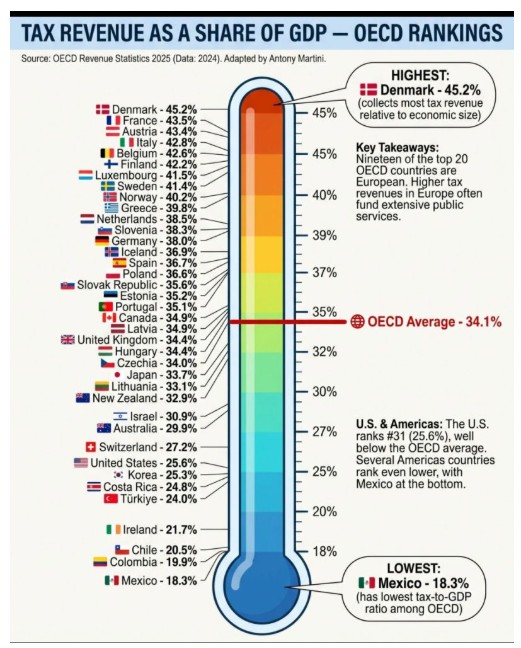
A lot has changed since then. According to the latest OECD figures, Greece ranks 10th for tax revenue — including income tax, VAT, other taxes and social security contributions — at 39.8% of GDP. It is also well above the OECD average of 34.1% of GDP for that year, as shown in the chart by Antony Martini.
As you can see, eurozone countries are above the OECD average, with few exceptions.
The countries with the highest tax revenues as a share of GDP are Denmark, France, Austria, Italy and Belgium, at 45.2%, 43.5%, 43.4%, 42.8% and 42.6%, respectively.
A look at these countries’ performance in terms of average growth, budget deficit/surplus and public debt over the past decade reveals the following. Denmark has grown at an average rate of just over 2%, runs a budget surplus and has very low public debt, at no more than 30% of GDP. Its strong industrial base and exports are clearly contributing to this performance, which is close to or better than the corresponding OECD averages.
By contrast, the other countries — France, Austria, Italy and Belgium — have recorded average growth rates over the past decade ranging from 0.9% in Italy to 1.3% in Belgium, leaving them well below the OECD growth average. They have also posted budget deficits ranging from 5.8% of GDP in Italy to 4.2% in Austria, and public debt ranging from 140% of GDP in Italy to 80.5% in Austria.
One could argue that Denmark is a Nordic country that combines high taxes with satisfactory growth rates thanks to the Nordic model, which channels money back into the economy through investment to boost productivity and the competitiveness of its economy.
By contrast, the other countries — France, Austria, Italy and Belgium — focus on funding their pension systems, state bureaucracy and so on. The result is that investment does not increase significantly and productivity remains weak.
It is worth noting that Greece has recorded average growth of 1.9% over the past decade and 2.7% over the past five years, both above the OECD average, alongside an average budget deficit of 1.8% of GDP over the past five years and very high public debt that is falling rapidly. However, structural problems, such as low productivity, which remains below 60% of the European average, persist.
Ultimately, the question here is not just which country has the heaviest tax burden, but what it gets in return for that higher tax burden. In other words, how effectively government spending delivers on the goals that have been set. In some countries, those goals may be social cohesion, while in others they may be higher productivity. There is no easy answer, as many factors are involved.