Greece and other countries facing rapid population ageing have a difficult equation to solve as the number of workers supporting retirees declines.The effects will become more visible over the next 10-20 years. Demographic trends do not change abruptly, but once they do, they are very difficult to reverse.
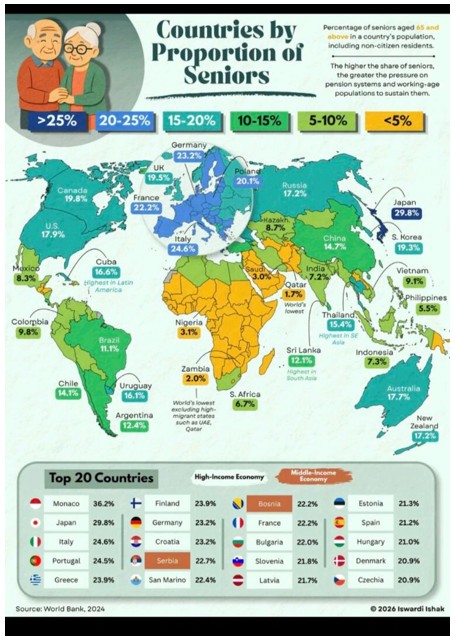
A look at World Bank figures for the share of the population aged 65 and over, using 2024 as the reference year, reveals the following. Greece, at 23.9%, already ranks fifth in the world, behind Monaco at 36.2%, Japan at 29.8%, Italy at 24.6% and Portugal at 24.5%, as shown in the tables by Iswardi Ishak reproduced below.
Among the other countries in the top 20, Germany is at 23.2%, Finland at 23.9%—the same as Greece—Bulgaria at 22% and France at 22.1%.
As is well known, population ageing puts pressure on pay-as-you-go pension systems, increases healthcare spending, creates labour shortages and causes fiscal deficits to swell.
Greece also faces the disadvantage that its public debt is very high and must continue to decline as a share of GDP in the coming years. It is also the eurozone’s laggard in labour productivity; risk-taking is not a characteristic of Greek society, and the country lacks the entrepreneurial culture needed for innovation to thrive.
In addition, Greece’s political system, regardless of which party is in power, makes important decisions based on political cost.
Under these circumstances, prospects for the high growth rates over the long term that could offset the negative effects of population ageing and the lack of a culture of risk-taking and innovation are poor.
Therefore, fiscal discipline is the only way to achieve stability. Only in this way can the state ensure that it meets its obligations over the long term, for example to pensioners and other creditors, without triggering a new debt crisis.
Of course, Greece could maximise the benefits of adopting new technologies, since it lacks the resources to take part in investment in cutting-edge technologies. The use of EU funds, such as the NSRF, could help achieve this, boosting the potential growth rate of the Greek economy.
But, realistically, there is only one safest course for avoiding a new debt crisis in the future, given the challenges posed by population ageing, the country’s heavy indebtedness and the reluctance of most of the population to take risks. Fiscal discipline.