Derivatives are contracts whose value is derived from the price of another asset, known as the underlying: a share, an index, a bond, a currency, a commodity or an interest rate. The buyer does not acquire the asset itself, but an obligation or a right linked to its price.
There are four main types: forwards, futures, options and swaps. They differ in whether they impose an obligation or confer a right, whether they are traded on an exchange or over the counter (OTC), and whether they involve one payment or a series of payments.
Forwards
A forward is an agreement between two parties for one to buy and the other to sell an underlying asset at a predetermined price and on a predetermined date. It is traded over the counter, usually with a bank, and its terms are tailored to the parties’ needs. The outcome is realised at maturity. This flexibility comes at the cost of counterparty risk: the other party may fail to meet its obligation.
What they are used for. Mainly by businesses that want to know today what their costs or revenues will be in a foreign currency or for a commodity.
Futures
A future works on the same principle as a forward, but is standardised and traded on an exchange. The exchange sets the contract size, expiry and underlying. A clearing house stands between the buyer and seller, acting as the central counterparty and reducing counterparty risk.
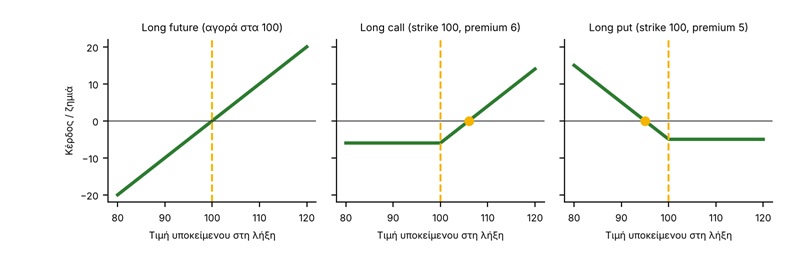
Futures require margin and positions are marked to market daily: gains or losses are credited or debited to the account each day, and if the balance falls below a threshold, a margin call is made. Because only part of the value is deposited, futures involve leverage. The price of a future is not a forecast: it is derived from the cost of carrying the underlying, meaning its price plus interest minus dividends.
What they are used for. Mainly by institutional investors to hedge portfolios, by traders to take leveraged positions, and by arbitrageurs when the price deviates from fair value.
Options
An option gives the buyer the right, but not the obligation, to buy (call) or sell (put) the underlying at the strike price. The buyer pays the seller (writer) a premium for this right. Asymmetry is the defining feature: the buyer can lose no more than the premium, while the seller collects the premium and takes on the risk; an uncovered call writer theoretically faces unlimited losses.
The premium consists of intrinsic value and time value, which falls to zero at expiry, and becomes more expensive as volatility rises. European-style options can be exercised only at expiry; American-style options can be exercised at any time up to expiry.
What they are used for. They have a range of uses: as insurance for a position (protective put), as a source of income (covered call), as a bet on the direction or magnitude of a move (straddle) and, in combination, to create almost any profit-and-loss profile.
Swaps
A swap is an agreement between two parties to exchange cash flows on predetermined dates, calculated on a notional amount. It is traded mainly over the counter and carries counterparty risk.
Depending on the cash flows involved, swaps include interest rate swaps, currency swaps, commodity swaps, equity total return swaps and credit default swaps (CDS), which act as insurance against an issuer’s default. Interest rate swaps account for the largest share of the over-the-counter derivatives market.
What they are used for. To convert floating-rate borrowing costs into fixed costs, manage a bond portfolio’s sensitivity to interest rates, and hedge currency or credit risk.
The three uses
All types serve three purposes. With hedging, we reduce a risk we already face, paying either a cost or by giving up some of the potential gain. With speculation, we knowingly take on risk in the expectation of making a profit, with leverage amplifying the outcome in either direction.
With arbitrage, we exploit a discrepancy between the price of a derivative and that of its underlying, without taking net market exposure, thereby keeping prices close to their fair value.
| Type | Trading venue | Obligation or right | Counterparty risk | Typical use |
|---|
| Forward | OTC | Obligation | Yes | Locking in an exchange rate or price |
| Future | Exchange | Obligation | Minimal (clearing house) | Portfolio hedging, speculation |
| Option | Exchange or OTC | Right for the buyer | Minimal on an exchange | Insurance, income, a bet on volatility |
| Swap | OTC | Obligation to exchange cash flows | Yes | Interest rates, currencies, credit risk |
Risks and conclusion
Derivatives amplify both gains and losses. The main risks are leverage and margin calls, counterparty risk in OTC contracts, liquidity drying up in a crisis, and basis risk, when the derivative does not move exactly in line with the position we are protecting. We believe their use should start with the objective, not the instrument.
Before taking any position, we need to understand the notional value, the maximum loss, the cost and the expiry date.
Note: The figures in the examples are hypothetical and do not include commissions or taxes.
* Director of Research at Solidus Securities A.E.P.E.Y., leading portfolio analysis and asset allocation optimisation and developing comprehensive financial models to assess risk and forecast market trends. President of ΕΕΠΑΜΑ - HACSA.
** This article is for informational and educational purposes and does not constitute investment, tax or legal advice. The figures are indicative, based on publicly available historical data, and do not guarantee future returns. Consult a certified investment adviser before making any investment decision.